
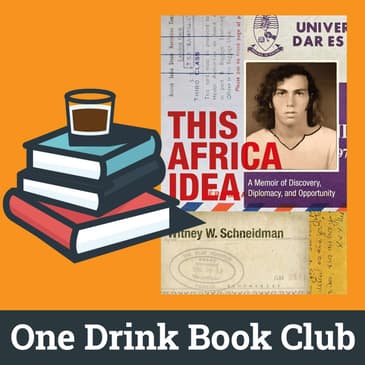
In this episode of The One Drink Book Club, host Jamey Bowers sits down with author and Africa policy expert Witney Schneidman to discuss his memoir, This Africa Idea: A Memoir of Discovery, Diplomacy, and Opportunity.
Schneidman shares the remarkable story of how an adventurous trip to Africa as an 18-year-old—including finding himself in Uganda during Idi Amin’s 1971 coup—sparked a lifelong fascination with the continent. That experience ultimately led to a career spanning more than five decades working to strengthen relations between Africa and the United States.
Jamey and Witney discuss why Africa remains misunderstood by many Americans, the continent’s extraordinary political and economic transformation, and Witney’s experiences working with leaders including Nelson Mandela and President Bill Clinton. And, of course, there’s a drink: both host and guest independently arrive with passion fruit, inspired by Witney’s first unforgettable visit to Nairobi.
It’s a conversation about adventure, diplomacy, history—and how one unexpected journey can shape the course of an entire life.
[00:00:00] Hello and welcome to this edition of the One Drink Book Club. I'm your host, Jamey Bowers, and today we're going to be taking a journey unlike any we've taken before. It's a story that spans continents, revolutions, presidential administrations, and more than 50 years of history, all through the eyes of one man who set out as a curious teenager with a backpack and came home with a life's calling. Our featured book is This Africa Idea, a memoir of discovery, diplomacy, and opportunity by Witney Schneidman.
[00:00:33] This isn't just a memoir. It's a travel adventure, a diplomatic history, and a personal story about finding purpose in the most unexpected places. Witney takes us from hitchhiking across East Africa during the tumultuous days of Idi Amin's coup in Uganda to working alongside world leaders like Nelson Mandela and President Bill Clinton, helping to shape American policy towards a continent that is too often misunderstood and forgotten. Witney, thank you for joining me. It's a pleasure to have you.
[00:01:03] Jamey, thank you so much for having me on your show. This was, I thought it was a really interesting book, and admittedly, I am like a target market. You talk a lot about how Americans don't understand Africa, have not spent enough time trying to understand Africa, and have seen it through a very warped perception of poverty and turmoil, and haven't given it the attention it deserves.
[00:01:29] And I was reading this, and I thought, yes, I am one of those Americans who doesn't know nearly enough about Africa. So I thought it was a great look at that. Great, thank you. Yeah, that's what I wanted to do. That's what I set out to do. But that's sort of what I've been doing all my life.
[00:01:47] You know, early on, I sort of took on the role of being a bridge of understanding between Africa and America, and particularly working to inform Americans about Africa and why they should pay attention. Yeah, well, before we get into kind of the meat of the story, did you bring a cocktail tonight? I did. I did. Okay. What inspired you here for that?
[00:02:12] Well, you know, I gave it great thought, and I could have been a South African rosé, summertime, but, you know, the drink I brought was a passion fruit juice drink. And the reason was, I'll never forget it, being the first time I got to Nairobi when I was 18 years old, going into a restaurant. And here in the U.S., you'll go in and they'll have, you know, soda fountains and Coca-Cola.
[00:02:40] But in Nairobi, they had passion fruit in the dispenser, and I got it, and it was so good. It was natural passion fruit, and it just sort of fed into the extrasensory experience that I was going through at that time, discovering this new world and how fascinating it was. So even to this day, when I'm in Nairobi, I have passion fruit juice drinks.
[00:03:05] So I wanted to bring it to your show and bring it to your audience to encourage folks to get some fruit juice in their life. I, it's kind of funny because I also brought a passion fruit drink. So it clearly was somehow in the ether that passion fruit was appropriate. And mine was called the African Sunrise. Amazing.
[00:03:28] I've seen, I saw a couple different recipes for it, but the one I chose has two ounces of gin, three-fourths of an ounce of passion fruit juice or passion fruit syrup, and then three-quarters of an ounce of lime juice, and then a splash of ginger beer. Wow. That sounds much more interesting than mine because, to be honest, I had to go hunting for the passion fruit juice drink, and I started at Mom's like an hour or two ago, but I was determined to find it.
[00:03:58] And here we were. Well, I was lucky that I just oddly had some passion fruit syrup still from a cocktail I made a few months ago. So I was ready. I hope we have an opportunity to meet in person so I can come and have a taste of that. Yeah. I'd be happy to. Well, like we said, we live close to one another. Yeah. And we should definitely meet for lunch and share a passion fruit cocktail.
[00:04:24] So you were enamored with Africa from a very young age, and what was interesting to me is that you had a mother. You took a gap year after high school, and a lot of people take a gap year, but you basically went off the rails. I mean, you went to Israel. Yes. You were going to be—you kind of joined the Kibitz and were there for a little bit and met one person who mentioned Kenya to you, and that one person changed your life.
[00:04:54] Well, yeah, sort of. I mean, you look at the chain of events. It was a combination of events. I guess the backstory was that, you know, I was a huge underperformer in high school. It was a dismal experience, and I knew I wasn't ready for college. So, yes, I told my mom, look, it's going to be a waste of my time and your money. I'm going to do something else. Well, what are you going to do?
[00:05:17] Well, about two weeks after high school graduation, I was at a friend's house and heard an acquaintance talking about their time on a Kibitz, and the penny just sort of dropped. I said, you know, that sounds like an adult version of the summer camps that I've talked to. So I got this idea to go to a Kibitz. They had a Hebrew program. And, you know, my dad was Jewish. My mom was Episcopalian.
[00:05:41] We, they were not particularly religious, but I just sort of pitched it, yeah, Mom, I can study Hebrew, you know, do something constructive. So she finally bought into the idea, right? So I was going to spend six months on the Kibitz and three months backpacking in Europe. And I got to Israel, and two things happened. One, I started the Hebrew lessons, and it was like, get me out of here. It's homework. It's tests. I have to be in school. Get me out of here.
[00:06:06] And then, yes, I met this American kid who had grown up in Kenya, and his stories of game parks and hippo pools and endless beaches on the coast. And he said, yeah, you should come on down. You should come visit. So shortly after that, you know, I go to the Kibitz library. Instead of doing my homework, I got an atlas out and studied the map of Africa, Kenya, and then wrote my mom a letter saying, Mom, I've been invited to go to Kenya, and that's where I'm going.
[00:06:35] Can you send the next $300 care of American Express? So she wrote back a letter, you know, a week or two later saying, tell me more about this Africa idea as time goes on. And, you know, amazingly, that became the title of my book. But I got down to Nairobi and, you know, thought I died and gone to heaven. It was so beautiful. The air was crisp, clear. It was warm. I already talked about the passion fruit juice, but the, you know, the vegetation was so lush.
[00:07:05] Staying at the youth hostel with a fraternity of backpackers. And I get this idea to hitchhike up to Uganda, go see what's going on over there. So I persuaded this other American kid to do that with me. We got up to Kapala, traveled around the country. And I happened to be staying with this schoolteacher that we met in this one town called Umarara, a British guy. And, you know, he had a younger brother who was a backpacker, and he took sympathy on us.
[00:07:34] So he put us up for the night. The next morning, his wife was driving us back to the road to continue our travels back to the capital of Uganda, Kampala. And he comes running out. He says, oh, honey, you got to turn around. Something's going on. The radio's off the air. The military left the town this morning very early. Something's not right. And these kids should not be out on the road. So we went back to their house. And that afternoon, he came in and he turned on the radio and he said, you guys are going to listen to something you're never going to hear again.
[00:08:03] And sure enough, the military music was on. The state radio was back on the air. The military music was playing. It stops. His Ugandan voice comes on. He introduces himself as Field Marshal Idi Amin. And for those of your listeners who don't know who Idi Amin was, he was one of the world's worst dictators of the 20th century. But at that time, I was just saying, what is going on? You know, like six months out of Philadelphia, Pennsylvania. Coup d'etat.
[00:08:33] Who's making the rules? What are the rules? Who are enforcing the rules? And he said borders are closed to further notice. So a couple of days later, we made our way back to the capital of Kappala. We got in touch with U.S. Embassy. By now, a week had gone by. They said, you know, the first convoys leaving the country tomorrow. You guys need to be in it. So we got a lift in this car, went back to Nairobi. And I did my travels, started university the next year.
[00:09:00] And when I started reading about Africa, a couple of things happened. One, I found it fascinating for a kid who never opened a book in high school. Now I couldn't put him down. And then I realized that that coup I had been in, this was what Africa was all about. It was about change. And it was ending one era of colonialism, beginning a new era of independence. Southern Africa liberation movements were fighting against white minority pool. And I thought it was so important.
[00:09:29] This tectonic shift of time was taking place on this continent. So I said, this is what I'm going to do in my life. I'm going to be a breach of understanding between Africa and America. And one day I want to run my country's policy to Africa. So I've been living off that dynamic for the last five decades. Unbelievable. Obviously, this early travel in your life made such a difference. I know that when I was 16, I did kind of a tour of Port-au-Prince in Haiti.
[00:09:57] And it really changed my perspective about the United States, about the Caribbean, about bad governments and what that meant to the population and poverty. As you kind of travel changed your whole life's career and trajectory, have you talked about that with young people and, you know, how important do you think it is to get out and experience different cultures that are different than your own?
[00:10:25] I think that's the essence of life, if you ask me. And that's, you know, one of the motivations for writing this book. And one of the messages is connect with the African continent, connect with people on the African continent. If you're a young person, you know, you can do Peace Corps, you can travel, you can do a semester there. If you're middle age or older, maybe your church group takes a trip or a community organization or your business or your hobby group.
[00:10:55] Some way, find a way to connect with folks on the continent because you will be uplifted. Your perspective of the continent will change. I think your perspective on life will change because the African perspective is different from ours. And it's ours is rich. Theirs is rich. And it's about sharing, sharing perspective, sharing insights on life. So that's why I'm passionate about cross-cultural contact, communications, participation.
[00:11:24] What talk about what you think the misconception is versus what the reality is on the ground in Africa. And why do you think, you know, what? Why is that misconception exist? Why hasn't the either the media or why have we ignored Africa so long? Well, it's it's it's that's a long conversation. But I think a lot of it, you know, goes down to the, you know, the expression if it bleeds,
[00:11:53] it leads, you know, like the story on the front, you know, the front of the newspaper. You know, people don't want to hear about, you know, a successful deal happening in Malawi, but, you know, on sugar or that kind of thing. You know, that's not going to sell newspapers. Wars in Sudan sells newspapers. So, I mean, there is a history of conflict on the continent, no question. And I think in the early independence era, you know, in the 1960s, when the Congo,
[00:12:22] Democratic Republic of the Congo became independent, the Belgians were kicked out. You know, that really captured Western attention because 100,000 white Belgians fled and there was violence. By the end of the 60s, you had the crisis in Nigerian Biafra. And I think that sort of helped to cement perceptions of Africa, you know, as a continent of conflict, continent of crisis.
[00:12:48] But, you know, what I found and when I went to school out there, I did a when I finished college and I was on my mission, I knew what I wanted to do to be a policymaker. And I knew I needed a grounding. So, I got this idea to spend a year at school, which I did at the University of Dar es Salaam. And when I first got out there, I was the only one who looked like me in a student body of 2,000 African students. I couldn't understand names like Mukundala and Sabaha.
[00:13:17] It was really hard to start conversations. I felt so foreign. And, you know, I was asking myself, does it even make sense what you want to do? How are you going to fit into Africa? You want to be a bridge of understanding? That makes no sense. But by the time I finished my degree 12 months later, I realized that I had more in common with my friends and classmates and separated us in terms of they wanted to make their countries better. I wanted to make America better.
[00:13:47] I wanted to make America a positive force on this journey in Africa for economic growth and economic development. So, I was focused on the positive side of the ledger. What can I do to contribute here in such a way that it's good for Africa and it's good for the United States? So, that's been my focus all along. And I feel like it's been the right focus to have. Well, it certainly has led to an interesting life full of adventure.
[00:14:15] So, I think that's fascinating. You know, most of the people, if I know somebody who has gone to Africa, they tend to have gone to Kenya or South Africa. They've kind of done the safari thing. What would be your advice to Americans in order to try to engage with Africa? What would be your top three visits that might be different than the standard kind of stereotypical African trip for an American?
[00:14:43] Yeah, I'm a big fan of getting down to the Kenya coast because it's such a melting pot of cultures. Because, you know, boats from India and Persia have been coming and going from the Kenya coast for a thousand or more years. And that interaction between the visiting sailors and the local Bantu people, that's produced the Swahili language and the Swahili culture.
[00:15:11] And it's all evident there. The history is so available in terms of how people look, the cuisine, the architecture. Mombasa, Melindi, Lamu. These are towns on the coast that I find just fascinating. So that would be one. You know, through my church in Alexandria, Virginia Christ Church, for the last 40 years, we've been very involved in a relationship with Mengo Hospital in Kampala, Uganda, where, you know, we support the hospital.
[00:15:39] We visited it a number of times. And that relationship is so uplifting. I mean, it's often said by those of us involved that whatever we contribute materially, what we get back sort of spiritually and in other ways just far exceeds what we have shared. And to go out there, to be in the hospital, to meet the people, to meet the administrators and to see the people at work is really amazing.
[00:16:06] And then to go to a place like Murchison Falls or Queen Elizabeth Park, you know. I mean, going in the game parks is like going fishing. Anytime you can do it, do it, you know. So those would be two instances. I think in West Africa, Senegal's a fascinating country. Goree Island has a door of no return. And that's where you really, you know, that's where so many folks who came to the U.S. enslaved, they went through that door.
[00:16:35] And you just realized the enormity of the history, the enormity of the Middle Passage and the challenges that this culture and these people and these societies dealt with. It just wakes you up to, you know, it's a very complicated world. And yes, we have our issues. We have our challenges here in the United States. But so do others. And to understand those, I just think, gives one great, great meaning and sense of fulfillment in making that effort. Yeah.
[00:17:04] You know, in your career, you obviously then were in the policy side of things and you saw lots of politics go through. You talk about apartheid and kind of the end of apartheid. One of the things that to me, talk a little bit about your experience with Nelson Mandela, what you felt like you learned from him.
[00:17:24] And also what always struck me as inspirational is how you had this longstanding conflict between two groups in the country. And people on both sides almost assumed that for there to be an end of it, one group was going to, you know, kind of just dominate the other. And they managed to change their government and the power structure, but it didn't mean that it was the end.
[00:17:52] You know, it wasn't a total lose-lose situation or a win-lose situation. And talk about how that's maybe a lesson for other groups that are in conflict. I mean, right now we have a lot of conflict around the world and there has to be something at the other end of it where can we use this as an example? Well, first let me talk about Nelson Mandela because I had just the great good fortune and honor to be in his presence on several occasions to meet with him, to talk with him.
[00:18:21] And I was just stunned. How does somebody spend 27 and a half years in prison because of the color of your skin and be an icon of graciousness and reconciliation? How does that happen? And he was. And he was very funny. He had a great sense of humor and he was very clear and firm about what he wanted. So that was one of the great privileges of my life.
[00:18:48] And then you put that into the larger context, which you've just referred to. I mean, the transition from apartheid to democracy, the peaceful transition, the democratic transition, is one of the great stories of the 20th century. And today, South Africa, 30 years after that transition, has a government of national unity. They have a strong democratic constitution. They have strong courts. And it's not perfect. There's poverty.
[00:19:17] It's crime. But I think it's a model of what you really were referring to. How do you get there? And I think one of the ways you get there is leadership. You know, people used to talk about the South African miracle. And I used to think this was not a miracle. People, you know, changed their views and they learned how to accommodate the concerns of others. And they took time to do it.
[00:19:43] From the time that Nelson Mandela came out of jail in February 1990 to the elections in 1994, four years went by. So, you know, the whites and the blacks, the ANC and the government used that time to bring other parties into the dialogue. They had a constitutional conference. They really worked on the new order very deliberately. And you have, you know, in the South African national character, South Africans love South Africa.
[00:20:12] There's just no question about it. And it's a very beautiful country. And so I think that contributed as well. So, yes, there's conflict around the world. They're very conscious. And it's really about leadership. It's about people coming together. You know, F.W. DeClercq was the head of the National Party at the time. And, you know, it took him to have this vision that we need to change. What we have here is not sustainable. There'll be more violence. There'll be more isolation. Our way of living will only go down from here.
[00:20:42] So we need to negotiate a new order that not only preserves what we have, but makes a future better for all of us. And unfortunately, that's often what's missing in conflicts that go on and on and on. People just say, focused on one singular outcome or their ego or feeling that just their way is the right way. And so you don't get to a peaceful resolution like the South Africans were able to achieve.
[00:21:11] You know, it's interesting that you mentioned F.W. DeClercq because he is often left out of that story. But he had to make a change of heart in order to have that peaceful transition. And he had been such a hardliner throughout his career. And I think we've seen that in some of the bigger changes, societal changes, you know, in the Catholic Church. You know, Vatican II happened because they brought in a pope that they thought was going to be a hardliner who tended to be more liberal.
[00:21:39] You know, it's so there's a little bit of personality driven things where you have to have the credibility to make a change. And so but it takes a certain amount of grace and a certain amount of introspection and an ability to recognize that it's not about you and that you have to go for the greater good. Right, right. And, you know, takes vision and and and ability. I mean, you compare what let me say something to F.W. DeClercq. You're absolutely right.
[00:22:06] It's important to remember that both DeClercq and Mandela got the Nobel Peace Prize in the same year. But there was no love lost between the two. That is for sure. But I think history, you know, should be kind to F.W. DeClercq and playing the role that he did. And the person who started down that path but wasn't really able to pull it off is someone like Mikhail Gorbachev, right, who had that vision to take the Soviet Union into a new era.
[00:22:33] But unfortunately, he was, you know, overtaken by forces he couldn't control and therefore was unsuccessful. But these these are these are the great questions of our time. You know, why is somebody able to lead a society and a government to peaceful, positive change? Yeah. And and so you talk a lot about the qualities that we should be paying attention to in Africa.
[00:22:57] What you've seen from your time on the ground there, you mentioned entrepreneurship, democracy, innovation, optimism, just kind of a youthful optimism. I think you you mentioned that right now in the beginning of the book, you say that there are one point four billion people with a median age of 19 in Africa. So, I mean, this is a young continent. It's filled with young people in that they have just an enormous amount of economic potential.
[00:23:26] How give some examples of those things as you you saw them in person on the ground of those positive, optimistic qualities. Well, I write about one instance where I work with a cell phone company called MTN. Today, MTN is one of the largest cell phone providers on the continent. It's a South African company. And it went into Nigeria in 2000. And at that time, Nigeria was a population of one hundred and fifty million.
[00:23:54] And maybe there were eight thousand cell phones at the time for one hundred and fifty million people. Today, there are two hundred and forty million people in Nigeria and one hundred and eighty million, one hundred and eighty million cell phones. So that just shows you the enormous growth that has taken place in the digital realm. And I I was working with with the U.S. law firm at that time. I'm not a lawyer, but they asked me to join the firm and help them develop an Africa practice.
[00:24:24] And there's this one instance where MTN five point two billion dollars. Right. For because they had unregistered SIM cards that were and and the Nigerian government had put in place this this rule that all the cell phone providers had to register the buyer at the point of sale. Well, MTN had, you know, five thousand or five million two hundred and unregistered cell phones. So they got fined. So we got involved.
[00:24:54] Covington got involved and we helped to negotiate a resolution to this matter. And we got the fine down to, I think, one point two billion dollars, something that MTN could could manage. And I tell this story because it's emblematic of several dynamics on most people have perception of Nigeria. You know, the more accustomed to hearing about the prince is going to try to shake you down.
[00:25:18] But this was an instance of where we were able to work with the government to get a resolution that was transparent, that was equitable. And the only only ask other than paying the fine that the Nigerian government had is that they wanted MTN to list on the Nigerian stock exchange so that Nigerians could buy shares in this cell phone company that, you know, accounted for more than 50 percent of the business in the country.
[00:25:44] Well, today, MTN is one of about 12 or 14 companies on the Nigerian stock exchange that has a value of more than a billion dollars. And, you know, people just don't think like that. Think of Nigeria in that way. And I guess the last point about that story is, you know, I mentioned how in 25 years Nigeria went from 8000 mobile phones to 180 million. Well, Nigeria never had landlines.
[00:26:14] And I'm aware that, you know, most of your younger listeners don't have never used a landline, but but they know what it is. Right. It never worked in Africa. So Africa just sort of skipped a generation going right to cell phones. And that adaptive capabilities is what I find fascinating. And it's really unlocked a lot of, you know, fintech, fintech opportunities, mobile banking, mobile purchases, mobile sales and mobile insurance.
[00:26:42] And it's really mobile savings, mobile banking. And, you know, I just find that kind of adaptation, create creativity just absolutely fascinating. And that's why I'm focused on the continent like I am, because I see so much innovation happening. What do you think America is doing well from from like a State Department standpoint in their interactions with Africa? And what do you think they're doing poorly right now?
[00:27:09] Well, what what is happening now under the Trump administration? They have implemented a policy of trade, not aid. So the whole a dynamic has been dismantled and discarded. That's good and bad.
[00:27:24] It's good from the point of view that the focus of this administration is on commercial diplomacy, promoting business, helping U.S. companies be successful, having our embassies and our ambassadors being proactive, really working to develop the partnerships with companies on the continent, with with with with companies in the U.S. That's all very positive. What we've lost in dismantling USAID is a lot of our soft power, a lot of our support for health
[00:27:53] care, a lot of our support for education, a lot of support for governance, for journalism, for civil society. And I think that's quite important. So, you know, I think I think we have to be mindful of the strengths and the weaknesses of our policies. But there is a lot positive. But I think we have to be mindful of areas that we may have lost. For instance, we have embassies in about 53, I think, 52 or 53.
[00:28:20] Right now, we're missing 37 ambassadors on the continent. And that's that's that's not right. We need to get those positions filled as soon as possible so we can have the full representation of U.S. diplomacy there to deal with a range of the issues. I guess the last point I would make, what this administration has done is to focus on critical minerals. And that's quite important because 30 percent of the rare earth critical minerals come from Africa.
[00:28:49] And a country like the Democratic Republic of the Congo produces about 70 percent of the world's cobalt. And cobalt is a critical item in electric vehicles and batteries and in our aerospace industry. The problem is that most of that has been exported to China. And China accounts for 90 percent of the processing of critical minerals like cobalt. So this administration has made a real focus to sort of try to get U.S.
[00:29:17] companies involved to bring those minerals here to the United States. So so we're not vulnerable to China in in that respect. Yeah. Now, I thought I and I'm not just saying this to be to be complimentary, but I thought the book was really well written. And sometimes when you are a scholar or a diplomat, good writing skills don't necessarily, you know, go hand in hand.
[00:29:45] It's very different writing a memo than it is to write a book and to keep a narrative that goes through and have it be interesting and also to have it be personal. Like you, you talk about a lot of tough things with your childhood and your father's death. What what is your writing background? How did you learn to write and how tough was it to write this book? Well, I mentioned earlier that when I was in high school, I was a major underperformer. Right. I got low grades.
[00:30:14] You know, nobody there was not a lot of hope for me. Right. So I've always been battling sort of this perception that I was an underperformer. So I always thought that I work harder and I just you know, I just paid attention to it. You're absolutely right. You know, I've written so many blogs on U.S. policy to Africa and, you know, it's four or five paragraphs. You put your own opinion at the end. Do enough of that. People start calling you an expert.
[00:30:42] But but it's a very sort of stilted kind of writing. When I started writing this book, I just discovered, you know, I was I was opening up journals that I kept when I was 22 and 24 and 33 and 34. I had letters that I'd written my mother, you know, back in the you know, back then. And it just I just I just felt free to write in a way that I'd never written before.
[00:31:07] And I just found it so enjoyable just to tell this story, you know. Well, it's great. You know, it's funny. One of my written down questions here is. Did you keep a diary or a journal? Because so many of your recollections of these pivotal points in your life, even back when you were, you know, 17, 18, were so detailed where you talk about a person and who you met and they said this.
[00:31:33] And I thought either Whitney has this amazing memory or he has kept a pretty detailed journal throughout his life to kind of keep these details so fresh and so detailed. Yeah, well, obviously, you know, I think all of us have very vivid memories from, you know, inflection points in our lives. Right. So there is an element of that. But yes, you know, I mean, some of this stuff I just copied right out of the journal and then
[00:32:01] just, you know, put it in a narrative context. And some of the stories like when I was on that bus in Côte d'Ivoire, right? And I was with my girlfriend at the time and we were going to this town of Sassandra, this beach town. And the bus pulls off at two o'clock in the morning and the bus driver says, Sassandra. And I just seen a sign that said, Sassandra, 10 kilometers this way. And we were in the bush. We were not in Sassandra.
[00:32:29] So this led to this big negotiation. Everybody gets off the bus. And then he says, I'll take you. So we get back on. And right now I'm standing right next to the bus driver. And he says, no, we're going to San Pedro. So I dive for the keys in the ignition. I'm not usually this kind of guy, but I dove for the keys in the ignition and sort of flipped it off. But I quickly remembered that we had to do a push start that morning. And we were going to be exponentially more unpopular if people had to get out and push the bus.
[00:32:58] So I flipped it on and the bus kept going. And he looked at me and said, OK, I'll take you to Sassandra. But I have got a detailed account of that in this journal that I was able to. I mean, I remembered it, but it's so great to have the contemporaneous notes. That's fantastic. But let me say something else about that. One, I worked with an independent editor from the get-go, a woman named Carolyn Lambert, who was just fantastic. I met her in Washington. She moved to South Africa.
[00:33:28] She lives in Shanghai. But she was really helpful. And then I gave passages to a lot of friends to read to get their take on it. And then I called up folks that I'd been with and hadn't talked to in 20 years saying, do you remember this? Like, I remember this. And it was really fun. It was really cool. How long did the writing process take you? Took me about seven years. Wow. And I was in no hurry. I'm not a fast writer anyway.
[00:33:58] And I had a big job. I was working at Covington & Burling, the law firm. And I would get up like at five. I would write from like six to 7.30 and then go to work. So I'd do it like an hour, hour and a half every day. And then when I was traveling on airplanes, I had more time to work on it or hotel rooms. And so that process over that amount of time got the manuscript done. Well, congratulations. I think it's a great book.
[00:34:28] I wish you lots of success with the book. And my kind of closing question is, if there was one thing you would want Americans to know about Africa, what would it be? Africa is a place you need to connect with. You need to meet people there. You need to make the effort to reach out because you will be immensely rewarded in your understanding of human nature and your own human nature.
[00:34:57] So I guess that would be my message. Make the effort to get on the continent. Make the effort, even in your own community here in the States, make the effort to meet some folks from the continent and understand their culture and their cuisine and what they do. And you will enjoy it immensely, I can assure you. Well, thank you very much, Whitney. I appreciate it. For those of you listening, if you haven't subscribed, please give it a subscribe on whatever podcast platform that you listen to.
[00:35:26] And join us for our next time on the One Drink Book Club. Thank you very much. Thank you, Jamie.