
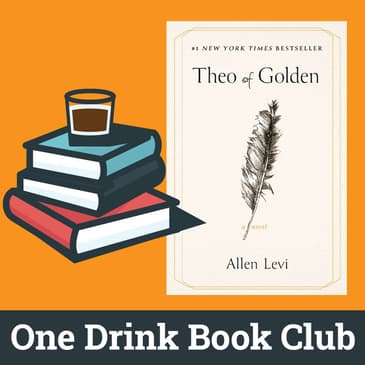
In this heartfelt episode of One Drink Book Club, Jamey is joined by longtime friend Amy Balcius to discuss Theo of Golden by Allen Levi — a warm, thoughtful novel about kindness, connection, art, and the quiet ways we can change each other’s lives.
Together, they explore the mysterious and generous Theo, the unforgettable residents of Golden, Georgia, and why this debut novel feels especially timely in a divided world. Along the way, they talk about friendship, intuition, creativity, coffee shops as community spaces, and the simple power of making people feel truly seen.
Of course, no One Drink Book Club episode would be complete without cocktails: Amy mixes a bright “Golden Hour” cocktail while Jamey pairs the book with a Passion Fruit Porto Sour inspired by Theo’s Portuguese roots.
If you love books that leave you hopeful, conversations that wander into meaningful territory, and stories about the beauty hidden in everyday life, this episode is for you.
[00:00:06] Welcome back to the One Drink Book Club, the podcast where we pair great books with great conversations and at least usually one good drink. I'm your host, Jamey Bowers, and today we're diving into Theo of Golden by Allen Levi. This New York Times bestselling fiction is about a mysterious elderly gentleman named Theo who arrives in the small southern city of Golden, Georgia. He then begins a mission of anonymous kindness by buying pencil portraits from a local coffee shop and returning them to the people depicted.
[00:00:36] It's a heartwarming story about friendship, connection, generosity, and savoring the art we all experience around us. Joining me today is somebody I've known for a long time, well before podcasts existed, my college friend, Aggeliki Pelekidis. Amy is a wise, kind, and thoughtful person, and I can't think of a better person to unpack a book that centers on connection and friendship. So grab your drink of choice, settle in, and let's talk about Theo of Golden.
[00:01:03] Amy, thank you so much for coming and joining me on this. Super excited to be here. Thanks for having me on. Been looking forward to this conversation, really. Well, I assume you liked the book. Loved this book, yes. And I know you texted me this past weekend and you're like, hey, look at this photo of this book in the number one spot on the New York Times bestseller list. Yeah. I get it. I get it.
[00:01:28] It's not a surprise why. And it's so impressive that it's his first novel. Yes. That's got to be special. It's an incredible debut. Yeah. And I also think it's something that probably is needed right now. It's a little bit like the Ted Lasso of books in the sense of we're in this time.
[00:01:48] It's very divided. And you have this main character who brings people together and is warm and thoughtful and generous and kind. And I think we all could use a little more of that. We could all use a little more Theos in our lives for sure right now. It's interesting. And I want to talk about it a little bit more. There was a question in my mind that perked up a couple of times as I was reading it. Was Theo almost too good? Did it make it unrealistic in some ways?
[00:02:17] And I think there are some things in it where the author tried to combat that. But it sure tried to humanize him. Right. Just. Yeah. Yeah. Just even just a little bit more relatable. Exactly. Exactly. So the other question is, what did you make as your drink tonight? Yes. Well, I have I have a glass of water. Okay. Just in case. Hydrate. But then also I have my one drink book club glass. Nice.
[00:02:47] Thought this would be the perfect time to break it out. But I made myself a golden hour cocktail. Ooh, it's pretty. And you can use different bases. I used gin for this one. So this was two ounces of gin, an ounce of Aperol, an ounce of elderflower liqueur, and then about three quarter ounce lemon juice. And then an orange peel. Nice.
[00:03:17] That sounds delightful. And it's great for a nice spring day. Kind of light. Yeah. Kind of nice. Well, that sounds. What are you drinking over there? So I made a passion fruit porto sour. And so I looked for cocktails that had port in them because our main character, Theo, is from Portugal and grew up in the port region and had worked in the vineyards.
[00:03:47] So this has a white port in it, one ounce of white port, one ounce gin, three quarters ounce of lemon juice, and then a half ounce of passion fruit syrup. So it also has kind of a golden color. Theo had a lot of passions in his life. So I thought it would tie together here. I get it. That is gorgeous. And cheers. Cheers. This is good. Also, mine, you can do with or without egg white. I kind of like the froth of the egg white.
[00:04:18] Looks amazing. And a little trick is you get more froth if you do a dry shake with the egg white first. So when you shake it up, you don't put the ice in. You shake it, then add the ice, shake it again, and then pour it out. So it's a little cocktail tip for you. A little tip for the future. I don't normally mix my own cocktails. I'm going to be honest. So this was really fun. I was having to Google some things.
[00:04:48] But if I say so myself. Well, it looks good. And I think you're actually the first person to use the Wondery Book Club cocktail glass on the podcast. So that's good. Excellent. So did you listen or did you read the book? Both. Nice. Yeah. I did a little bit of a hybrid approach on this one. I listened to the audio book. Well, I started by listening to the audio book.
[00:05:17] And I probably got 10 chapters in and realized I like this book a lot. I'm going to want this book to live on my shelf and or be able to give it away to people. And so, yeah. So I listened to it. And then I bought the hard copy as well. I'd like to go back and just kind of refresh things. But the audio version was delightful. It was very well done.
[00:05:47] It was extremely well done. David Morse was the voiceover talent who narrated it. And one of the things about this book for people listening is it has a lot of characters. And David Morse did all the voices and really did a good job. The one thing, if there was a complaint, and it's not really a complaint, is that he has kind of a southern drawl, which is perfect for this book because it takes place in Georgia. Theo is very thoughtful. He's very patient.
[00:06:16] He moves to Golden and he has a lot of time on his hands. And so it talks about him walking down the street very slowly and noticing this and noticing that and talking with people. It was very unhurried. So the voice was also unhurried. And so it definitely was one of those ones. I don't do you. Did you listen to it at 1.0 or did you speed it up? I went hardcore 1.0 on this one.
[00:06:39] It was partly also because I kind of, I didn't predict the exact ending, but I knew there's got to be some sort of reveal here at the end. And I just was really enjoying it so much. I didn't want to rush it. Totally fair. I just, it, I have become conditioned to listening to it a little faster. And this one, I was like, it, it had reverted to one or like maybe the second time I listened. And I was like, oh no, I can't, I can't do this. This is the speed.
[00:07:09] I got it. I got to bump this up. So what, you know, Theo, and I kind of mentioned this, how he, he goes to a coffee shop in Golden. There are 92 portraits on the wall. He gets this spark of an idea to buy the portraits. And they're all people who are local residents. And he wants to gift the portrait to the person who is drawn there. And, but he wants to meet them.
[00:07:34] And so he has to send these letters that approach them in a way that's not threatening or creepy and deliver that. And so he meets these wonderful people and kind of gets to know them. Who was, who were the people that really stood out to you as kind of interesting characters that you really liked? Well, I loved Theo.
[00:07:54] I mean, it's hard to read this book and not just absolutely adore a human being that is characterized in such a warm way as the author did with, with Theo. I mean, to your point, he almost doesn't seem real at points because he is just so curious and gentle and emotionally available. And just, you know, probably who we all kind of aspire to be. Right.
[00:08:23] And so I, I really did love the character of Theo. I also really loved Minette. Oh, yeah. Minette, if you remember, was the very first portrait that he did a bestowal to her. She resonated with me because she kind of reminded me of this career woman. And, you know, I've had that in my own life. And, and just that questioning that you do of, you know, wanting to be a mom or how do you, how do you find work-life balance and, and all of these things.
[00:08:53] And it just was a really special meeting, I feel like for Theo as well, because it was his first portrait bestowal. And it just really stuck with me, how he navigated that conversation, how he made her feel so seen. And I actually marked that particular passage in the book because it was, it was page 41.
[00:09:15] And that is the first time I cried in the book when he, I mean, if you remember, there's a, there's a part right where they sort of wrap up their conversation. And, and he stands up and it says with a touch of the theatrical, but in a voice heard only by her, he holds out the portrait and he declared, Mrs. Minette, listen, Quintus, before I go, I remind you, this face belongs to one who is strong and brave and kind. And I just thought, I want somebody to tell me that.
[00:09:46] You just, you can just feel, it's palpable. She feels seen by this stranger, this man that she had just met. So I really liked that character. I think it set the tone for the whole book. I really liked almost all of them, but I agree. She was neat and she was complex too. And it was interesting to this, the whole idea you say being seen, which makes total sense because one of the things that Theo would do is he would buy these portraits and they were done by this local artist who was very good.
[00:10:16] And Theo certainly was complimentary of the artist, but he would stare at the photo or the portrait for, you know, days before he would bestow it on someone and talk about what he sees. And even some of the people who received the portraits had never looked at their own face that intently. And so to have a stranger say, I have been staring at this and this is what I see in this face is so unusual. And it's crazy. We all look at our own face in the mirror every day.
[00:10:46] We're, you know, putting on makeup or we're shaving or whatever, but do we really look at it? And to have somebody who is outside a stranger do that so intently is so remarkable. Magical for those individuals and the book. Yeah. It was beautiful. Do you think it was interesting? One of the things he worried about was obviously sending this kind of unsolicited letter to people saying, I'm this older man and I want to give you this gift. You don't know me. Can you meet me at this fountain?
[00:11:15] He would always do the bestowals at a fountain that's kind of along the main drag in Golden. And there were a couple of times where he was either concerned and in one particular case where a jealous boyfriend intercepted the letter and thought this was a creepy stalker type person. Do you think Theo could do it? Was age necessary for him to do it?
[00:11:43] Could somebody who was 25 or 35 or 45 get away with this? Or did you have to be an 87 year old man? Wow. I mean, what a good question. There were a couple of times in the book where I thought, what would I, I mean, what would I do if I got a random, you know, out of the blue handwritten. And they make the point multiple times, the author does, that he has beautiful penmanship and is very charming, right?
[00:12:12] And it kind of comes back to the conversation that that first portrait bestowal, like with Manette. There is a very, I think, pretty real life conversation between her and her husband because she's like, check out this letter. How do you think I should handle this? I probably shouldn't go. It's weird, right? This is kind of weird. But then I think curiosity gets the best of them. And they have this discussion and they weigh the pros and the cons and they decide to go for it.
[00:12:41] And I do think it helps, you know, that he's like, you know, this isn't a public place. I'll be on a bench besides the fountain at 7 p.m. at night. And, you know, I'll have a green cap on and I'm an 86-year-old man. I mean, you're kind of like, hmm, kind of weird, but maybe I'll go check it out. It'd be very different, I think, if it were, you know, some 30-year-old dude who sent you a letter. It's like, hey, babe, meet me by the fountain.
[00:13:12] Hmm, I don't know about that. At 10 at night, I'll be wearing the black leather jacket. No, thanks. You know, it's interesting, you know, Theo more than once, he was very, he was religious. Or actually, I would say maybe even less religious, but more spiritual. And he basically, this idea popped in his head and he felt like it was kind of a divine idea that this was put there and he should do that.
[00:13:41] Have you ever had those moments where something pops in your head and you say, geez, that's a little weird, but I'm going to go ahead and do it because it feels like I should be doing that. I mean, yeah, totally. I mean, probably the best example I could give and truly the most sort of like life-changing and transformational example is, I mean, you know, we were college buddies.
[00:14:06] I decided at the end of my college career with about six months to go to apply to be a Peace Corps volunteer. I was kind of going down a very corporate, you know, path, interviewing through the business school, doing all the things. And then I got this idea and I don't even know where it came from, but that I was going to, you know, go change the world. And it was uncharacteristic probably.
[00:14:35] I mean, like I'd never even traveled out of the country. Wow. I mean, like what? You know, it was weird to everybody around me and even my family. I think, you know, my parents were like, you're doing what? What's going on with that? And I, people would be like, why?
[00:14:52] I mean, there's so much here in the U.S. that you could do to, and I would say, and I remember saying this at the time, like, I am having a hard time explaining it, but I feel compelled to go do this. And so, yeah, less than a month after I graduated from Indiana University, I was on a plane to Eastern Europe with the Peace Corps assigned to the country of Lithuania, which I was like, great, where is it?
[00:15:22] And, you know, you know, the punchline to the story, which is then on my very first day in the country of Lithuania, I met my future husband, a random Lithuanian guy. And so here we are, 29 years later. I mean, it, I was absolutely compelled and guided by some, some sort of a higher power on that one. I have to, I have to think. That's, that's so neat.
[00:15:49] Yes, it absolutely, I think was divine intervention. But do you have a story? I mean, I just shared that, that's, that's a, you know, you've got to have one too. You know, I do have a story and I, at the, at the risk of repeating myself, I think I actually told the story during a different podcast, but it's one that was really powerful to me in that sense of this was obviously planted there. And I was in eighth grade.
[00:16:17] We did a class trip from South Bend, Indiana to the East Coast. And so we drove these buses and it was like two weeks and we went to Niagara Falls. We went to Philadelphia. We went to New York. We went to Washington. And in New York, we stopped at some giant mall. Probably it was in New Jersey. And they let us roam the mall for a couple of hours. And I was with one other guy. We had kind of paired off and we were tooling around.
[00:16:44] And I noticed that there were all these kind of like older people who were just kind of sitting on benches, you know, at malls. It was kind of the reason they would go there during the day because there was nothing else to do. And it struck me that these people were there and they looked kind of sad. And this idea popped in my head that I should go buy a rose and give it to one of the older women there. Like, what a crazy idea for an eighth grade guy to do this.
[00:17:11] I looked up and there was a florist, like literally right there. I went in and I bought one rose and I came out and my buddy was saying, like, what are you doing? Like, why did you just buy that? Where are you going? And I looked for the first woman I saw sitting on a bench, some older woman. So I walked over and I gave it to her. And I just said kind of awkwardly, like, hi, you know, this is for you. And then I kind of quickly scurried away because I thought this was super embarrassing. Why? You know, that was kind of a weird thing to do.
[00:17:40] And we were going up an escalator and I feel this tap on my back and it was her. And she said, did you give me this rose? And I said, yes. And she said, thank you so much. My husband died one year ago today. And like this, I was feeling sad. I mean, I was just like, oh, my gosh, like talk about being a vessel there. It was really crazy. But what I'm often reminded of is, and it doesn't have to be divine intervention, but
[00:18:07] what Theo said to these people was so powerful because as you said, they felt very seen and they felt like they were being somebody who was being kind. And I am always struck, and I've told my kids this, like you don't realize the power that you have to make other people feel good. And it's just words. Like if you can say something that you recognize or that you see, I mean, we all carry good opinions
[00:18:36] of our friends, of our coworkers and things like that. But taking the time to mention it means so much to people. And it happens so few times. And so I think especially when you're young, you're so focused on yourself and your own insecurities and things like that. But you don't realize this power you have inherently. And it doesn't come from money. It doesn't come from power or success.
[00:19:01] But literally just expressing positive thoughts to somebody and sharing those is such a simple gift to give. For sure. What a great story. And I think it's twofold, right? It's like one, listening to the intuition. I think this would be very Theo approved, by the way. Listening to the intuition of that moment for you. Just talking about that example, right? But then, you know, actually then taking the action.
[00:19:28] I think a lot of us throughout the day, or maybe you think of an idea or you have some sort of intuition about something kind to do. And then do you actually do it, right? Yeah. And there's so many things that kind of get in the way, especially if it's, I mean, some of it's just the regular stuff. Hey, I'm busy. I got other things I'm working on. And then sometimes it's this risk of like, Theo, this is a little bit weird. You know, hey, I'm buying this thing and I'm going to give it to somebody who I don't know.
[00:19:57] That's a little uncomfortable. And it's uncomfortable for both Theo and the receiver. Like, hey, we've never done this. So, yeah, it's getting over that, which is hard to do. But, you know, the risk is so low to say something nice. What is somebody really going to or what is the really going to be offended by that? You know? Exactly. So anyway, it's interesting. One of the things they really focus a lot on art, both man-made art, whether it's the
[00:20:24] portraits or painting or architecture, as well as natural art, you know, flowers and rivers and trees and all of that. But they also touch on music. Music plays a part, both in some of the characters. There's a cellist who is a character and people who sing. I mean, how did you connect on that? What speaks to you more? Is it visual or is it musical? Is it words? Man, I love it all.
[00:20:53] I love just creativity in whatever shape or form that is, right? So, right. Music plays a big role in the book, art for obvious reasons. But you're right. It's more than just, you know, portraits or paintings or things like that. But you really get the sense as Theo navigates his way through the book and going on walks and
[00:21:16] literally just observing the natural world and having so much, admiring the beauty of it and noticing. I mean, it just it really made me pause and think, how many times am I just like blowing through somewhere or so? And I this book was a little bit of a good wake up call slash reminder. Like, I mean, there is something to stop and just smell the roses every now and again and
[00:21:43] not being so focused on, you know, just the next thing on my list or, you know, whatever that might be. But I I really love and appreciate all that. I love music. I love art. And I learned I read a little bit about Alan Levi. He himself. I mean, what an interesting guy. Did you read about him at all? I did. And the former litigator, musician, songwriter himself. And I just think it's so interesting.
[00:22:12] And maybe that's why it comes through so beautifully in the book. His descriptions of art and music and the musicians and the book is because he himself feels so connected to those to that creative medium. Yeah, I had the same kind of reaction as you did in the sense of I really need to slow down and appreciate what I have. The one time, you know, Washington is so pretty in the spring.
[00:22:40] We have so many blooming trees and the tulips and the daffodils and everything. I mean, it's really spectacular. Me growing up in the Midwest, spring was always gray and rainy and cold and kind of gross. And so I have that's the one time a year when I'm walking the dog that I can't not stop and smell the roses, so to speak, because it's just all around you.
[00:23:03] But there's so there's something to to look at and admire and ponder on in every season. And it's like I thought I agree with you. I think the book was a really good reminder to do that. No question. You I don't know if you realize you just did this, but the word ponder. Sure. Right. Features in the book because it is the name of one of the characters, James Ponder. And then also where Theo lives is called Ponder House.
[00:23:30] And so I don't think that's probably a coincidence. I had the same thought and I scribbled it on my notes here. Ponder House. Not Echoluki. He was kind of he was kind of smacking us in the face with that. But yes, you talked about Minette being one of your favorite. Characters. I really appreciated Tony, who was the love.
[00:23:57] He was the kind of gruff, funny, sarcastic bookstore owner on the main drag and quickly became a close friend with Theo. And he was a Vietnam vet. He had a lot of, you know, bad experiences there. And he shared a lot of those with Theo. But he really was a generous soul and a kind person and was like a perfect fit for Theo's generosity and interest because he was also very smart.
[00:24:26] While he had kind of this gruff exterior, kind of almost a New Jersey attitude about this. But underneath was a big softie. I really enjoyed the interactions between Theo and Tony. Me too. In fact, one of my favorite scenes is how Theo celebrates his birthday in the book. Well, explain. I don't think we're we're doing a spoiler here, but explain the birthday because it really was neat.
[00:24:53] Yeah. So there's there's a scene in the book with the character that you were just talking about. And he's he's a little curmudgeonly, right, Tony? Like he's he's kind of jokey of, you know, rough exterior. And again, a bookstore owner and constantly asking, you know, joking with with Theo to buy something. Otherwise, he's going to go out of business next week. It's a really a great character as written.
[00:25:18] There comes a time in the book where Theo invites Tony to celebrate his birthday. And just the thought and care that Theo puts into celebrating his friend's birthday. I mean, probably as I'm describing it, it almost sounds cheesy, but how he has a local restaurateur and person come over to create this magnificent meal is just captured by their conversation after dinner. Mm hmm.
[00:26:16] You know, just for me as a listener, I was like, this is just beautifully written. And again, I was listening to it. Right. And so just that that wasn't that. I don't know if I have that page mark, but that was probably another time that I may have shed a tear or two just because it was just so beautifully written for Tony. How about you? What did you think of that scene? I loved it. And the fact that one of the things he gives him is a bottle of port or he opens it for both of them to share, which is even nicer. Even better.
[00:26:44] It was from Tony's birth year. So it was a very old bottle. He said, Theo had said during that year he was working in the fields, so he could have very well have harvested the grapes that went into this bottle and to celebrate. I mean, it was just clearly one of Theo's love languages is gifting, you know, is gifts because he really throughout the book gives unbelievably thoughtful gifts.
[00:27:14] And it's revealed you don't know much about Theo throughout, at least his history. You know about his character, but he is the author purposely kind of shields who this guy is. Why is he in Golden? But you realize that he's pretty wealthy. You don't know why or where he made his money along the way becomes friends with some people who aren't as well off or need some help.
[00:27:41] And he is constantly, you know, in one case, he hired a lawyer for somebody who was going through the legal system and was going to get a public defender. And he got him a really good lawyer. Another one, a little girl had been in a car accident and her dad was a janitor at the local college. And he bought, he made sure that she had a really good orthopedic surgeon and was, who was dedicated to her and he paid for all of it.
[00:28:08] So he was clearly a man of means, but also knew how to use it in really effective ways, in meaningful ways. So I think I, I thought that was very neat. We talked a little bit about how, was Theo too good? What was your reaction to that? There was the one scene where Theo had given, was going to give a portrait to a younger, beautiful young woman.
[00:28:33] And her kind of jealous jerk boyfriend shows up and kind of threatens him physically and, and is confrontational. Did Theo's reaction to him surprise you? I mean, a little bit. Yeah. Because you see a side of him that you'd never seen before. But let me tell you in the moment, I was like, hell yeah, Theo. Yeah. Theo got really angry. He got super angry and frankly, it made him a little bit more believable as a character.
[00:29:03] I think I kind of, I kind of liked that scene because it did make him feel, I mean, just a little more relatable and believable and maybe a little bit less like a saint in the book. But I'm glad they, I think that was a good scene to sort of humanize him a little bit. Yeah. I couldn't help but think about you and Minda and Boba Conti, which is your coffee shop in Carmel, Indiana.
[00:29:31] And you have enough, you have two locations in the Indianapolis area. The coffee shop plays an interesting role in Theo of Golden because it is the place where all these portraits are hung. But it's also a place where the community kind of gathers and the owners are a couple who become friends with Theo. And it is really kind of a home base for many of the characters in the book.
[00:29:56] Is, does that something you and Minda had in your head when you started Boba Conti? A hundred percent. I mean, we're not or never planned to be in the coffee shop business. And just because my husband is in commercial real estate, you know, just kind of the opportunity came up. And, you know, all credit to Minda and his vision for things like that. But he was like, this is what this community needs in this location. Our first one down in Fountain Square in Indianapolis.
[00:30:26] And he felt so strongly about that. And by extension, me too. I'm like, absolutely. It's people need a gathering place, right? You know, it's this concept of a third place and a place where people can meet and linger and connect. And then same when we open the second location here in Carmel.
[00:30:47] It just, it feels like you can play a role in creating intentional spaces where people can feel a sense of belonging and or connect with other people. I mean, no better place, right? Than to connect than in a coffee shop. Absolutely. And I know, too, talk a little bit about how you also support local artists, which I thought was a neat, you know, when I read this book, I thought, I know some people who do that as well.
[00:31:17] Right now, it's inspiring me. Like, maybe we need to find a portrait artist out there. But yeah, so we love art and have always loved art. And maybe this is one of those divine intervention ideas, Jamie. But probably now, three or four years ago, this idea came to us of like, well, we have these hot cups, you know, like a to-go cup that you get in a coffee shop. And, you know, it's our standard, you know, coffee cup.
[00:31:44] But what if, you know, what if we supported some local artists and worked with local artists to put a design, their own design, their own art on one of our, you know, to-go cups? So this started probably three or four years ago. We, I think at this point, we've done, I don't know, maybe 13 or 14 features of artists with their art on the cups.
[00:32:12] It's wild how much support we get from the community. People absolutely love them. You know, we have a place where they put their signature on the cup and we put up posters in the coffee shop as well just to highlight and feature them and give them a little fame and glory. And it just kind of goes together, right? Like art and community and gathering spaces. It just felt like a natural connection. Yeah, it's really neat. And I've seen some of those and they're really cool too.
[00:32:40] And so I think it's a great idea and it's a neat aspect. I don't want to necessarily do any spoilers about the end. There's a bit of a twist. But to me, it was interesting. I don't know about you. It didn't change how I felt about anything else in the book. I almost thought it was like an interesting way to explain why Theo was in Golden.
[00:33:03] And there was another kind of touching scene or two where it might draw a tear to your eye. But at the same time, I felt like the journey to get to that point was really the meat of the story. It could have ended a couple of different ways and it really wouldn't have changed how I felt about the book. And that was my opinion. How did you feel? Same. You know, it was interesting. And I think you're the same.
[00:33:30] Like I've read my fair share of mysteries over the years. Whodunit. And so I have always this natural sort of like, I want to figure it out. Like I want to figure it out before the end kind of a thing. And what was so funny about this particular book, I was like, I'm not going to do that. I'm going to let this unfold. I am not going to try to, you know, predict and or figure out what's going on here because I don't know.
[00:33:56] It's like the pace of it and how it all flowed together and just kind of like it got to me apparently. And so by the time, you know, you get to the end of the book and all is revealed. All right. It felt very natural to me. And like, yeah, I knew, you know, something's got to explain why this Portuguese man is hanging out and living in Golden, Georgia for a year plus.
[00:34:23] And is just a gem of a human that's got to resolve somehow. We only ever know him by his first name. And so I don't know if it's the twist at the end surprised me as much as it just felt a little bit like, yeah, that makes sense. Yeah. That just that just really ties it up in a really beautiful way. I had the same thought. It was good, but it wasn't like one of it. Twist is almost a wrong word for it.
[00:34:52] It's more of a reveal. It is a reveal. It's not like. It's a bestowal. It's a bestowal of an ending. Yes. Is what it is. That's true. It's not like we find out he's Batman and. Right. Exactly. So what is the next book on your nightstand coffee table that you are tackling? Is a good question. I have so many. You know, we call it the TBR pile in my family, right? The to be read pile.
[00:35:22] And it is constantly growing and being added to for sure. But I think, you know, the correspondent. I don't know if you've heard about that one yet. I have read the correspondent and I think you would very much enjoy it. So I think you're going to enjoy that. Right. And so I've heard good things about that and actually have a dear friend in her 90s named Sybil. And I understand the main character is also named Sybil.
[00:35:49] And so I am excited about that one. How about you? What's on your TBR? Well, there is a new nonfiction by the guy. Now his name is escaping me. Who wrote Empire of Pain and the book about Northern Ireland. I think that one looks very good. It's about a murder in London or a missing person in London.
[00:36:12] I have also been reading the Dungeon Crawler Carl series, which also was on this week's list on the New York Times bestseller. Not something I would normally gravitate towards, but it's been super fun. And now that I've finished six of the books in the last month. And so I'm on the seventh now and there's only eight. So I'm kind of locked in. You're powering through.
[00:36:41] Well, I will say I listened to Legends and Lattes after your last amazing podcast guest. And I really enjoyed it. I loved it. That was really fun. The Dungeon Crawler Carl came out of that conversation with Josh. So apparently his wife, Megan, is a big fan. I love it. It's great. Well, Amy, thank you so much for spending the time and making your cocktail, especially since you were not normally the person who mixes cocktails at your house. Thank you, everybody, for listening.
[00:37:11] If you haven't subscribed to the podcast, please do so. We try to talk about fun books and have good conversations. Have a great rest of your day.