
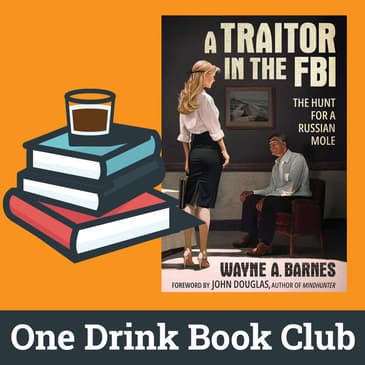
Wayne Barnes joins Jamey Bowers to unpack the true story behind his book, A Traitor in the FBI, a first-hand account of the operation that helped expose Robert Hanssen, one of the most damaging spies in FBI history. Barnes explains how his counterintelligence background, undercover experience, and writing process shaped a story that reads like a thriller but is grounded in real bureau history.
We discuss the case itself, the psychology of recruiting sources, the FBI’s internal hurdles, and why Barnes believed the story had to be told in his own voice.
[00:00:06] Hello and welcome to another edition of the One Drink Book Club. Today, I'm discussing A Traitor in the FBI with author Fred Waitzkin. The book is the never-before-told story of the undercover op he personally ran to expose the KGB's mole inside the Bureau during the 1990s. The mole was later revealed as Robert Hansen, who was called the most damaging spy in FBI history. Thanks for coming on the show, Wayne. My pleasure. Thank you very much for having me, Jamey.
[00:00:34] I thought the book was great. It was, you know, I'm a big fan of kind of spy novels. I've done, I've read a lot of Ben McIntyre and obviously Ken Follett and Tom Clancy. Some of those nonfiction, some of those fiction. But this was the first book I think I've read about a spy case where it was written by somebody who was intimately involved right in the middle of it. And so I thought that was a really interesting perspective.
[00:01:01] I'm glad you have that. I also enjoyed, besides the one you said, Alistair McLean, who wrote The Guns of Navarone. Yeah. And Frederick Forsyth, who was the day of the jackal, that sort of thing. Anyway, I always enjoyed reading those things. I did not know it would lead up to being a career in the FBI doing something very parallel to that. I had no idea.
[00:01:20] But I really wanted to write this. When my father was passing away in the 90s, I told him I wanted to write this story. In the bureau, you write paperwork. If you want to get a job somewhere else where you're writing and they hear that you were in the federal government, they assume you cannot write. The presumption is you have no idea how to write. And they think that you write a book like a police report for an accident, A Car the Color Blue, you know, that kind of thing. Sure.
[00:01:44] Which is not right. But I had a niche. I had Spanish in high school and French in college, and they taught me Romanian. She would best get just lean by speak Romanian, another Romance language. So I was debriefing Romanian defectors. There was a general who came over ahead of their intelligence service for months and months. And then the Russians who spoke English. So I debriefed about 24 intelligence people during the Cold War. Most agents see one during a counterintelligence class at Quantico, but I, you know, I had a niche.
[00:02:14] But when you write them up, you're writing up in what we call a letterhead memorandum. It's got the bureau letter at the top and then it's paragraphs. Instead of a to and from memo and other numbers, but it's just a straight story. So I would write them. And if a person at headquarters reading these has a four page LHM letter memorandum and he gets to page three and he's kind of yawning and he's not coming through. So I took Truman Capote as my model where he wrote the very first book in that. True crime. Yeah.
[00:02:43] And the narrative nonfiction was the category that he created when he wrote in cold blood. He went out to Kansas, saw the farmhouse with the blood on the ground and all the family dead and all that kind of thing. But he wrote it as fiction would be written, but it was a true story. That was really the model, the model for this. So when I was writing my LHMs of all the dozens and dozens of interviews with people, I realized that I had to do something different in the bureau. I had to use adjectives and adverbs. Sure.
[00:03:09] I had to make it flow as a story. It wasn't poetic. Some prose, but it wasn't too poetic. So I was crossing Pennsylvania Avenue and a man who had been a senior person in the, in the bureau at Washington field office. So it was now at headquarters as a senior guy section chief, which was a few levels up for me. And he stopped me in the median strip on Pennsylvania Avenue, which is a dangerous place to stop with cars zipping by. And he said, Wayne, Wayne, Wayne, stop. I have to talk to you. Like, okay, what do you want?
[00:03:36] And he said, I was reading that LHM this morning. What about so-and-so? I said, yeah. He said, I get to page four. He said, I turned it over. He said, I wanted more pages. And that was the first moment that I realized there might be something to this. Maybe, maybe I got some skills here. And that, and that was important. But the craft of writing is very important to understand it, to make it flow. And various, various reviewers who've written things about the book. If you, if you can actually stop someone from when they're reading, this is partly my ego, but also somebody else.
[00:04:06] Every time there's a review, reviewer will take out a small paragraph saying like, and he wrote this, like that was good. And there was a wonderful lady named Diane O'Connell who helps, of course, sharpening your manuscript. So she gets everything as tight as she can, but she was picking people to be in her class. And she read in the first few pages where the three agents came out to San Diego to pitch me to do this. One was his fellow named Dave Greb, dear old friend. And I, and I described him. I said, I knew Dave since he first became an agent. He would come into the field office with a slender build, white shirt and tie.
[00:04:36] Bobby Bureau, we joked, always the straightest arrow in a room full of straight arrows. Yeah. And she stopped. She said, I see him. I know him. I know exactly. You don't have to say the height or the color of hair, but. Right. And if you can do that, but so I, that was, it was very moving to me, but it, you know, it's pros, but if you can do it, then you win. So I had to write it myself was the point. I just could, I mean, I have a good friend in Bob Whitman. He was, I had an art team in Philadelphia. He wrote a book called Priceless, which was all recovering stolen art,
[00:05:06] Rodan statues out of Philly and the art team. And his book was called Priceless. And he had a fellow named John Schiffman, who was a prize winning writer for the Philadelphia Inquirer. And they got together. So John, so Bob Whitman told him the stories and John wrote them. I could not do that because I get to the point in a, in a page or paragraph and I realized, oh yeah, and this happened and I'll put it in. If I tell someone the story, then they write it down. You miss that. You miss, it's, it's like a personal touch, but you miss that. And it was so important to me not to, not to miss that. So.
[00:05:35] Well, you know, it's interesting. You read the book and you get a sense of who you are very much. And that does not, that does not surprise me based on what I gathered about your personality that you would want to do it yourself. Give a short synopsis of the story. I mean, I kind of mentioned it was about trying to, to find out this mole in the FBI, but give, give just kind of the quick rundown. Well, I, right. So I, I was in the Bureau from 1971 to 2000.
[00:06:04] When I went to language school in Monterey, California for Romanian in 1973, that meant my career would be in counterintelligence. So I was in the Washington field office after that for 18 years. And the first seven or eight were working the block countries during the cold war. That's Romania, Czechoslovakia, Poland, Hungary. And then for the next eight or nine working Russians, KGB and the military GRU, but KGB. And there was a special squad that had just been started by the head of the CIA and the FBI to put three FBI and three CIA case officers together.
[00:06:33] And that was an important thing, but it was all undercover with the goal of recruiting a Soviet intelligence officer was called courtship. Okay. I learned more things there. I worked a lot of undercover things, but that was really it. So when I came off that three and a half year shift, I told our assistant best lady in charge, I want to write a handbook about how to work a manual of how to work undercover counterintelligence. How you use a credit card, how you pick a name, how you pick a house, how you meet people, those kinds of things. So I wrote, it took the next six months from midnight to eight in the shift.
[00:07:03] But having that experience was important. So in 1990, I had a daughter born with spina epifida. We got a transfer to San Diego where the best orthopedic surgeons in the world live at Children's Hospital. And she got surgery every other year. It was wonderful. But it meant from 1990 on, I was no longer in Washington. So we had learned information from various defectors that there was a penetration of the FBI by the KGB. And of course, every KGB and Romanian and Czech intelligence guy, yeah, we got you guys penetrated.
[00:07:32] So then the Romanian general, a fellow named General Pacheco, he defected. And we asked them, like, you're the general in charge, like head of the CIA, head of the KGB, head of Romanian intelligence. Said, nah, we just tell them that so they won't defect. That's all bullshit. So, but this one, so, and finally a Soviet defector came out and he had actually photocopies of FBI internal documents, which meant somebody somewhere actually had somebody. So that was, that was different. So they put together a case which immediately became the most sensitive case in the FBI,
[00:08:02] penetrated by the bad guys. And for years, it seemed. So because I had left Washington in 1990 and they had learned that the, what we call the unsub, the unknown subject, the case became known as gray suit. Gray suit was the overall case. So the gray suit subject had been active giving secrets to the Russians in like 1992, 93, which meant I was not the bad guy. So among all, among all the agents in Washington, who are they, who are they going to pick? You know, like we, you don't want to send the spy, the traitor to try to recruit a Russian.
[00:08:32] Right. Who's going to point out his picture. Who is the spy. Yeah. So, so I was happy to for, but I had been gone long enough, but I had worked all the kind of things they needed to work, especially all the undercover experience, not writing the manual, but all the undercover hours and hours where they go FaceTime with Russians. So anyway, on a first very beginning of the book, three agents under what we call cover of darkness with the FBI does not do cover of darkness. They flew out to San Diego and meet us at a hotel. Don't tell anyone we're coming. Not your wife, not your supervisor, no one in the counterintelligence squad.
[00:09:02] That's, that's unheard of by the way, you know? Yeah. Yeah. Yeah. So, so I met them and they right away, they said, we have a penetration in the FBI. And it turns out that it was not someone who the Russians recruited. It was someone who volunteered himself. And all the psychiatrists and psychologists have looked at that and they think of compartmentalization is part of it. You get up in the morning and you, you, uh, you go to mass, you go to firearms, you go to work and, and then you give secrets to where, how does that work? Yeah. So that, that was what happened with Hansen.
[00:09:30] And so it wasn't a question of who did the Russians know or meet that they recruited? Not like that at all. It was not, that was not even sort of in the cards, but it does require an egomaniacal personality. A narcissist predator had pulled it off because when Hanson was arrested for the first thing he said to the guy running the SWAT team, he said, well, what took you so long to catch me? Right. I remember that. It's crazy. But it's, it's such a revelation. So in any event, so the agent said, there's a guy coming to a film festival from Moscow who is
[00:09:59] one of the Russians we believe knows the identity of the spy in the FBI, the traitor in the FBI. So that's all we had to go on. It was this, this man. Now there are certain people in sections in the embassy where they dealt with counterintelligence or what we call the dead drop activity, non-personal communication. You're out in the woods at one o'clock in the morning in a Fairfax park and the, have the black bag under a bridge exactly like it's in that, like you think it's exactly that way. So whoever may have been doing that could have seen the man, but there was a scenario
[00:10:29] that we learned about where one day in the smallest of the buildings in the Soviet, I think they had like 12 official locations, big buildings and military office, but one was like a duplex house and off of Massachusetts Avenue, but a small place. And you walk up a couple of steps on a porch and you go in, it didn't look like other stuff, like for a small consular office, somewhere where you can just walk in. And so someone walked in there one day and he said to the guy behind the desk, get me somebody from the KGB. And the guy said, there's nobody like that here.
[00:10:58] He says, go back there and get who's ever there. So a guy came out and then he went back and that was the last he was ever seen. Now I think it would have been a rainy day. So he would have had an umbrella and even cameras would have not dug it out. So from that incident that obviously, and he had superior intelligence knowledge, not about some defense contractor individual thing, but this was intelligence community wide. He had knowledge of things. So anyway, so that was the basis of it.
[00:11:25] So the man who would have known would have been in that room and saw the guy come in. So he would have seen the face. Now you say, do you remember a face from 15 years ago? So let's say for not that you're a Russian, not that you're in the embassy, but you're at a desk or you're right nearby. And a guy comes in and says, I want to talk to some of the KGB. That's different. And then you say, there's no one here like that. And he says, go find somebody. Would you remember that? I would probably remember that. That's a jump. That's a jump. So anyway, that was the essence of what had happened. So it was a good lead.
[00:11:54] It was a lead that had to be covered. It was that simple. So find the man who would have recognized that face from a photo. So that was the man who was coming from Moscow to attend a film festival in Santa Monica. And he was actually accompanying a movie producer from Armenia. He was just a nice lady, but she only spoke Armenian and Russian. So he and she needed translators that were kind of connected at the hip.
[00:12:19] Anyway, so the idea was then, as the agent said, go to the film festival, find this guy, meet him, befriend him, recruit him, and then show him photos of a dozen senior FBI agents we suspect of being the bad guy. Now, it's senior agents. Easy thing. Easy thing to do. Why not? So I see your tongue on your cheek. So Tom Cruise's movies with Mission Impossible were physical obstacles, jumping out of airplanes and going off of cliffs with a motorcycle. This was psychological.
[00:12:47] There were two superpowers, the Soviet Union and the US of A, and they thought they were members of the best superpower. So why would this guy be willing to talk to me? Sure. Sure. So it did end up pointing out a photo. But the point is that while there are other leads, as you saw from other parts of the book, there were so many efforts with so many Russians trying to get this information. And I retired in 2000. So I was not there when Hanson was arrested. So for many years, my presumption was like, you know, this is how it worked. But I was no longer in the loop.
[00:13:17] So anyway, for your synopsis, I had to find a way to meet the man. I should say that when a Russian is assigned to the Soviet embassy in Washington during the Cold War for four years. Here for two years, they've got a two or three month home leave back in Moscow and then back for another two years in the US. During those four years, it is almost impossible to recruit a Russian. Sure. So I said to the agents in the hotel, how long will I have to do this? And they said, well, eight days. That's how long the festival lasts. Like, ah! So that's, do you not like me? Do you really want me to? Do you want me to?
[00:13:46] That's a tough job. Do you want me to fail? Well, so obviously it didn't work exactly that way, but it did work. But the question is how to pitch the man. So anyway, so he eventually did point out a photo and, but you know, the ups and downs and there's an interesting concept in writing, which is called the writer's journey. They've made many books about it. Any, any story starts with here. And as you go along the story, there's, there's an up or this is good. You're succeeding. Oh, it crashes down. This was a setback and then a bigger high and then a bigger low.
[00:14:15] Well, this happened exactly that way. Like they made the book based upon this kind of a scenario. Sure. They didn't, they didn't make up fiction books. It came from reality. And so when I realized that was the case, I, that was one of the reasons I thought I should write it. But I started writing a book about what the FBI did during the cold war in the mid nineties when I was still an agent, but you can't write stuff in the bureau. And I started to write it. And my then wife said, gee, you'll be more hireable if you take the California bar and pass the California bar.
[00:14:44] So I'd, I'd been raised in Philadelphia, went to Penn state and Villanova for law. And I passed a New Jersey bar. Then they went in writing the FBI in 71. So I don't know if you know many lawyers, but if you ask them, would you like to take the California bar 25 years out of law school? Well, that doesn't sound like fun. So I, I studied for the bar for a couple of years and I passed it. And then I went back to writing, but that book, which I called the dance before the wall, it was a saga of what the FBI did during the cold war. It's on the shelf someplace. It has not been published, but it was too long.
[00:15:13] It would have to be a shorter book for a first book. So I use Ken Follett as the example. He had written eight or nine great, you know, the eye of the needle, the key to Rebecca, all great spy formulaic books. And finally, one day he said to his, his publisher and his literary agent, I want to publish an entirely different book. And they said, we got a great formula. We're making a lot of money. Don't change it. And he said, I won't write another word until you publish this book. Let me do this. Yeah. So they said, well, what is it about? And he said, it's about building a cathedral in Southern England in the year 1265.
[00:15:43] They said, absolutely not. Well, it became the Pillars of the Earth, which sold more books than all of his other books combined, plus two movies and three series. So that was good. So I realized that the one book was like 300,000 words and it should be 85,000 or so. So that book is on the shelf. I like that book to be next, but you have to have an audience, a personal audience will read your stuff with your name. So that's on the shelf. But then when they say, if you can't get a book published, write another book. You think that's easy.
[00:16:10] So then this story came along and I realized that I didn't, I wasn't looking for credit per se. You could probably tell my personality. I'm not looking for credit. This is U.S. Intelligence history. This is, so when I did do a Freedom of Information Act request for my case, what I did in the, in the great year later, they came back and said, we had nothing. And the reason is because when I, I met the man, Ivan, I would go back to my hotel.
[00:16:34] I would type up on my personal Toshiba laptop, print it out in the hotel, you know, printer, clear the barrel so that somebody else couldn't read what I had written, take it to FedEx and send it to my friend, Gene McClellan, part of the case in Washington, FedEx it overnight. He would get it and walk into the office because the bad guy had the capability of searching the FBI computer for a case mounted against him. So this was all literally off the books and they, they read that and they couldn't even scan it in. Yeah. Yeah.
[00:17:03] So it's, they, they all read it around the big, in the skiff, the secure facility, and they just put them in a corner. You know, they gauged the knowledge. They understood it. And then apparently when it was over, no one scanned them in. So there was, so if I didn't write this book. It would have disappeared. Yeah. And I, and I, my old acquaintance, Cliff Stahl, he wrote a book called the Cuckoo's Egg about East Germans working on behalf of the Russians, penetrating the arsenal, Redstone, Redstone arsenal when the internet was new.
[00:17:32] And, uh, he, he was able to figure that backwards. He gave classes at Quantico at the FBI Academy. And I was speaking one day when he was there and he heard other, not this story, but other stories like it said, you have to write this down. I said, FBI agents do not write down stories. It's in the file. That's it. And he said, no, no. And he said, if every, if every 75 years from the year, like 2000 BC, someone started writing down that they saw this flame in the sky. He said, if that didn't happen all the time, we would never know that that was Haley's Comet. Right.
[00:18:00] I said, it won't be like, it wouldn't be like it wasn't there. It was like, it never happened. He said, you can't let these stories be like they never happened. So that was really what convinced me to do that. Well, I don't know if you made a drink for this because I kind of do a, you know, that's a little bit of the shtick is to do a cocktail. This one seemed to be an easy one. I kind of went with the super obvious here. I made a white Russian, which I thought was appropriate for this, which is two ounces vodka,
[00:18:27] one ounce Kahlua, and then some half and half. Well, I can say that as a father of five children, my life was spent as a designated driver. And in the FBI, especially under Louis Freeh, if you had a gun, you did not have a drink. Yeah. If you had a drink, you didn't have a gun. Yeah. So I never got to drink too much. But this is called Ferrari-Carano. Oh, yeah. And it comes out in Northern California. I've liked it a lot. The Fumé Blanc, it's good. Yeah.
[00:18:53] And there's another wine which they make in Spain that's called Marquez de Cáceres. And in 1493, when the pilgrims from all over Europe were coming to Spain, to Santiago de Compostela, where the royals, Los Royos Católicos, Ferdinand and Isabella, they realized they're getting thousands of pilgrims, Pelagrinos from all over Europe, France and Germany, other places,
[00:19:18] were coming to Galicia for the celebration in July of St. James, but Santiago. And they had hotels back in that day, which were like hostels, but some were like castles. And they created a wine just for those people, the Pellegrinos. Oh, cool. And it's called Marquez de Cáceres. It's a dark red, and it's wonderful. That is my favorite wine. I don't have a bottle here today. From California, I'll take this one from California. But that's it. But not as much mixed drinks.
[00:19:48] But yeah, I appreciate having a glass of wine in the evening. That's a good thing. I agree. I agree. Well, one of the things that I was really impressed with was the preparation. And you go into a lot of detail about building your background, building your story. But then also the idea of that first meeting with Ivan and how you had to make sure that he felt that he was the one initiating the meeting.
[00:20:13] And I thought that was like a really an interesting rule of thumb. And part of my question to you is how much of, you know, you obviously wrote a manual on a lot of this stuff. How much of this was based on things that were taught to you or things that you learned in the field? Never wanted to be the one to take undue credit. In the early 70s and before, a lot of counterintelligence was based on what we called sources.
[00:20:41] A legislative assistant on Capitol Hill would meet with a Russian every two weeks for lunch. You would get assessment for that person, the legislative assistant, about Ivan or Romanian or Czech, whomever. And I realized that you get much better assessment if my eyeball can be on the man and I can do it instead of a surveillance watching whatever. Plus, they had other jobs to do working for, you know, a senator. So when I started in the field office, I think there were 17 agents had undercover identification.
[00:21:08] There were 700 agents in the office, probably 500 of them were counterintelligence to some degree because of all the embassies and whatever. And I became an undercover coordinator. And I said, meet with one of your sources. Maybe he does mining things or something with grain, his lawyer involving grain. And you'll meet with the Russians about the grain trade, that sort of a thing. He'll say, hey, Ivan's coming to my or Evgeny is coming to my house for a party on Saturday. Why don't you come and meet him? I can't come and meet him. I'm me.
[00:21:35] So having that happen a number of times, I set it up so that at the DMV, the Department of the University of Virginia, they would open for us one morning at 730 instead of 9. I would take all the agents, all the forms filled out to get alias ID. And they would start with a driver license. And you take your driver license, go to your local Arlington library or Fairfax library. We had a retired agent, special agent in charge of the office, had worked as a head of security for a local big bank. And I went to him and said, here's what I need.
[00:22:05] I need to have like 100 agents get alias ID. So we got credit cards for everybody. I was giving a class at Quantico and guys from the Honolulu office said, I need a credit card too. So we got credit cards for everybody. I mean, the Russians couldn't do it. But if they sat down and said, OK, when your American contact pays for a meal, what bank is the card from? And if they're all from the same bank, he's an undercover FBI. They didn't get that far. But that was the, but so you made it.
[00:22:33] So all these things in working undercover and how you meet someone. And the CIA has a concept they call the cold bump. So let's say you're an undercover CIA as a consul or a second secular attache in Algeria or London or someplace. And you invite many people to the reception. Some come in off the street. And when you meet someone, they call it a cold bump. Like you're both standing back to each other and you're back into somebody. And then you like start meeting them. Well, that's about as ice cold a bump as you'll ever have.
[00:23:02] So I realized that was the opposite of what I would want to try to do. And you have to trick them. So you never want to meet someone and have them think that this is a controlled circumstance. Sure. Like variations of the cold bump. So as we did with Ivan, we had a lot of special surveillance group, the SSGs on this. I set them up so that they would do something so I was in Ivan's eyeball first. He would clearly see me. And I had good backstopping.
[00:23:30] Polly Platt was our academy member who was so helpful. But she didn't know any about that. She just knew that she was, that's another point to make. She just knew that there was a Russian target. And her brother was in the CIA back in Washington. So he kind of volunteered her and she was willing to help for patriotism and for her brother. But in the Hollywood milieu, they would never want someone to do a thing like this. And the beauty was that she went through all this with international intrigue and Russians and spies, all the people making those movies.
[00:23:57] Like they would love to be the one inside a case like this. They would give their eye teeth for that. But so she was the one. So it was good because she was really undercover undercover. Yeah. But even she did not know we're trying to catch the spy in the FBI. She just knew we were dealing with a Russian. And likewise, all the surveillance people. It was just another Russian. Sure. So none of them knew the ultimate reason why we're putting all this together. So I had to have him see me first was the point and know who I was for sure.
[00:24:24] And then the secondary part of that was I had to see him know Polly. Now he would not know who Polly Platt was. All the senior people at the film festival would know her because, like for your audience, she wrote the screenplay for Pretty Baby. She discovered Brooke Shields. She did the set design for all of Barbra Streisand's rom-com movies. And she's really well known in Hollywood. She'd been married to Peter Bogdanovich for a while. So that was another name. But she broke all the glass ceilings by herself. She was really, really good. The Russian and the Armenians wouldn't know that.
[00:24:51] So we had to make it so that they would know this is a person. This is really somebody special. She was your credibility. She was my credibility. My beard. Yeah. But you know what? At various times in the book, when things are taking place and things are going perfectly, I mean, I know I'm the director. I'm the director of this movie. And the funny thing is, the movie Argo came out right about this time. Oh, yeah. And in the beginning of the movie, I forget who the older Hollywood guys are. Alan Arkin, I think, was in it. Yeah. So he's one.
[00:25:21] There's another one like that age. And they're pulling strings in Hollywood to set up the scam. And Argo was about seven Americans from the embassy in Tehran who were hiding in the Canadian embassy and had to try to get out of Tehran, pretending to be part of a movie, movie something, movie maker. But all the backstabbing and lying that goes on Hollywood came right out of that movie. I'm sitting there at home thinking, I know. I just had that happen to me. But I couldn't say it because it was the most sensitive case in the Bureau. Sure.
[00:25:51] I mean, how much time was I away from home? A lot of time. All right. Anyway, I didn't mean to go on, but that's. No, no. That was part of it. I mean, it was really interesting. Well, one of the things I thought was like at the very, you know, you do all this prep work. And at the end of the day, you decide that you're not the right person to make the ask to get him to point out who this spy is. And you bring in somebody else.
[00:26:17] And talk a little bit about how you made that decision and why you thought that she, a woman, would be a better messenger. Well, let me say, I do have pride in myself and what I've done. But I don't have ego that I've got to be in the middle. It's more important to me to have things work. Sure. Have the end and be right. So I go back to John Douglas, who was the original profiler. He invented profiling. He created by going to serial prisons, interviewing all the serial murderers. He was profiling them.
[00:26:44] What is the person of someone who does that inductively instead of epithelials and fingerprints from a crime scene? Who is in the category of people who do this? And you have the inductive and deductive trying to come together. But you profile an individual. How do they do what they do and why do they do it? So looking at Ivan, he had never had a relationship with a man in his life. Like I say, if he had a child born who was a boy, if he had a good father, it would have been entirely different. But he had no affiliation at all. In fact, he avoided having a contact with men. You wouldn't notice it, but in fact, he did.
[00:27:13] And he had a job when he was in the embassy where he worked at off. A lot of times we call off campus, but in his apartment where his wife was there and whatever. Yeah. Yeah. And my only involvement with him was because I was working to get progress for his colleague, his traveling partner's movie. So I was a tool for him and I made myself a tool for him. So he would continue. But then when Polly came in the picture, I mean, that was, it was orgasmic for this man to have contact with her.
[00:27:40] And it was, it was what, you know, it was exactly what we needed. But I realized that with his producer from Armenia and with Polly Platt and I was out of the picture, but I was, I was, what do you call it? I was the puppet master. I had the strings. I have marionettes. And not making it sound nasty, but it was part of the part of this part of the story. But I realized that, you know, he wouldn't hear me. So as you mentioned in brief, there was an over what they called an overt prong where they wanted to just pitch him up.
[00:28:09] Say, well, you take money to give us this one piece of information that, you know, and like, right. You never have it. Someone will not take money to have you have them violate their principles. That's, that's, that's, it's insane. But they somehow they thought that was the, the, the gameplay. That was the, that was from their playbook. And it not only couldn't work, I maybe work harder on mine and setting up and backing it up. Cause I knew the overt prom was going to, was going to fail.
[00:28:34] But so picture two agents have a suitcase full of money and they knock on your hotel window door and you answer it. And like, there isn't any good opening, you know? Hi. Yeah. Hey, do you want to, do you want to rat out your country for a suitcase full of money? Or we might be mobsters and steal it from you tomorrow. Like, I mean, the whole thing, there's zero trust.
[00:28:57] I, I, I, I found it unbelievable that the original plan was to have you kind of figure out who he was and watch him. And then they were going to try this very, you know, ham fisted attempt to bribe him. And it just, I mean, clearly you didn't think it was the right thing to do and you didn't think it would be successful, but it, it seemed like moronic that they would, that was the plan. Well, part of it is just having, it's not just smart.
[00:29:25] It's the smart from the experience to know what will or what won't work or may or may not work. And that, that just didn't have a plan. For instance, just some, some things only from having the experience of 29 years carrying the little badge. If someone actually came to you, well, let's assume you're a Russian, but even if not, and they say, we'd like this information. And I have a suitcase full of money. In fact, I have a million dollars in a suitcase. Okay. Well, I've done this a lot. A briefcase, a regular briefcase, like this long, this way. Yeah.
[00:29:53] You can only fit $250,000 in a briefcase. When they have a brief, when they have a brief, when a hundred dollar bills, if you have a briefcase, they have a million dollars here. No, there's not. You know, this is good knowledge to have. I'm glad I know this now. So if anybody tries to bribe me, I'll say, Hey, wait a second. That briefcase tops 250. Right. So when you're, if you're going to back to my, let's assume you take it. It's a suitcase, four times the size of a briefcase. Okay. It's a suitcase. Assuming it's all hundreds, not a cashier's check, which whatever. Okay.
[00:30:23] There's literally nothing he could do with it. Yeah. He can't store it someplace. He can't put it in a bank. He can't get a cashier's check and take it home. There's nothing to do with the money. If he gets over there, he can't put it in his mattress physically. And he can't get through an airport with a million bucks in cash. So there's physically nothing he could do with it. So even if he said yes, whatever reason that he would have to say, well, you can't help me get this home. Well, he does. He can't have the money at home. Right. You can't have an influx of money. Yeah.
[00:30:50] You know, when bad guys are robbing something, which is a lot of money, and they all say, now you guys with little money now, you can't start buying cars and stuff. You can't do that. That's an understatement compared to this statement. Yeah. It's just, it's enormous. It's just, I hate to say, I hate to say not mature enough. But if you think, well, if I give him this money, he'll tell us a story. At the very basic level, you may think that's an idea. But if you get past one layer or second layer. No, it's not. It can't possibly work.
[00:31:18] So I felt better about my part of it, knowing that I was going to be in season anytime soon. Yeah. If you have people doing surveillance on someone like Ivan, they'll watch him leave the festival and go to his hotel room and then go out to dinner, come back. You don't know what he's going to do tomorrow. So having what we call a recruitment in place, an RIP, as opposed to a flat out defector who comes with all of the secrets, but then he doesn't know anything after that. A recruitment in place. That's the most valuable person because they can tell you what's going to happen tomorrow and what does happen tomorrow.
[00:31:46] Instead of a straight defector that his last knowledge is the day he left and he can just guess about things. So recruitment in place. So the surveilling people could see what he was doing, but they didn't know it was in his mind. For instance, remember we'll call in the book he and the Armenian lady, they wanted to go to not Disneyland, but the tour, one of the other. Oh, the universal. Yeah, universal studio tours. Whatever it's worth, there are no freeways in Moscow that are like the 805.
[00:32:15] That doesn't happen. So we wouldn't have known that there were even issues without having someone in the setup room in the contact place. Anyway, so that's anyway. Well, so clearly when he did point out who the spy was, you were in the taxi when that happened. No, no, no. You weren't there. And so clearly they wanted as few people as possible to know who was pointed out. Right. Because they're going to have to build a case against him.
[00:32:45] How many years later was it that you found out that's who Ivan fingered? So you know this from the book, and this is the really summarized down. We needed to have him come back. We couldn't get him to stay any longer. He had to go back whenever that was in February or March in 1998. We had to have him come back to the U.S. We had to stay in touch every couple of weeks on the phone with the fishing line out. And they're trying to reel him in, getting him back to the States.
[00:33:13] And finally, I explained to Polly, I don't need the lady back. I just need Ivan back. And she didn't know because they're always together. Right. So she explained, oh, she had a film festival. She started in Austin five years before that. And, you know, let's invite him back and be a member of the international film panel, you know, which was a surprise. Yeah. And I thought that would fit great. She said, I just made it up. It never happened before. So she needed special invitations for him. And there was a lot of complications with that. But so it finally came to that film festival. And that's where it all happened.
[00:33:43] But I had told my Gene McClellan and the other fellas I was dealing with in Washington that this has to be a female agent. And it's a more intense level, but it's probably worth understanding the concept. If I tried to pitch him, I'm a friend. He knows me. Yeah. Yeah. At best, I would be like a source for the FBI, helping an FBI. Because my cover was so solid, as they said in the books someplace. If I actually showed him FBI credentials, he would think that was from a movie.
[00:34:12] He would think that was fake from a movie. No, there's no way. My cover was so sewed up, exactly who I was supposed to be. And that's how you plan it, so that there isn't any cold, cold bump. So I could have passed him off to an FBI agent. But he already met two FBI agents. And he said no to them. Right. So that was really not going to happen.
[00:34:34] So I went after we especially had the dinner out at the shutters on the beach, which was a very beautiful and expensive place to have a meal with their best meal of their lives. As they said, I realized that it would have to be a female agent to do this. And there weren't that many agents on the squad. But you can see from the cover of a book, I was at the Miami division a few weeks ago. And the book has a female agent on it. And a lot of women I've met say, oh, no one would look like that. And I was meeting, I was talking with four, five female agents.
[00:35:03] Same shape, same blonde hair, same nice heels, same fit, like crazy. And I said, here's the cover of the book. What do you think? And Neil said, like, that's one of us. That's what female agents look like. It's that simple. But anyway, so that it doesn't have to be believable for the public. But that one is actually true. So I went, I relied on Gene McClellan to be the one to pick out the female. And even then, it was a battle because headquarters would not agree to have a female.
[00:35:29] And the real story was KGB never, ever would be pitched by a female. They'd laugh at you. I said, but it's this guy's personality. We're zooming on this individual. And finally, Gene, he went to the highest ranking woman in the FBI. Her name was Sheila Horan. She was a great lady. She was the deputy assistant director, I think, which is what we call mahogany row. The seventh floor of the FBI headquarters. Instead of having a steel gray desk like all the agents have, they have wooden desks. They call them mahogany row.
[00:35:56] She's up in mahogany row making, you know, doing good things. But so he argued with her and explained it. And finally, she let it go on the basis of we should let a female agent try this, knowing that it would fail with a male at that point. But that was part of the obstacles. That's psychological obstacles. Not psychological obstacles with Ivan. Psychological obstacles with the FBI and with the senior people headquarters. Like, Jesus, what do I have to do? You're having to manipulate both sides here. Well, hopefully.
[00:36:24] And like I say, and if I try to tell someone this story as a ghostwriter, I don't know how it could have ever worked. I couldn't put the passion in telling someone. Don't have that. Expect them to write the passion down the way I felt about it. Sure. So hopefully that comes through. Well, yeah. And what I liked about it is that it was an interesting story of this, you know, gaining this trust, getting this knowledge, you know, developing a source, you know, kind of the spy part of the story.
[00:36:54] But it also is a really interesting look at the inner workings of the FBI and how that system works, which I thought was also interesting. Well, again, writers and editors tell me you can't put a modifier in front of the word unique. It's not very unique or somewhat unique or pretty unique. And there's even a chapter in the book called unique, which makes that point.
[00:37:19] But of all undercover cases ever run in the FBI, this was different than all of them. And so when I retired in 2000, I did not have it. I knew that he pointed out a picture, but I did not know who he pointed out. And we never knew. Now we call this the Hanson case. But then, you know, we didn't know. And who the pictures were shown to various people over time, that changed. Some got knocked out. Others got put in. So I had no. So and I have to make not as much an apology, but explanation.
[00:37:48] The first part of the book is three quarters of the book. And part two is that that's a part that could be fiction. Sure. It could have been fiction. It's true. Every word of it is true. A couple of names were changed, but it's all all true. If that's fiction, that's exactly how the story flows. I should have a page now between part one and part two. Part two is the aftermath. It's like whatever happened to Rebecca King, the female agent, for instance. I thought that was brutal, but I thought it was worth saying. But it's not part of it's not part of the story.
[00:38:16] He pointed out a photo that never saw each other again. We know the bad guy is. I'm out of it now. Right. But that and other aspects with, you know, are there still any spies out there? Was this the last spy from the Cold War? Well, to a certain extent, yes. But it doesn't mean the KGB goes home. Now the SBR and the FSB, they don't go home. You know, they'll pick up their tent and go away. So it added some, what I think, reality to the world of intelligence beyond what this one story is.
[00:38:42] So I would say to people, if they just want to read a good spy story and it's exciting, it has ups and downs, just read part one. If you want to know on a nonfiction basis how the FBI works besides what you already saw, how things played out and other aspects. I mean, I had written many other chapters, which could be a part of an intelligence anthology, which covered various vignettes. But what I put in there covered like the aftermath of that case. And hopefully that would work.
[00:39:12] But so I sat at home. We had moved to Miami at that point. And the fifth season that the Austin Film Festival was ongoing, that was the one we had in 1998. I bought the T-shirt. It has a red V, a Roman numeral five, the V with the line at the top and the bottom on a black shirt. And every once in a while I would wear it. I would sit at my desk typing or writing. And that is the only evidence that I was ever there. Nothing else. No credit cards, no anything. Nothing.
[00:39:41] So I was hoping one day I heard news that, you know, FBI spy arrested, right? Yeah. And then it happened. And then I was not involved with it, but I didn't have a right, I wasn't read into it any longer. I was out of the loop. Sure. Which is fine. And it wasn't until the movie Breach came out with Chris Cooper playing the role of Hanson and Ryan Philippe as Eric O'Neill, the clerk in his office, and Laura Linney. And I think the clerk says to Laura Linney, I don't think he's a bad guy. You know, he goes to Mass, he does whatever.
[00:40:09] He's working for the Mafia and now he's working for the Russians. And it was a big surprise. And he didn't believe it. And she said, well, we paid a KGB officer $7 million for that information. I sat there and I thought, I didn't pay anybody any money. In fact, every time I've ever done this, they don't want money. I've had, let me just say, I've done an awful lot. Many, many cases to draw from. And they do this on friendship or if they think they're not in a trap, but they feel uncomfortable, they say, I'll tell you this. And like, just leave me alone. Don't talk to me again. This is what you want to know.
[00:40:39] Like, just forget you've even ever met me, but you're still friends, but they don't want it. They don't want money. They don't want anything special. I mean, when you're meeting with a guy every other Tuesday for drinks after work at some nice bar in old town Alexandria and you say, and your friends now, and you say, would you like your son to go to Georgetown University or Moscow University? And he laughs. He says, of course, Georgetown. Yeah. He's over. His brain is already in your corner. Sure. And that's an assessment question. Go back to John Douglas and the profile. Yeah.
[00:41:13] He's over. He's over. He's got to wait years to come out or do whatever. Yeah. Yeah. He may, he may know there's a question not unlike the kind we dealt with here, but some kind of a question. And he would say, I'll tell you this now, but forget you ever met me. I don't want anybody to know this. Don't write it down. Don't do whatever. Yeah. But no one says, yeah, I need a million bucks, you know, out of the question. Right. Now, there's a cost to resettling. The CIA had their resettlement branch. Yeah. Yeah. Expensive to do with the family, but that's not money they get in hand. No.
[00:41:42] That's resettlement and educational training for the kids and the wife and all that kind of stuff. But that's not involved in finances when you say how much you're going to give a guy who's a defector. It works a different way. Interesting. Interesting. Well, you also talked about the challenge of getting this published and getting it approved. How long was that process? Well, you're kind by using the word challenge. You're not an underestimator, but boy.
[00:42:10] Which was harder, writing the book or getting it approved? Like a thermometer, the frustration level, getting it approved. Well, you never know that there's going to be the next hurdle. You know, every cliff you climb has a plateau above it. And walk down the plateau and there's another cliff and you don't really appreciate that. False peak. Yeah, that's for sure. So writing it, it took three years to write.
[00:42:35] Once I realized, I mean, in the writing world, there's a great lady named Kathy Varecki has a class called Pitch to Published. There's like 500 people online every week with editors and literary agents and many people learning about the trade. Just learn that whole trade of getting a book published because you don't just go to a publisher. Right. That's an enormous amount, big hurdles to go over with that. I mentioned Diane O'Connell before with Manish Group. All that has to be done. You should have some ability to write in the first place. But that's part of enjoying, love the idea of writing. But, you know, the frustration level.
[00:43:05] So the frustration would go away when he pointed out a picture and then I was out of it. My part was over. But realizing that, not disaster, but I mean, it's like the Romans just went through or the goths. You know, the field is littered with the enemy. That's, you know, what happened to those people. Again, and no one knew. Only very few people knew. So then it came to writing it. And when the movie came out that showed it was somebody that was paid money and I didn't pay any money, I had to know more about it.
[00:43:34] And in 2013, I decided to write it down. When Freedom of Information did not know I existed. Right. Didn't know my part of the case. That was brutal. I decided to write. It took three years to write. And I've done, I've had, like in the writing classes, get something published. Write an article that'll be published in a newspaper or art magazine or something someplace. So I got 15 articles published about art and feel-good pieces. So I had actual editors look at my stuff and it got published. So that's a checker block. And that's just part of the climb. So I wrote it.
[00:44:04] And in 2016, I sent it. It's a pre-publication review. If you have a big drug case you worked in Detroit or a big kidnapping case in Tampa, nothing was ever classified. Confidential while the case is ongoing, but nothing like the counterintelligence cases. So have at it. But writing a spy story, nah. And the fact is, I like to use the word temerity. No one ever was an agent who did this for a living ever had the temerity to write the story down and send it to pre-publication review. Ever.
[00:44:33] So when the movie Breach came out, which was the story of Hanson, but it starts where he's identified. They know who the target is. Yeah. And all story is catching me in the act. And there have been, I think, 14 books written about this case. None of them have asked how he was caught. How it was my part of the story. They don't know that. Now, whether or not my part actually was what succeeded, because I was out of it at the time. Sure.
[00:44:55] I think, again, without having a big ego of any sort, I think the way it played out, what it took to do that, both the experience and the timing and the recruiting people like Polly, recruiting other individuals and having the surveillance people do the stuff they did that they'd never done before. All those things. I mean, it was extraordinary. It was worth writing down how that works. Oh, yeah. Yeah.
[00:45:18] So anyway, so when they went to Gene McClellan, who, again, has been a dear friend for years and was my man at headquarters when my part was taking place to get a female agent and to get permission to use her and other things back there. But he was the house in Alexandria. I would FedEx overnight my reports. He would walk into the office and say, hey, I got stuff from Wayne in California. Give it over here. So that was good and good natured. So I'm happy and proud that it worked the way that it did.
[00:45:48] My view is this is a story that should be told, not because it's me or my story. How it worked. It was extraordinary. And like Gina's always said, we did everything they asked us to do. And they had no idea what their ask was when they asked it. They had no idea. That's why they started with the overt prong, the cold pitch boys, you know? Right. I mean, they were decent agents, but I had hundreds and hundreds of hours of face time with counterintelligence targets, Romanian Czechs, Poles, Hungarians, and many Russians. I wrote the book on it. Excuse me.
[00:46:18] I understood that. And they were more field agents. They were supervisors and read the paper, but just finessing some of the, you can tell how the finesse worked with certain things. I mean, people often, I won't bring it up, but people often talk about the very first moment I met him when I almost fell in a swimming pool. Yeah. Which is a great, that was great. Yeah. That's creative. Right. But anyway, so all the things to make it work, that had to be told. If nothing else, that just had to be in a story someplace because it is, you know, it's heavy.
[00:46:45] So doing the case was complex, more complex than anything I had. But I took, I saw it as taking all the stuff that I'd learned, all the stuff that I'd done, all the stuff I helped with others with, used all that to make this case, which was the ultimate case work. Okay. So then comes writing the book and sending it to hit FBI pre-publication review. They have 30 to 45 days to review a book. And, but they never had anyone submit, we call it FCI, foreign counterintelligence, as opposed to FBI, but FCI is what we all call, but counterintelligence. No one had ever submitted one.
[00:47:13] Now they may have had stories they thought were meritorious, but this one was, this was like, was it, this was in a box with a bow on it. This was a story that's complete and other, you know, others that they sort of begin and they sort of end, but it's cases in general. This was a, this was a different one. So they had 45 days review a book three years later, three years later, they wrote, they wrote back and they said, no, like, like that. It could have said hell no, but it was pretty close. So I flew up there three times in the next four years.
[00:47:42] I argued my case with them and just only, I'm not sure how much time you have, but just as a good example of an argument in seven, 1977, we had a voluminous amount of information about an Eastern block purse guy, personality. And I had had undercover contact by way of dozens, hundreds of pages of information. We went to Quantico to try to figure to the behavioral sciences unit, behavior analysis unit. Now, like we have all this, what can we do with it? How, how should we piece it together? And we had never had that situation. We had so much to figure it together.
[00:48:12] So finally, on the, on the block, the block squad, uh, we had a meeting of the, the brain trust, the ones who did the most on the squad. And I said, let's try this. Let's answer three questions. What makes him laugh? What makes him cry? And does he love his wife? What makes him laugh? Like sit in the car and say, what would you like, Ivan? What would you like? Of all things in life. If he grabs the steering wheel, he yells, a Mercedes Benz, right? That's what makes him laugh. You know, would you like your son to go to Georgetown or Moscow? You, you know, what makes him happy? It makes him laugh. You know, what makes him sad?
[00:48:42] One fellow had a child born wife has to go home, be eight months of pregnancy when you're a diplomat. And the child was born at seven and a half months premature. So a child was born in a hospital and it needed immediate heart surgery. And the diplomat knew that if the kid went back to book to, to Moscow, that he would die for sure. Sure. So we found the best doctor in the country who handled this particular case, flew him into Washington and he did the surgery. The kid lived, right? The kid would not be alive if not for the FBI. Okay. Yeah.
[00:49:11] Well, so, so, so what makes him cry? Having a child die, you know, what makes him happy, you know? And with his wife, some of the, some of the diplomats, they would like to bring out their wife, uh, their wife's family, their own family, cousins, everybody, you know, 17 people. Yeah. Yeah. But if he, if he hates his wife, he wants to make his defection, a de facto divorce, a divorce, I'm leaving and leaving her behind. So that's why the three questions. So I was in a meeting with like a dozen people around a conference table in the headquarters
[00:49:38] having this discussion and this section chief lady, nice person, but she was against me. And she said, see, now the Bureau owns those questions. We use those questions for personality assessment. You can't have those. I said, it's like psychology 101. Yeah. I said, like, it's like, I can rent a guy to have a, teach me how to pick up a girl in a bar. Yeah. And it's what makes him laugh. What makes him cry. You know, it's, that's it, you know? Yeah. Yeah. And they fought me. I said, I have a son who worked for Lockheed Martin in robotics. He had like 11 patents. Lockheed Martin owned them, but he figured it out.
[00:50:06] I said, you don't own, you can't own three psychology questions. Right. And that was one, it was one of their arguments. Like what? So, but again, we had created those questions exactly for this kind of a situation. So anyway, so finally, after full, after seven full years, they led it through September, 2023. And I had been various course, we read a one page query letter, you know, 300 words, what the book's about, what the character's like, what the conflict is, why I should read it, what it's compared to 300 words in one page. When I started to do this, I said, I can't read it. I can't read a query letter. It's still classified.
[00:50:36] I can't, I can't even, I can't even write that. So that's an initial. Yeah. You had to start from square one. So that was an initial frustration that nobody had to deal with either. But anyway, so anyway, I'm happy that it got where it is. It came out April 7th. It, it sold out on the very first day, April 7th on Amazon. Unless your name's in politics or Hollywood, that doesn't happen. I'm not sure how it happened. But probably pre-orders, I'm not sure. But then it was number one on new releases on Amazon for the rest of the month. And it's doing okay now.
[00:51:03] I've done maybe, I don't know, 20 podcasts, 40 radio presentations of drive guys in the morning, Salem, Oregon, Baton Rouge. So you try to get as much publicity as possible. Sure. Is this was just a Tom, Dick and Harry movie about what it's like to be an FBI agent? That's, that's one thing. But I see this much more personal. So when Gene McClellan was asked by the people from pre-publication review, they said, the bottom line is we don't want Wayne giving the KGB, now the SVR, FSB.
[00:51:30] We don't want Wayne giving the Russians a handbook about how the FBI catches spies. Sure. And one of the nicest things anybody ever said about me, he said, this isn't how the FBI catches spies. This is how Wayne catches spies. And that, and that, I think that may have made the difference. I don't know. But it's just how, how it has worked all those years. And hopefully I would think that if there's a person gets out of law school or college and is a principal in a junior high or just some, something in the tech world. And they would read this book somewhere in their brain.
[00:52:00] They would have thought maybe law enforcement would be interesting, not local, not state. They would read this. They would say, boy, I would like, I'd like to do that. I mean, that's something that would be interesting. I would rather have it be a recruiting manual instead of a give the Russians a secrets manual. And as you can tell, it isn't how you did it. Every step along the way was a different fact pattern. We've never had to convince headquarters to use a woman before. Right. That doesn't have to admit that. You can't take that in the book. Well, now we know how to do that. No, you don't. So anyway. Well, Wayne, congratulations.
[00:52:29] I'm glad that it's doing well. I enjoyed it. And I certainly enjoyed talking with you about it. So I appreciate your time. And thanks for joining us on the One Drink Book Club. It's been my pleasure. I have my wine here. Yeah. When we get off the air, I'll have a glass of wine. All right. There you go. Thank you very much. I really appreciate it. I've enjoyed being with you.