
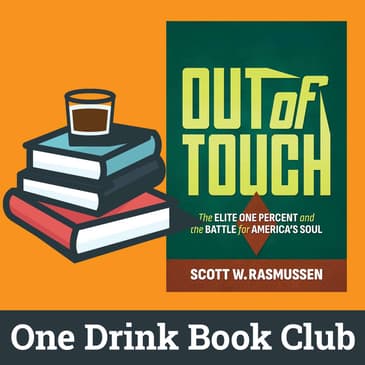
In this episode, Jamey talks with famed pollster, Scott Rasmussen about his new book Out of Touch: The Elite One Percent and the Battle for America's Soul. In it, Scott takes a closer look at the growing divide between America's ruling class and the rest of the country. Drawing on years of polling and research, Scott argues that a small group of political, media, corporate, and cultural elites has become increasingly disconnected from the values, priorities, and concerns of everyday Americans—and that this disconnect is reshaping our politics, our institutions, and our national identity.
[00:00:06] Hello and welcome to another edition of the One Drink Book Club. Today, I'm joined by one of America's best-known pollsters and political pundits, Scott Rasmussen. Scott's new book is Out of Touch, The Elite 1% and the Battle for America's Soul.
[00:00:21] It takes a closer look at the growing divide between America's ruling class and the rest of the country. Drawing on years of polling and research, Scott argues that a small group of political, media, corporate, and cultural elites has become increasingly disconnected from the values, priorities, and concerns of everyday Americans, and that this disconnect is reshaping our politics, our institutions, and even our national identity.
[00:00:47] I've known Scott for years and I've always appreciated his insights and observations on politics and culture, so I'm really excited to discuss this book. It's right here. You can go out and buy it on Amazon. So, pour yourself a drink, pull up a chair, and join us for an interesting conversation with Scott about his book and the Battle for America's Soul. Welcome, Scott. Thanks for joining me. Jamey, it's great to be with you. Happy to talk about the book and always happy to chat with you.
[00:01:16] Well, thank you. As I was just mentioning to you, number one, I usually don't commit to do podcasts with people I haven't actually read the book with yet, and I made an exception for this one because when I saw that you had a new book, I knew I would like it, and I knew I would find it interesting. So, I reached out to you and asked you to come on the podcast. And the other thing that I generally do, as you know, Scott, I tend to work in politics and issues most of the day.
[00:01:45] And so, when I do this podcast, which is more about, you know, reading and literature and interesting things that I find outside of work, I generally try to avoid politics because it's something that I do most of the time. But I knew that this would be insightful. And also, you have always taken a pretty bipartisan look at things and things that I thought were very interesting. So, thanks for being here.
[00:02:11] Years ago, I had a chance. I was in Nashville. I was sitting with some of the best songwriters in the industry. And we were having a nice dinner. And they just kept wanting to talk politics. And I was like, you guys are the really cool kids in the room here. I want to talk about what you do.
[00:02:31] And Lee Miller, who's now the head of the Nashville Songwriters Association, looked at me and said, Scott, we just sit around all day and try to figure out new words to rhyme with love. What you do is interesting. I think that's true for all of us. We get out of our day job and we want to do something else. Well, and, you know, one of the things that I always find interesting about polling and public opinion things, and I've moderated hundreds of focus groups through the years.
[00:03:01] And every time I've ever done a focus group, I think, oh, that's interesting. I didn't realize people would think about it like that. And so many times I think we all go through life looking at things and assuming that everyone else thinks the way that you do. And the reality is they don't. And so it's always interesting to get those insights and to be open to them. You know, a certain amount of time we're all pretty arrogant and we think we know what people think.
[00:03:29] And if you I'm sure you feel this way and I know that I feel this way is that no, I don't know. I'm pretty, pretty obvious that you have to do some of this research. You know, a friend of mine a long time ago said we're all ignorant in different ways. We think we know certain things and we do.
[00:03:48] But sometimes what we learn is that the questions that pop into our head aren't the questions other people are asking or the words that we use aren't the same words. We just think about things differently. And when I started in polling and look, I'm old, I've been doing this forever, did my first poll in the late 80s. There were three television networks that kind of set the tone for everything. We all had a common vocabulary.
[00:04:17] I don't think we could find five of your listeners right now who share the same streaming programs because we just all have different consumption habits. So how do you ask the question like that? How do you begin to explore that and really capture all the different viewpoints? So you have to be very open to it. You have to look at things from a different perspective.
[00:04:41] When the way I do it is if I see results that don't make sense to me, I don't think people are stupid. I think I'm missing something. What am I missing about the way I'm asking the question? What am I missing about the way that I understand the way they're looking at the world? Because if I can understand that, it helps me better to connect with them. Absolutely. This book is interesting.
[00:05:07] There is a common discussion point in Washington and I'm sure around the country that says, hey, we're at unprecedented times. The country is very polarized. Everybody is kind of at each other's throats. And if you believe one thing, well, then all of a sudden you believe all these other things that go along with that. And then you're diabolically opposed to somebody else who thinks these other things. And you can make big assumptions based on somebody's hat or T-shirt or whatever.
[00:05:37] Oh, they must believe in X, Y, and Z. And I have not seen what I found was really interesting was your perspective on this question of, have we been here before? Why are we here? And then, more importantly, how do we get out of it? And so what motivated you to kind of take on this book and approach this problem or question? Well, let me start with just some perspective on this.
[00:06:06] I address it in the first chapter of the book. We are in a strange time. In the 60s and 70s, when a new president was elected, people from both parties wished them well. When Lyndon Johnson or Richard Nixon or Jimmy Carter became president, people from both parties said, yeah, we like the way they're starting. We're happy for them. We want them to work.
[00:06:31] And then with those three in particular, by the time they ended their time in office, it had gone the other way. But again, people say a Democrat for Lyndon Johnson or Jimmy Carter, Republican for Richard Nixon, we're quite willing to say, I don't approve of the way this guy is doing things. We're not in that world anymore. Right now, there is Team Red and Team Blue. Whether it's Joe Biden in office or Donald Trump, your party says you're doing great.
[00:07:01] The other party says you're doing lousy. This is new. This is a new territory. And a lot of people say, oh, well, it's because Donald Trump. I mean, I give an example in the book of two Midwestern women who have known each other for more than 50 years. They agree on most things, but they can't talk about politics because they think they're on opposite sides. Donald Trump is not the cause of our polarization today.
[00:07:29] It began in the 80s. It has been growing ever since. And, you know, we can come up with lots of reasons for it. I can go into lots of details about it. But the first and most important thing to recognize is Donald Trump is not the cause of our polarization. He is the result of it. Which I thought was an interesting point and which makes a lot of sense to me.
[00:07:54] And your idea that people at least were willing to give the other side a chance once they won. They said, well, you know, hey, they're in and I want them to be successful. And, you know, I understand that sometimes that's lip service, at least from the Congress. But now we are not even in a point where you're going to do lip service.
[00:08:14] I feel like this, the current reflecting pool drama is a good microcosm of the entire issue in that you have people who are, you know, reveling in the fact that there's algae and problems. And then you have the other side exaggerating or making claims that they don't know are true. I mean, the whole thing is just ridiculous.
[00:08:39] And this is about, you know, a stagnant pond in Washington that 99.5 percent or 99.9 percent of the country never sees. But it has turned into a much bigger deal because it's a way to score points or own the other side in one way or another. And it really does not. I mean, who at a certain point you think, well, yeah, doesn't everybody want a park to look nice? But, well. Yeah.
[00:09:08] When you know what, you talk about that, there's a couple of things. First of all, you're absolutely right. We now live in a world where if I tell Republicans that Democrats believe water is wet, the Republicans will disagree. If I tell Democrats that Republicans think the sky is blue, they'll say, no, it's not. It's never been blue. But the other part of it is we live in what I call a 10-10-80 nation.
[00:09:35] It's not that we're 50-50 split right down the middle. There are 10 percent of voters who are on the left who are engaged in a bitter war with 10 percent on the right. And the other 80 percent just hate the fighting. They don't like either side and they just want to avoid it. They want to keep their heads down, avoid getting caught in the crossfire so they can live their lives, raise a family, build a business, do whatever.
[00:10:05] And they're the ones who actually move America forward. So when you talk about something like the reflecting pool, yeah, the 10 percent on the left says this is a great example of Trump's incompetence. And the 10 percent on the right say it's vandalism or something else. And the 80 percent are we have a war on Iran. We have gas prices that we're worried. What are you talking about? And that's part of the problem.
[00:10:35] These 10 percenters on both sides are more concerned with beating the other team than they are with representing the 80 percent or moving the nation forward. Yeah. And it's interesting. So in the book, you also go a little bit further. And it's not just the far right and the far left, but there is a group that you call the elite 1 percent. And then even more so, you call the politically active elites.
[00:11:03] Explain who they are and why they are problematic to our democracy in general. So the elite 1 percent are a group that, you know, I've been looking my entire career to try and identify who sets the narrative. What's what's what's missing? Why do they miss what's going on in America? And it started for me because I did my initial polling for the term limits movement. This is an 80 percent issue.
[00:11:33] Republicans like it. Democrats like it. Young people like it. Old people like it. Everybody likes it. Maybe not members of Congress. Maybe not certain people in a political world. But every time in my early days of polling, the reporters talked about term limits as a controversial issue. And I'm thinking, how can an 80 percent issue be controversial? That's kind of what's been driving the process.
[00:12:02] Over the years, I noticed there were some groups that were consistently out of touch in the cross tabs that I saw. I look at lots of polling data, obviously. One group were people who made a lot of money. Another group were people who lived in a densely populated urban area. You know, people who live in a Manhattan zip code with 123,000 people per square mile.
[00:12:27] Look at the world differently than somebody who lives in a zip code with 250 people per square mile. I noticed those differences. And then the big one was people with a postgraduate degree have views that are different than just about everybody else. And, Jamey, you've heard a lot of talk about the diploma divide, kind of that people with a college degree are more Democrat. People without are more Republican.
[00:12:51] There's a little bit of truth to that, but the bigger truth is the gap is between those with a postgraduate degree and everybody else. So I began to develop this idea that what if you combined all three of those attributes? Postgraduate degree, make a lot of money, live in a densely populated urban area. I pulled together some results from early surveys that I did, and the results were stunning.
[00:13:18] The first time I tried it, Joe Biden was still in office. 41% of all voters approved of the way he was doing his job. But among this elite 1%, his approval was at 82%. Wow. This is crazy. So we eventually did some research on it. And what we found, some of it, I guess as I look back on it now, shouldn't have been so surprising.
[00:13:46] But the people who are this elite 1% or the politically active elites, those who are in the elite world that talk politics daily, they trusted the federal government a lot. And they also believe that most Americans do. Actually, according to the Pew Center and others, it's been 50 years since a majority of Americans have trusted the federal government to do the right thing most of the time. But somehow these elites have missed all that data.
[00:14:15] Another big thing that we noticed was that these politically active elites tend to think that the rest of us have too much individual freedom. When you ask most Americans, they say the problem is we don't have enough individual freedom. And we could go on and on through this, but there's a real sense that I picked up as I went through the data
[00:14:40] that the battle for America's soul is that these elites reject America's founding ideals. They don't believe in freedom, equality, and self-governance. Half of the politically active elites don't think you should be allowed to vote unless you have a college degree. Most Americans have entirely different views. They still embrace those founding ideals.
[00:15:02] And one of the things I thought was interesting was how you talked about the elites and this disparity in how they view individual freedoms. But then I really thought it was interesting that they assumed everyone kind of agreed with them or agreed with, which I guess isn't surprising, but it was really interesting to see the numbers on it.
[00:15:30] And so I found that kind of fascinating. And then you then talked about kind of this Woodrow Wilson inspired, hey, well, if we're elites, we like elites, we like college educated or graduate degree people. We think that they should be the ones to make all the decisions.
[00:15:53] And so it was kind of this idea of building this bureaucratic state where those people had as much power as possible. And so talk a little, well, before you talk about that, I want to say, all right, so I haven't talked about what cocktail I made that was inspired by your book. So I decided, I drew on the elite one percenters.
[00:16:14] And so I made a champagne cocktail, which is basically a sugar cube doused in bitters with champagne poured over it with a lemon twist. So just to set the stage there. Okay, well, Jamey, let me just confess that for most of my life, all I drank was beer. And the reason for that was because I knew how much alcohol was in a beer and I knew how much I could handle. But then all these craft beers started coming out.
[00:16:44] So now I moved up. I drank a Jack Daniels and Diet Coke, a tall single. So that's why I don't have it with me right now, but that's my drink of preference. Well, I am sad to say that it took me until I was about 40 before I realized that, hey, if I go to a party and I drink Miller Lite, I'm not going to get in trouble with what the things I say or with my wife or other deals. So it took me a long time to go with the beer plan.
[00:17:15] Well, I'm glad you figured it out. And I really appreciate your cocktail tonight. So the first thing is I think it's important to recognize we all live in a bubble. The politically active elites, 82% of them believe that most Americans agree with them on key issues, which is ludicrous. It's not true. It's not even close to true. But it is hard to break out of our balls.
[00:17:45] The people we talk to who share similar views, we all have it. It's just that most of us aren't in a position to set the narrative the way the politically active elites are. So that's part of the reason it's dangerous. Another part of the reason is they are so far out of touch. You know, the politically active elites, most of them not only think we should ban private ownership of guns, but they think most Americans share that view.
[00:18:12] They think most Americans want to live in a community where guns are not allowed. They have views on climate change that are way out of touch. So when they believe that those views are shared by others, it becomes a problem. But when you get what makes it really dangerous is the Woodrow Wilson connection. And full disclosure here, I think he is the worst president in American history.
[00:18:39] Back long before he was president, long before he was even governor of New Jersey, he was an academic. He wrote an influential article called The Study of Administration. And this was an idea that really we should model ourselves not after America's founding and not after the ideals embodied in the Declaration of Independence,
[00:19:03] but that we should look to Prussia for a model of governance, that we should put experts in charge and keep the public as much as protect the bureaucrats from voters. At one point later in his career, Wilson said the biggest problem with the American people is they've never gotten over the Declaration of Independence. He hated that idea. And by the way, just again, full disclosure, I have not gotten over the Declaration of Independence.
[00:19:33] I still believe in those ideals. But Wilson thought that was a problem. And he was part of it wasn't just Wilson. He was part of a culture. One of his mentors, when he was getting his PhD, and by the way, Wilson is the only president to have a PhD. One of his mentors founded the American Economic Association. This is after the Civil War, late 19th century.
[00:19:58] And if you wanted to join that association at that time, you had to sign a manifesto, which basically declared that free market economics does not work. It wasn't an open discussion. You had to acknowledge that to get in. Wilson himself wrote that the post office proves that pretty much anything private sector can do, government can do better.
[00:20:24] And so he wanted to nationalize communications and transportation and things. It's been 140 years since Wilson wrote that article. There have been steps forward and backwards. But the administrative state that we have today traces its roots back to Wilson. And I guess more relevant to our crisis today is that in the 1960s, as that culture of experts was really taking hold,
[00:20:52] our educational system went in a different direction from the rest of America as well. Sure. And I think it shows how much the regulatory state and how many decisions get made outside of both state and federal government legislatures. And that is the culmination of that philosophy.
[00:21:20] Right. There's this idea that, you know, Congress can pass some rules and then some regulators will figure out how to interpret them and implement them. And in theory, that's great. In theory, a lot of things are great. But in practice, what it means is that a regulator can sometimes faithfully interpret the rules. Sometimes, because it is Congress, after all, sometimes the rules are a little vague so you can interpret them your own way.
[00:21:48] Then we have a system where federal bureaucrats issue what are called guidances to state and local governments saying or to businesses, this is how we'll interpret a rule. I mean, it creates what Brookings Institute scholar Jonathan Rauch calls the parasite economy. I love the term.
[00:22:05] And the idea is pretty much that once you begin to have a group of people who are not accountable to anybody making these rules, well, then you have companies and others beginning to pay to influence the rules. And the people who make the most money off that are those who are in the middle of who are the matchmakers in between. And, you know, look, if you believe in America's founding ideals, there's something wrong with this.
[00:22:34] The elected representative should be in charge. I dedicated the book to the nation's 519,000 state and local elected officials. They should have a bigger say in what goes on in their communities than a bureaucrat in Washington. Absolutely. Now, some of the examples you use were they tended to be more progressive or liberal ideas.
[00:22:58] But you also explain in the book that it happens on the right as well in that people feel like, oh, no, you know, we might be fighting the left, but we're going to use the same tools and we're going to use the same experts. But they're going to be our experts. So talk a little bit about how both sides utilize this kind of anti-democratic philosophy. Sure. You know, and by the way, again, this is human nature.
[00:23:28] This is not anything shocking. But when one team puts in some experts and says, we're going to make some rules and the other team hates the rules, they don't think we should get rid of the power of one person to do that across the nation or we should let local communities do it. They think, no, we're going to put somebody in charge who makes the rules.
[00:23:51] I mean, one of the examples I talk about is when Barack Obama was president, he put in some rules about for colleges, about gender identity issues. And then Donald Trump came in and changed them. And then Joe Biden came in and changed them again. And Donald Trump came in and changed them back. It's crazy that we have a system where a one person can change those rules.
[00:24:20] And so the way I describe it in the book, I love the Hunger Games movies. It's one of my favorite franchises, I guess. And, you know, in that movie series, the beginning is we know who the enemy is. The enemy is the capital. The enemy is those oppressive people in Washington who are living off all the outlying districts.
[00:24:43] And it resonates because, you know, the most affluent communities in America live around Washington, D.C. We recognize that. As the movie series goes on, you learn that there's another district that's been hidden that you didn't know about, District 13. And they had been building this capability to fight the capital.
[00:25:08] And there's a moment in the series when you think this is where the good guys come out. District 13 gets their military. They take on the capital and they defeat them. But what you learn at that moment is that the president of District 13 really isn't interested in a free Pan Am, a free country. She just wants to run the capital. And to a degree, that's what's happened.
[00:25:35] The progressives began this idea of government by experts. And in response to that, a lot of conservatives began, conservative activists began to say we need to fight back in the same way. And they've lost sight of the fact that they were initially fighting for a set of ideals. Now they just think that if our team's in charge, it's better. And that's a tough state for us to be in.
[00:26:03] You know, I have a thought that has occurred to me in the last couple of years in that as hypocrisy in Washington is dead. And that, you know, it used to be, I mean, there's obviously always been hypocritical politicians. However, 10 years ago or 20 years ago, if you showed a politician that a year ago you said the exact opposite of what you're saying today, they would at least be sheepish about it.
[00:26:33] They would feel cowed that you brought this up and that there would be some shame involved. And today, I don't even know that they would get the question. Everybody is so expedient and so whatever works today, they can explain. Yeah, I was completely against that last year, but it was totally different circumstances. So I don't need to feel bad about that.
[00:26:56] And so, you know, I used to say that Clinton was the end of shame in Washington where he just decided to not be sorry and to keep going. And people said, I guess that's a choice we hadn't thought you could do. Nixon left because of shame. Clinton said, I'm just not going to be ashamed. And I feel like the Donald Trump era is the end of hypocrisy. Nobody cares. Both the hypocrites or the media doesn't seem to really care.
[00:27:26] You know, if you would go back and look when President Biden was in office and Republicans were furious with his executive orders about student loans and the fact that he was defying Supreme Court rulings and trying to find new ways to get around it. And the Democrats were saying, but he's doing the right thing. This is OK. Donald Trump comes into office and the Republicans are now saying it's executive power.
[00:27:56] It doesn't matter. It's the right thing to do. And the Democrats are saying, how can you defy the courts? So you're right. The end of that hypocrisy. And it's really sad. Most Americans don't buy into that. Again, it's part of the reason this 10-10-80 nation, these 80 percent just feel filthy when they talk politics. They don't want to get involved in it. And they still embrace our founding ideals. They're the people we need to get back into the process.
[00:28:25] And again, I think the way to begin to move in that direction, we don't need a grand plan. We don't need somebody coming up within four years. I'm going to solve all the problems of the world. We need to move incrementally towards a better solution. I call it radical incrementalism in the book. It's the idea that you move things forward by making small changes in your daily practices.
[00:28:50] And what we need to do is gradually, one step at a time, one issue at a time, begin to move power closer to home. Have more decisions made by state governments than federal government. Have more decisions made by local governments than state governments. And it's going to take a lot of work to get there, but I'm confident we can do that because it really is ultimately the idea that America was founded upon.
[00:29:18] Well, you started the book out saying that you were an optimist and then you proceed to go for, you know, 150 pages that made me super depressed. And then you did talk about the solution, which is more accountability and kind of these more decisions closer to home. Why do you think, you know, talk a little bit why you think local decisions, you know, the idea that a congressman or a congresswoman represents 750,000 people, that that's too much.
[00:29:48] And that you're going to get better decisions and better policy out of somebody who's representing a smaller number of people. Sure. If you have, if you're a member of Congress and Jamey, you've talked to lots of them over the years after they've been in Washington a few terms, they know their district primarily as crosstabs in a poll. They don't really have that, that connection to the district.
[00:30:13] A local elected official sees their constituents in a grocery store, sees their constituents at a soccer game. They are, they are part of a community. Now, the local officials have an advantage over most voters in that members of Congress also listen to them.
[00:30:36] Corey Gardner told me a story about when he was in the Senate, he would always want to see all correspondence from a local elected official. You know, he'd get a summary of the phone calls from the constituents coming in during a day, but he would actually see the correspondence from these officials. That connection to a community is really important. And that's what begins to set people apart. And I want to be clear when I'm talking about this. We're not saying local officials are saints.
[00:31:06] We're not calling upon a mythical group of people who are somehow going to rise up and save us from corruption. And in the book, I talk about George Washington, the father of our country, lost his first election for the House of Burgesses in 1755. But then in 1758, he ran, he ran again. And what did he do differently? Well, he bought beer and wine and rum for people going to the polls and he won an election.
[00:31:35] So he became the father of our country. It is the connection of the local community that makes it more important. And it's also the more you let decisions, the more you let people have their own choice in who they want to follow, the more you decide what community you want to be a part of, the better off we are living up to our founding ideals and restoring power to individual Americans. Well, I will hold up my glass to that.
[00:32:03] I think that it's a great idea. And I think I agree with the 80 percent that would like to see less rancor. And my neighbor who worked for a Democratic senator, we got along really well. And he used to say, well, you know, Jamey, we're between the 40s. And so you might be on different teams, but for most of our opinions are pretty close together.
[00:32:30] They just might be on one side of the 50 yard line, but it's only a little bit. And I've often thought of that. And I think most people, when you strip down what people actually think about policies, it's a much smaller, it's far less polarized than what you would think. Yeah, I think there is a lot of common ground you have to look for.
[00:32:53] And I think the difference between our political era today and that earlier time is that we've forgotten to look for. If you were to go back and watch the very first televised presidential debate, Kennedy versus Nixon, the very first rebuttal. And by the way, one thing startling in that is the candidates were given nine minutes to talk. So at that point, Senator Kennedy spoke for nine minutes.
[00:33:20] Then Vice President Richard Nixon had a nine minute rebuttal. He spent the first half of his rebuttal saying, my good friend, the senator from Massachusetts, and I agree on all of these things. Here's where we disagree. And it was important to highlight the disagreement. I mean, that's a really important part of it. But it was just as important to list the common ground.
[00:33:45] And today, when we have a 30 second or a 90 second clock in a debate, you don't have time for that. No, or 140 characters on Twitter. Exactly. It's more about scoring points. It's more about laughing about the algae than it is about coming up with a solution. That's exactly right.
[00:34:05] And, you know, I think at the end of the day, one of the reasons that I'm optimistic, I do know the 80 percent and even some of the 10 percenters still believe in America's founding ideals of freedom, equality and self-governance. That comes through in survey after survey. They want people to be free to pursue their own dreams. They think we should all be treated equally before the law.
[00:34:31] And as Tocqueville said, in a larger sense, we should be equally a part of the public square. The self-governance idea is more than just we get to vote for somebody. No, we get to govern our own lives. I don't know about you, but my wife plays a big role in governing my life. I play somewhat of a role in governing hers, people you work with and people you associate with. This is all part of the governing a society. So those things are really important.
[00:35:00] But the part that we sometimes forget in the political dialogue is that positive change begins outside the political process. In the 21st century, I would argue that Google smartphones, social media platforms have had a bigger impact on America than all four men who have served as president.
[00:35:24] I would believe that AI is going to have a bigger impact on the next generation of Americans than whoever the next four or five presidents are. And a great example of this, one that I just love because I remember reading about it back when it was a new document. Jimmy Carter, at the end of the 70s, pulled together a group of experts to talk about a national agenda for the 80s.
[00:35:50] And it was labor leaders and business leaders and academics, all the people you would expect on a presidential blue ribbon commission. They wrote a book-length report. Nowhere, nowhere in the document was the word computer mentioned. They had no idea that Steve Jobs and Bill Gates were planning to change the world. They just missed it.
[00:36:15] And I'm very optimistic about the fact that change begins outside of the political process because ultimately, again, that gives consumers and individuals a chance to play a role. Well, and I agree with you. I would consider myself an optimist, too. And I think that people want to make connections with other people and find common ground and would much rather be friends than to be enemies.
[00:36:40] And so it may end up being more people who just decide not to talk about politics. But I think there's something on the other side of where we are now. I think there is, too. And look, we have a group of political leaders that I would charitably call old. Even older than me. Yeah. And change takes place with new leadership. There will be a new generation of leaders.
[00:37:09] And I think one of the big things that we're missing today is our leaders grew up in a pre-digital era. They're digital immigrants. They didn't really live in this world growing up. I don't know if it's 2028, 2032. Somebody is going to articulate a vision for America that connects our founding ideals to this new age that we're in.
[00:37:37] And that's when we'll get back to finding some of that common ground. Can't wait for it to happen. It's painful to wait for it to watch as we go through it. And a lot of times things get worse before they get better. But very optimistic that's coming because positive change in America does begin outside the political process. For me, it'll begin after we finish this one. I go pour that jack and die at tall single.
[00:38:05] Well, Scott, thank you so much for taking the time to talk about it. His new book is Out of Touch. It can be found on Amazon and other retailers. Thanks again for joining me on the One Drink Book Club. If you have not subscribed to the podcast, please do. And we'll be back with, I think our next book will be a fiction and something a little more less depressing than Scott's book. Thank you. Thank you.