
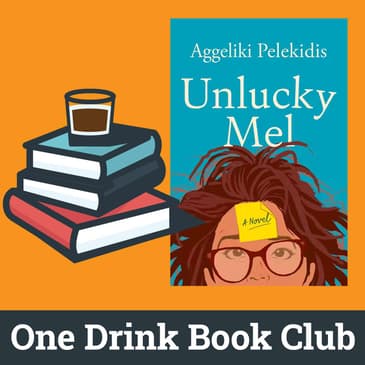
In this episode of the One Drink Book Club, Jamey discusses Unlucky Mel with author Aggeliki Pelekidis. The book follows Melody Hollings, a creative writing PhD candidate struggling to finish her book, deal with her aging father, maintain her personal life and get a job after graduation. As the title suggests—she suffers one set back after another in this humorous but anxiety-inducing story.
[00:00:08] Hello and welcome to another edition of the One Drink Book Club. Today we'll be discussing the novel Unlucky Mel. The book follows Melody Hollings, a creative writing PhD candidate struggling to finish her book, deal with her aging father, maintain her personal life, and get a job after graduation. As the title suggests, she suffers one setback after another in this humorous but anxiety-inducing story.
[00:00:31] My guest tonight is the author of Unlucky Mel, Angeliki Pelekidis. Did I say that right that time? Oh, so it's Aggeliki, but you can actually say it, Angeliiki. Angeliiki. I've been saying my name wrong for a long time because two gamas make a diphthong and you've got like an ng sound and I've been saying Aggeliki forever and then I was like, wait a minute, I think it could be Angeliiki too. So either way works.
[00:00:59] Excellent. Well, congratulations on the book. That's got to feel pretty amazing to have your baby kind of launch into the world, a first book. How has the reception been? It's been great. Like amazing. Like it's probably the most rewarding thing in addition to actually seeing the physical copy of the book is just when people get the book, their response to it is just so gratifying. Like it makes me so happy because it took me forever to do this.
[00:01:28] You know, I've been working on this book since I started it in like 2014 and it was accepted for publication, I think in around 2022 ish or something, you know, went through a lot of revisions before that and after that. So it took forever. So it's, it's super gratifying. And I'm just, I'm thrilled at the response it's gotten. I'm sure there's a combination of just getting it over the finish line is a big gratifying feeling, but then to actually get positive feedback and a lot of responses has got to feel great.
[00:01:57] Right. It sure does. Yeah. Especially since like the first book I ever wrote failed. So like this is my learning and changing how I do things and then succeeding. So like there was a lot of failure before this book. So to finally have something actually work is incredible. Oh, that's really interesting. What, what was the big difference between the two projects? What did you learn in your failed project?
[00:02:21] Plotting narrative arc. Yes. So, you know, I go through a PhD program. I love my PhD program. It was great, but we concentrated so much on characterization that I feel like we didn't.
[00:02:30] I don't know if I got as much out of, you know, how to actually plot a book. And so the first book I wrote started off as a short story that just meandered aimlessly. And when I, you know, I thought I was, oh, I was onto something. I had something amazing. And like my, the world was going to open up and agents went and like, you know, fight over me. And they were like, oh, thank you.
[00:02:53] No, not good. No narrative arc, no trajectory. And I was like, damn it. I don't know what the hell I'm doing. So I literally had to just start over and learn and like teach myself and like go through a whole process of reading craft books on plotting and then find books that I really appreciated the plot, how they, you know. Oh, sure. Ejectory of a character from beginning to end and say, okay, outline it, like reverse outline it. Say, oh, okay. So this is how it works. So I actually, I went from being one of those writers.
[00:03:21] That's like the seat of the pants type of writers that just goes and learned, well, that doesn't work for me. I'm, I'm, I like the logical progression. And so I'm more of an outliner now. And of course that doesn't mean like you have to rigidly adhere to an outline. You can deviate as it's appropriate or you want to, but I learned how to do that, how to outline a book. And then this is where this book came from. And so basically now that's who I am as a writer. I don't know if I will ever go back to just kind of the meander.
[00:03:51] It's not for me. Well, it's interesting. I mean, it's gotta be helpful for your brain to know where you're supposed to be going. And so even though it's working in the subconscious and getting there, but it's kind of funny that you, you've, you had to have that realization because I'm sure you've read thousands of books. And to, to not realize that kind of basic need for a narrative is kind of interesting, I guess.
[00:04:15] I think, I think it might have something to do with like programs that you go through, like the way books are, are studied when you're going through a creative writing program. And that's not true for all programs, but it might've been just the time when I was going through mine that the idea of plot, when it comes to like say literary fiction was not considered two things that go hand in hand, which is not true. Obviously that's, there's plenty of literary fiction that has, you know, these great moving plots.
[00:04:41] It's, it's, it was considered more of like a genre fiction type of thing. And then also there's the fact is like, I don't, I don't know if my book falls within actual, it's kind of upmarket fiction, I guess it's called with some literary tendencies, but it's not commercial. It's not, it really needed to have plot. Like it really needs to have movement.
[00:04:59] But yeah, you'd think that you would know that after reading so many books, but for some reason it just didn't strike me as something to think about in terms of the actual process of outlining. Like I could read a book and say, oh, look at how this plot is going. But then to actually say, well, this is how my book is going to start. Here's how it's going to end. And then here's all the middle and how we're going to get to that ending. That was something that I didn't have knowledge of the actual process of engaging in that type of outline.
[00:05:27] Was it more or less work once you kind of realized that was going to be the process?
[00:05:32] I think in a way more for me, um, because there was so much brainstorming and jotting things down and asking what if questions to develop scenes and putting them in order, rearranging them, um, thinking about characterization. Like there was a lot of stuff that was overlap. If I had done a meander, it would have, there would have been some stuff that was the same, but I think it was probably more work because I really had to think everything through.
[00:06:00] What's going to happen next. What's going to happen after that? Like what's, what's the logical progression that happens after this scene to the next. Right. So I think I would say it was a little bit more. Interesting. I've been on a little bit of a kick. I've read a number of like science fictiony fantasy things, which is not normally what I gravitate to, but I've had some people suggest stuff. And I feel like those you have to have outlined. Like you had to know where you were going, uh, or you would be, it would be just a complete mess.
[00:06:30] Right. And I love that stuff. Like that's my secondary literature that I like to read. Like I grew up reading that just as much as I grew up reading literary fiction and the classics because I was a complete Anglophile as a teenager. Oh yeah. You know, the Canon, all that. So I, you'd think having read all that too, I feel like outlining. Yes. That seems like a very wise idea, but no, no, I had to fail because failure is a good teacher if you let it be.
[00:06:58] Well, it is, but it's, it's hard to overcome too. I mean, it's, it can put up some serious blocks. So, uh, I give you double credit for, um, kind of going at it again and then realizing where, what you could learn from it. I am the most stubborn and persistent person. I don't, I honestly, I don't know if it's a Greek thing. Uh, you know, I'm not a big, like into horoscopes and stuff. It's Scorpia thing. I have no idea. I just, I, you know, I refuse to give up.
[00:07:25] Like I'm going to persist and learn and just keep going. And I, I have my lazy moments too, where I don't want to work on it at all. I'm writing, but I'm very persistent. So I don't think it was ever an option to quit. I knew I was going to, I was just going to move on to something else, like a different project and figure it out.
[00:07:41] Oh, good. It is the one drink book club. So I kind of teased you and said, I, I had found a cocktail that I thought was inspired by the book. And I actually found two. At first I was tempted by a New York sour because, uh, the book takes place in, in upstate New York.
[00:07:59] And Mel is pretty sour about lots of things in her life. So it seemed to fit. But then I realized, I think I've done a New York sour before and I don't really want to double up. So then I was trying to go for an unlucky drink to follow the title. And I came up with a, an unlucky martini, which is a martini with two olives. Oh, it's missing an olive.
[00:08:24] So yeah, apparently superstition is that an unlucky martini has two where a lucky martini or a regular martini has either one or three. Interesting. Interesting. That has to be an odd number. Apparently so, or it is a problematic. So in honor of Mel. And I also, there is the scene where she is at a professor's party and she over serves herself.
[00:08:49] And I completely remember her pouring a stiff glass of vodka in a wine glass. And so, um, I thought this would also follow. So I made sure it was a vodka martini, not a gin martini. I like it. That's awesome. I had one experience of drinking martinis and it was a difficult one. Um, I, there were too many coffee chocolate martinis. I think it was actually.
[00:09:13] Oh dear God. I still remember the hangover. My God. I always thought I could drink more than I could when I used to drink more when I was much younger. Now I have to admit, I don't, I don't drink as much. Um, but when I was younger, I seemed to think that I, I had much more of a tolerance than I did. I was delusional.
[00:09:29] Oh my God. The stupidity of it all in the world. I think back on like, you know, when I was like this little twerk, 20 something year old, I would drink, you know, kamikazes, not the sour mash ones. The ones with Rosie's lime juice that are like rocket fuel. Yeah. Drink those thinking, yes, that's an appropriate drink for me. Yeah. No, not wise at all.
[00:09:52] It actually took me till I was in my forties before I realized that if I go to a party and I have old fashions, I end up saying things I regret the next day. But if I stick to Miller light, I'm going to be pretty safe and feel fine the next day. But it, it was later in life that I realized that I should have realized it a lot sooner.
[00:10:14] I think it took me to like my early thirties. Then I was like, okay, I know, I know I'm a lightweight. I know I can't, I can't handle my alcohol very well. Um, and I have to admit in the summer, I love a Pimm's cup. It's going back to those damn anglophilic tendencies. I think up, there's this German beer. That's this, uh, grapefruit beer. I can't remember what it's called. Graveler.
[00:10:36] No, it's not that one. It's with an S something S C H something or other. And it is so refreshing because I'm out in my yard. I'm a big gardener. And that one during the summer is like perfect. I love ginger liqueur. Hanton the domain and, uh, with like anything, basically that's amazing. So I tend to do like those types of lighter drinks that are not super strong nowadays.
[00:10:59] Yeah. Those are good. And that's, those are all good for gardening. Uh, that and a gin and tonic. I always feel to go to your, uh, angle file tendencies. I thought about for this, I thought about a Zelda Fitzgerald. Ooh, what's in a Zelda Fitzgerald? If I remember correctly, it's something like gin, honey, lemon juice, something like that. So it's, it sounded kind of light. Almost like a bee's knees.
[00:11:24] Yes. And, um, I, you know, I thought about because of who, what her background was with like, um, F Scott Fitzgerald kind of dominating and health issues. So I was like, you know, that would be interesting. But then I looked more into her background. Oh, she did not. Her family was like KKK people. Oh, really? Yes. Southern bell type that I was like, interesting. Maybe that would not be a good choice. She should be left.
[00:11:50] You know, I feel bad for what she went through mentally, but, uh, maybe, maybe not. I have to say that your, your book did not make me want to go to grad school. Um, it did this track pretty closely to your experience. It did not. Oh, it did not. Okay. That's good. I always have to remind people, like, I don't know. It's such a weird phenomenon. Like a lot of people get it. Cause they, they know me, especially like, you know, Greek.
[00:12:17] Greek background, parents, immigrants, born in Brooklyn, moved around a lot. Mel, very different. My, my PhD situation was very different than Mel's. Like I, I, my professors in the English lit side were great. They would allow you to do both literary criticism as well as short stories quite often. There wasn't a lot of faculty that was creative writing at Binghamton at the time. There was a bit of a shortage. There was like a, you know, crisis in the humanities at that point when I was in grad school, but they were wonderful, supportive, helpful.
[00:12:47] Um, I, I did not have the same experience as Mel, but I did, I was in graduate school. So, I mean, I could see how it could go awry. I, I could see how there were issues when it comes to labor and gender. And, you know, the Vita count was happening around the time so that we, you know, you can see how frequently women's books were being reviewed compared to men's, how much women's stories and writing was being published compared to men's. And there was a disparity there. So that was on my mind as well.
[00:13:16] So yeah, my experience was, I have to say, I'm lucky. It was very different than Mel's. Well, that's good. Have you gotten feedback from readers who said, ah, I really identified with this. I've always thought that the academic world, the world of like healthcare too, there's a lot of egos, you know, when you're talking about a hospital and whether it's administrative or doctors or surgeons, et cetera, it's a lot of educated people in both situations. And it, you create these fiefdoms, uh, that could be very toxic.
[00:13:47] And don't forget to an academia. Sometimes you have people who they've literally gone through school their entire lives. They've never worked in any other type of environment. Like I worked in public relations in New York city for 10 years before I went back to graduate school. So I knew a nine to five, I knew a very demanding job. I climbed that firm and then nonprofit ladder. Um, and so when I went to grad school, graduate school was, it was kind of a lot of easy. Cause like I already had like nine to five, 365 days a year.
[00:14:16] Well, not quite because you have vacation days, but in academia, you have people who are like high school, bachelor's, master's PhD. Like they've never worked in any other environment. And honestly, um, they're a little strange sometimes like plenty of them aren't, but even perfectly normal, but some just don't have that same type of, I don't, I don't know. They're professional in different ways. It suits their environment. But in some ways there maybe could have benefited from working in different environments as well.
[00:14:42] I've hired a lot of graphic designers through the years and especially ones that have come out of school. It is a real jolt to them when you say I need a logo or I need a, you know, whatever, a design of something, a brochure, whatever it is. And I need it in like eight hours. And they're so used to having half a semester or two weeks to come up with 18 different comps and have brainstorms about it. And I, you know, like nobody's going to pay for that. You gotta, we gotta get this done right now. Yeah, exactly.
[00:15:12] It's just a very different environment. The pace is different. Who you interact with, because I think maybe in academia too, you're interacting with people who are very similar to you so often. To this day, there still isn't a ton of diversity as much as there should be. A lot of workplace environments, it depends upon the industry. I suppose you're going to have a lot of different personalities that you work with. Like when I worked at the New York Aquarium, I was working with the groundskeepers. I'm working with the maintenance people. I'm working with the trainers. I'm working with the keepers.
[00:15:40] I'm working with the scientists and the researchers. It's such a disparate group of people. Sure. You become very adaptable, I think, or maybe you go into it already being a little adaptable because you have to work with so many different types of people in different professions. That particular environment is also interesting because there are some quirky folks in the animal care space. I was on the board at the National Aquarium, both in D.C. and Baltimore for several years.
[00:16:09] And they were great people and really interesting to work with. But you're right. You had dolphin trainers and science people as well as the marketing people and the PR people and the operations guy. And, you know, it's a big job to try to manage that many different people. So a lot of characters in your book, you know, Mel is kind of against the world in some ways.
[00:16:33] She has some people that she either can't get to pay attention to her, whether it's a different professor. She has her frenemy, Ben, who is her good friend. But she realizes somewhere along the line that Ben is giving nothing back to the relationship and she is the only one giving. You touch on some of those inequalities, especially from a female male standpoint, that male authors are given more credit and things like that. And which I thought was was interesting.
[00:17:02] And it was also interesting when I was researching the cocktails. I looked up favorite author cocktails and I think all of them were male authors, which I thought, oh, this kind of tracks with what she's saying. But I almost didn't feel like Ben in particular was necessarily sexist other than more than he was just a big jerk. Yeah, I think he's very self-involved. Yeah. I think he has he crosses over at times like he has that one moment where he says to her, you're funny for a woman.
[00:17:32] So like his sense of what's humorous. And at the time, too, you know, when when I first started writing this book and also like at the time when the book takes place, there was so much discussion about like, oh, there's not any funny women. And it was like, OK, sure. Sure, there are. You just don't know them like your palate. I think the palate for humor sometimes because there was at the time it was dominated by male comics, funny male writers.
[00:17:56] The palate becomes so used to that, that when you're exposed to female comedians and female writers who are funny, it doesn't resonate with you as maybe a man because you're so used to one version of humor. And that thankfully has changed quite a bit. Like, I really thank the Amy Poehler's Tina Fey's and, you know, all these other women writers that have just done such a great job of saying, oh, that's nonsense. Women are hilarious. Oh, absolutely.
[00:18:26] And I think everyone you just named smart and funny. And speaking of that, I thought your book was very funny. I mean, I thought it was very humorous, both in your turns of phrase as well as some of the situations that you that you talk about. Did you find it hard to be funny on the page versus funny in person? Those are almost in some ways there. They can be different. I don't know that every funny person I know could write something that was funny.
[00:18:54] And I've known some people who are humorous writers, but aren't necessarily ha ha funny in person. And so how did how did you figure out how to be funny on the page? First of all, I learned something about myself. I realized I have been telling stories to make people laugh since childhood. Like, that's how I became friends with people. If I could crack them up, I had them in my power. Like, this was the control that I could exert. And then I think it was a process of learning.
[00:19:23] It was a lot of work to learn to take that humor in real life and put it on the page. But it was also studying funny writers. The book is also inspired by Kingsley Amos' Lucky Jim. When I found that, but every now and then, a lot of people probably experience this as readers. But every now and then, you know, when you encounter a book and you're like, Oh, my God, where have you been all my life? Like, holy crap, how did I not read you? Like, so many books, right? And years and years ago, that's what happened.
[00:19:52] I came across, I don't know who gave it to me, Lucky Jim. And I was like, Oh, my God, I'm dying here. And of course, that kind of fed into my Anglophilic tendencies. I'm better now with that. Like, grad school made me much more diverse in my reading. But at the time, so what I would do is literally write out some of his sentences. Write out the comedy moments. By case, yes. Like literally paragraphs at a time to get a sense of like, how is he doing?
[00:20:19] Like it turns a phrase that this changes in the sentences, the inner thoughts, the, you know, scenarios that he finds himself in. And that book taught me so much about humor writing. And like other writers as well, like George Saunders. When I first came upon George Saunders, when I first started graduate school, I was like, Oh, my God, are you kidding me? Because George Saunders does something that I absolutely adore. And that with him, it's like it's a blend of humor and pathos, right?
[00:20:46] Like there's such deep compassion for even his most absurd characters. But that doesn't stop him from putting them through hell. I absolutely adored that. And then Amy Bender was another one back in the day that I really enjoyed. And Laurie Moore. Like I would study these writers. I would write out things that they've written and like really pay attention to how their sentences and paragraphs were put together so that I could learn to take the humor that was in my head and put it into words on the page.
[00:21:11] Yeah, I feel like you have to be so much more precise than you have to be telling a verbal story because you get other cheats. You get to use your hands. You get to use voices or intonation. And it's harder. You've got punctuation. You've got word choice. But I really am impressed with anybody who can be funny in print when I think it's that much more difficult. I enjoy it. I mean, I wrote it to make myself laugh.
[00:21:39] Like if I couldn't make myself laugh, I was cracking up. Like I can still read parts of the book and crack up over it. That's what I wanted. I wanted that type of like it would be surprising. I was hoping to achieve that. I could create these lines and these scenarios and everything like that where people would be like, oh, my God, that's absurd, you know, and just literally laugh out loud. Like because I was going to make myself laugh out loud. So if I could make myself laugh, then I think, you know, OK, hopefully I can get the reader to follow along also. Sure.
[00:22:08] Well, one of the things Mel, as the main character does for those listening or watching, she often goes into these kind of like imaginary sequences in her head. So she'll be daydreaming or something will happen. And she kind of goes to this imaginary place and has a scenario that occurs that's usually very funny. And what I kept picturing in my head was the episodes of Ally McBeal or in Scrubs where somebody would say something and would spark this thought and they would go into this whole separate place.
[00:22:37] But they're very funny and they're very descriptive, which is is fun. Yeah, it's very. I mean, if we think back to like, what is it, the secret life of Walter Mitty? I feel. Yeah, exactly. That was the start of doing that. Maybe there was something before that, but that was kind of the start. And I feel like it's just a writerly tendency. So it was appropriate for Mel. But my mom used to do that. My mom was not a writer. She's this little Greek lady, very loud little Greek lady, immigrant woman, just big heart, but just could be a little obnoxious at times.
[00:23:06] And she had the most amazing imagination. The scenarios that she would generate, you'd be like, where is this coming from? You know, because she wasn't a really big reader. So it's kind of a combination of like, it's a writerly trait that Mel would have after she's a reader, right? She's been a reader. She's been very alone a lot of her life because of having a single father as her sole parent. So she retreats into books and that's developing her imagination.
[00:23:29] But I also think it's just, it's just sometimes a personality trait that people have that they just come up with these scenarios. Yeah, there's a certain type of person that likes doing that and has a tendency to do that. My daughter is a big fan of creating these whole storylines of people. If she sees in a restaurant, somebody sitting across the way, she will come up with an entire backstory for why they're there and who they're waiting for and what happened that day. And it's, it's fun to listen to.
[00:23:57] So one of the other big parts of unlucky Mel is Mel's relationship with her father, which you just referenced. And her father is going through the early stages of dementia. He is kind of depressed over the, the death of Mel's mother. Where did, where did that character come from? And how did you add that to Mel's life and her unluckiness? I think there's a couple of different things happening there.
[00:24:24] My father-in-law who passed away, there's a, like maybe a touch of him to the sort of briskness that Colin has just occasionally. Right. Just a little bit there. There's also the, the idea of how the patriarchy can be benign in its negative impact. Sure. Which is neediness and codependency. Right? So there was an element of that. So I needed to create a father. And then the fact that there is no female figure to help Mel out.
[00:24:50] The reason why she cares for Ben the way she does is because she learned to care for her father and be a sort of parent to her father. And so I think a lot of responsibility is placed upon her. So I had to, I really had to think about her backstory and then that helped me figure out who Colin would be as well. To create this relationship that would then lead to how she would kind of be flattered and fall for how Ben is. And so that was a couple of different things that were going on with creating Colin. And I'm just, I'm, you know, he cracks me up too.
[00:25:20] Like, and also just like, it is really sad the way dementia progresses. And it starts off with little things, little clues, and then it kind of escalates. You know, the way he, he gets more sort of obnoxious with women. It's an interesting thing that happens. It's really tragic. And so there was a part of that that I wanted to kind of throw in there too, and the way that women quite often end up being the caregivers for their elderly parents and the impact that has on their professional aspirations or their creative aspirations as well.
[00:25:50] Sure. Mel, you know, kept having to put everything on hold for, for her dad. And I think a lot of people can relate to that who have elderly parents, but you're right. Oftentimes it's the females and families that end up being the main caregiver on that. But it was Mel throughout the book kind of, I kept thinking to myself, geez, don't make that decision. Make this decision. And I think, you know, clearly you kind of did that on purpose. And she was very good hearted about it.
[00:26:18] It wasn't that she was intending to do things poorly or, or make those bad decisions. But was it hard for you to keep putting her in situations where you knew the reader was going to say, oh, don't go. You know, it's like, don't go in that room. Everybody knows that that's the bad room to go in. Yeah, no, it was not at all. Like I told her to put her through hell because I think it makes sense for her background. Like she's here's somebody who they went into a profession because their father thought, oh, this is a good idea. You'll find a job. They're very sheltered.
[00:26:47] They've lived in the same town their entire life. She's very naive and she's from a little tiny town. And here's this like big city slicker with a great publishing and like degrees. And he flatters her like she feels very special that he has bestowed his friendship on her. And so she's very vulnerable to that because of her background. So that's very different than me. Like this is where people are like, oh, it's not like you. I'm like, oh, my God, I would have never. You're not doing that to me, you know.
[00:27:15] So I didn't have a problem having her go through these things because I feel like it made sense given her background that she would make bad decisions because she doesn't have a lot of experience. Sure. One of the things in that relationship with Ben, Mel spent a lot of time editing Ben's book and then he did not return the favor and kept procrastinating helping her out. And when he did give her any feedback, it was superfluous.
[00:27:43] It clearly he did not put any time or effort and it was kind of demeaning and not helpful at all. Who is the person that helped you with Unlucky Mel and editing that? Did you have a good experience? I assume it was a good experience. I had I think it was at least three different people. My one of my two of my professors actually were super helpful. Jamie Wriston Colbert and Jack Vernon. And then I also had beta readers who were in the program with me.
[00:28:11] Olivia Chada, Barrett Bowling, Catherine Henyon. Like so five separate people right there were really helpful to just seeing different versions of it and helping me revise it over time. And then when it finally piqued the interest of the editor at Cornell University Press, where it was published, Jennifer Saverin Kelly, she was tremendous. It was a pain in the neck. I'm not going to lie. Like, oh, my God, can we be done with this revision already? We went through like two or three rounds of revision.
[00:28:39] But she really maintained my vision for the book while also helping me improve it. You know, it takes a village for real like to really write a book. Like if you're going at it by yourself, I feel sorry for you. Find those beta readers if you can, because they were all tremendous in helping me develop this book. Were you more willing to take feedback on the second project versus your first book? Did that change at all? No, not at all. Like I'll never forget this.
[00:29:06] One of the biggest compliments that my professor Jack Vernon said is that I'm incredibly teachable. I don't have ego when it comes to my writing. All I want is for the writing to be better. So even though like sometimes I'm like, oh, not again, like and I dread the work. As long as I have a sense that, you know, you're you're helping me and it's progressing. I will pay attention to anything that you say. The relationship I had with my editor at Cornell, Jennifer, was incredible because she would literally say, hey, can you do this? Can you? OK, sure. Let me think of something. I'll figure it out.
[00:29:36] Like your imagination is a muscle. And the more you use it, the more you can invent stuff, like the more creative you can be. Like so it was very cool. Like just get OK, can I we need something more here. We need to fix this here. OK, can you do this? Later, I'll figure something out. And like I was stunned even in like the final revision stage, the major revisions that we did before, like we got to line editing that I was still able to invent stuff. And I hadn't thought of it before. I'd be like, oh, my God, look at you. That's funny. Yes. Put that in.
[00:30:05] And like it's just you have to work at it. You work at it. It's amazing what your brain will create. You have to have faith in it. I totally agree. And that's one of the things I worry about with the increase in A.I. I think the laziness that it will encourage where you don't have to spend time thinking of things. I'll just put in a prompt and it will think of an idea, a creative idea for me, because I totally agree with you. And you do have to have faith that the idea will come. Yeah, especially if you work at it.
[00:30:34] Like I have to say, like, I don't really get writer's block because to me, when I'm kind of like meh or not go read. I'll find some prompts, see what happens. Like it doesn't have to be good. Just get something out there. I think some of writer's block is everybody gets that where you can't think of some brilliant idea or some creative idea. But it's when you don't have the confidence that it will come. That's when it really is paralyzing. Yeah, I guess that's, you know, I'm fortunate in that I've been a reader since child.
[00:31:03] Like reading was my thing from seven years old. I loved reading. And so your brain, I mean, it's got to be like on a on a cellular level is shaped by that. Your imagination, like that's why your daughter can like see people in a restaurant and come up with that. That imagination is something if you develop it over the course of your life and you continue feeding it and allowing yourself to make connections and like daydream. Oh, my God. Daydreaming is so important. You will come up with stuff. It'll happen. Right.
[00:31:31] Like you said, you'll have that faith, but you do have to also put the work in of feeding that. Just a little spoiler alert, because I'm going to talk about sort of the final stages of the book where Mel figures out that in her father's house where she is moved back in to kind of help take care of him. Part of that caregiver role figures out that there's a bunch of paint thinner and old chemicals and sludge, essentially toxic sludge in the basement next to the furnace.
[00:32:00] And she realizes that they've been literally living in a toxic environment, which is also akin to her Ph.D. program, which was also a toxic environment. And so there's this nice symbolism of getting rid of that toxic environment and kind of breathing some fresh air in everybody. It doesn't erase all the problems, but it makes it a lot easier to tackle those things.
[00:32:24] I thought that was a really creative way to get to the end and kind of get to some resolution for Mel and give Mel a little bit of luck there. Yeah, Jennifer and I had a back and forth on that where I was a little stubborn at points because there is something that can happen to your brain when you're breathing in this stuff consistently that can mimic certain things that are similar to dementia. So in the very early stages of the book, I wanted it to be that it was that was causing the problem. And Jennifer was like, no.
[00:32:53] So I have to really pull that back. And that was a big revision thing where it was just like hints of that. And it was more in line with just the fact that he's a hoarder. That's where he would keep stuff more so than like that's causing the problem. As a reader who wanted him to be better and then have him be able to take care of himself and kind of have a happy ending. I wanted it to be completely the reason. That's interesting. See, Jennifer, you were wrong. Should have left it alone.
[00:33:22] It wouldn't have hurt to have Colin be better at the end. I mean, come on. Why not? Well, what is next for you? What's on your to-do list? What are you thinking about now? I actually finally said, now that I think I know a little something about plotting, I'm going to go back to that failure book, take it all apart, figure out a trajectory for the three characters. It's about three different characters and work on that. I'm trying to get that done this summer. So a full revision.
[00:33:50] And I have a short story collection that I should probably submit more and see if something can happen with that. And so that's what I'm doing right now. I actually, for the longest time, once I started, I got back into novels. I started off with short stories. And once I got into writing novels, I was like, I will never write a short story again. I'm done. No more. And then this couple months ago, I joined a writing group and they all workshopped like shorter pieces. And I was like, let me go back and see if I have anything to workshop.
[00:34:19] And strangely enough, like I found these two pieces. One was like about two thirds of the way done. I finished it. I was like, I know what I want to do with this. I know. Oh, my God. It's a story. And then another one. And I just had like the first paragraph, but it had a voice. And I was like, I know what to do with this. And I finished that, too. So obviously, I don't know what I'm talking about. Short stories are fine. I'm still going to write them. So I'll probably keep doing that here and there and dabbling as things occur to me. But the main thing is like the novel. I want to really figure this out. Like, again, that goes back to my stubbornness.
[00:34:49] Like, sure. I know there's good stuff in that novel, even though it failed. I know that, like, even though like no agent wanted it, no publisher wanted it. I know there are components that if I can put them together in the right way and rewrite things, get rid of stuff, I can have something. So I'm going to stubbornly get that done this summer. That's my goal. Well, it sounds like you've laid out a pretty ambitious schedule for the summer. I'm way too ambitious. I have, like, I will literally work myself. I'm ridiculous sometimes.
[00:35:19] Like, I have to learn to like rest. Today I rested. I have to force myself. I'm a workaholic and it's not good. It's, it's a, you know, I'm trying to renounce my membership to the cult of productivity. It's not healthy. Like, legit is not healthy to be like that. And I think it, I don't know, maybe it's an immigrant thing. Like, I think I grew up with my parents being like that because, you know, here they came here and they had to work really hard to create a life for themselves. They didn't really have the same resources. And so I learned that from them.
[00:35:47] But, you know, I'm in a slightly different position and I can, I can actually rest some. Like, hey, how about that? Like, relax a little, you know? I have anxiety if I'm relaxing. So, you know, and so there's, there's some kind of happy medium in there. It really is. Like for me, like the most fulfilling thing is accomplishment. Yeah. And it actually speaks to something that's not necessarily entirely healthy, where I had a very strict great father who expected a lot for me.
[00:36:15] If you didn't achieve, you got the wrath, right? Or the science treatment. And so that is something to combat to a certain extent. When, if you're, if too much of your sense of self-worth stems from accomplishment, then what happens when you just have downtime and you're not really accomplishing anything? Now you have no self-worth. Again, like you said, happy medium. It's got to be a balance where you can actually give yourself a break sometime and feel like I'm good enough as I am. I think you're right. Although you can have different definitions of accomplishment.
[00:36:44] So if you, you like to read, obviously. So an accomplishment could be, you know, finishing a book, even though that that's not necessarily stressful or difficult. You know, I like to fish and if I catch a fish, I feel accomplishment. You know, that's a good point. Like, cause those can be viewed as accomplishments, even though like in my mind it's clay. So that doesn't count, but it really should. Sure. If I go and read in the garden, that's, I've accomplished something.
[00:37:12] It doesn't have to be like, now I have to work five hours growing vegetables. Yeah. A failure, you know? Yeah. I mean, obviously you need to weed your garden and you need to water it and all that stuff, but I find all that kind of stuff relaxing as well, but it does give me a sense of accomplishment. Well, thank you so much for taking the time, especially on your day of rest to come on and talk about your book. Thank you for having me. What a great interview. I loved your questions.
[00:37:38] Well, I, like I said, this is, this is a hobby, but something I really enjoy doing as well. So I get a sense of accomplishment, even though, even though it's just fun, kind of fun. No, absolutely. It was a lot of fun. I appreciate it. All right. I look forward to your next project and, um, reading what you, whether it's a short story or a novel. Well, let's hope. Cross your faith. And another one out there. It can only be a one book person. I got to have more. See, there it is. There it goes. There it goes.
[00:38:08] The ambition. Well, if you're listening to the show, please remember to subscribe. And, uh, I always appreciate reviews or feedback. Uh, go to onedrinkbookclub.com. Thank you very much.