
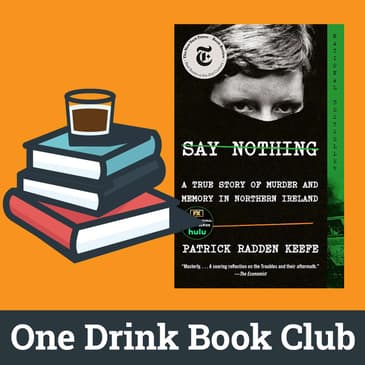
In this episode, Jamey discusses Say Nothing by Patrick Radden Keefe. The book is the true story of a murder that happened in Northern Ireland in 1972. But the book is about more than a single murder—it gives a detailed and gritty look at the IRA and The Troubles in Northern Ireland. Jamey's guest is Peter Blumberg, a good friend who always enjoys a good book and a cocktail.
[00:00:00] Hello and welcome to another edition of the One Drink Book Club. We're going to be talking about Say Nothing by Patrick Radden Keefe. Say Nothing is the true story of a murder that happened in Northern Ireland in 1972. But the book is about more than just a single murder. It gives a detailed and gritty look at the IRA and the troubles in Northern Ireland.
[00:00:29] And tonight my guest is Peter Blumberg, a friend who always enjoys a good book and definitely enjoys a good cocktail. Welcome, Peter. Thank you. Happy to be here.
[00:00:39] You made the suggestion for this book and it's super interesting. I really enjoy nonfiction. And I didn't know really, I mean, I knew about issues in Northern Ireland and knew about the troubles, but I really had no kind of in-depth knowledge. Did you know about it or was this book a real first look for you?
[00:01:01] For me, I've always enjoyed history books and I've read a lot of history books about the World Wars, the American Revolutionary War and the American Civil War. So in part, I was interested in the book just to kind of spread it around and learn about something else.
[00:01:13] I would also say that this story, in my opinion, is a bit underreported, you could say, because of what we might talk about later about the code of silence that was sort of imposed upon the people involved. And so not that much was really said about it, in my opinion.
[00:01:31] And that's why I decided to pick it up. I suppose one other factor that makes me interested in the book is that my personal ethnic background is Latvian, which is a small country in Eastern Europe on the Baltic Sea. And the Latvians have always been oppressed by others, including the Russians, the Soviets, but also the Germans and the Swedes. And so, you know, there was a little bit of a connection maybe for me with the plight of the Irish and the Catholics in Northern Ireland.
[00:02:01] Of anybody I know, I think you've spent more time in Europe and are more immersed in European politics than anybody else I know. And so it actually kind of surprises me that you were coming at this kind of from the same perspective that you didn't know a whole lot about it. But your point about the code of silence, the whole book's name is say nothing, kind of lends itself to that, which makes sense. And it was a civil war. And if nobody is talking about it, it kind of makes sense that we don't know a whole lot.
[00:02:27] Yeah, I think it's that. Although people who grew up in the 70s, I mean, we remember some of these things. I still very well remember when Lord Mountbatten's boat was blown up and he was the cousin of the Queen, Queen Elizabeth. And he was supposedly Prince Charles's favorite uncle. And, you know, it was just crazy that things were happening like this. And similarly, you know, you referenced that it was like that it was basically a civil war.
[00:02:52] And, you know, this brother upon brother fighting just seemed so foreign to me and I think to us as Americans. I mean, we, of course, had our own American civil war, but that was a century and a half ago. Although, you know, I have to say, you know, we've now it does sort of feel like we're a bit of a divided country again. And, you know, so hopefully we can resolve our differences and not resort to anything bigger than just debating.
[00:03:21] Agreed. Also, as I said, you're probably one of my friends who has been to Europe or spends more time in Europe than anyone else. I know. But you also are probably the premier cocktail maker that I know. Besides yourself. Besides myself. So I'm curious what you made for tonight. Yeah, well, I just took a sip of my drink. So that must have been the cue for you to ask this question.
[00:03:45] But, yeah, the drink I paired with this book is inspired by a Belfast bar located, actually, though, in New York City. And the bar is called the Dead Rabbit. And it was founded a couple of years ago by two Belfast Irishmen. They're actually Irish Catholics. I had double checked on that. And it's become one of the most famous bars in the United States. It's won multiple awards.
[00:04:09] The name, the Dead Rabbit, the name of the bar is named in honor of one of the original gangs of New York that has been portrayed in movies. And the bar is actually located in lower Manhattan, not far from the heart of Wall Street, in the area that used to be called the Four Points, where the gangs of New York used to rule. So the particular drink that I made tonight has been on their menu for many years. I had it just last summer when I was visiting there. And the drink is called Doctor's Orders.
[00:04:38] I'm not really sure what that exactly means. But I would loosely compare it to a whiskey sour in that it has about half of it is just spirit, Irish whiskey and bourbon. And then the other half is citrus. So it has lime juice and grapefruit juice and simple syrup. But it's an elevated cocktail because it has other elements. The simple syrup is actually infused with, I infused it with cinnamon. And then also I use this allspice liqueur as well. That's all part of the recipe.
[00:05:07] So it's a, you know, it's a kind of a cinnamony fall-like whiskey sour, I would say. Ooh, that sounds really good. And I am impressed that you have an allspice liqueur. I have never heard of an allspice liqueur. Yeah, I forget the brand. But, you know, you can buy it at liquor stores. So clearly the Irish Car Bomb was like a, you know, pretty obvious choice for this book. But I decided that that would be almost too obvious.
[00:05:34] So I did a little research and there is a drink that's very much based on a Negroni called a Belfast Bastard. So that's what I made tonight. Or actually I ordered. I am in a hotel room in Boca Raton right now. And it has two ounces of gin, a half ounce of dry vermouth, a half ounce of Campari. So that's like your basic Negroni.
[00:05:58] But the difference is that it has a little bit of pamplemousse liqueur inside with a couple of dashes of orange bitters. So that's what makes it a little different. And I really like to say the word pamplemousse because I think that's a fun French word. Sounds great. Yes. I love a good Negroni. And yeah, it's such a straightforward drink in that you just need three ingredients and kind of evenly dispersed.
[00:06:24] But because of that simple canvas, you can kind of upgrade it with interesting things like pamplemousse. So, yeah, sounds good. So in the book, Say Nothing, it starts out with the murder or disappearance of Gene McConville. And the author uses this kidnapping slash murder to kind of give you a storyline and people to look at.
[00:06:51] But it really is about a lot more. It kind of starts in 1968. It goes through the mid 70s and then it picks up again and it reintroduces some of these characters in more recent years. But did you find kind of the story arc of the Gene McConville disappearance a good way to kind of look at the issue of the troubles overall? Not only would I say it was an effective device, I would dare say that it's probably the book's claim to fame.
[00:07:21] Because it sort of takes a traditional history book model, in this case, a book trying to teach us about the troubles, but uses elements of a mystery whodunit as well as maybe a true crime genre book to propel the story along. And I'd read the book initially about four years ago or three years ago, whenever it came out and reread it in preparation for tonight.
[00:07:44] And I had forgotten that there was at the end of the book of the book kind of a surprise reveal about whodunit, who what happened to Gene McConville and and who was the trigger person. You learn a lot about the troubles, about something maybe a lot of us never really knew about, but you had the very intriguing storyline. And also you had talked about that.
[00:08:08] I mean, this Gene McConville woman story was a real tragedy because she was a mother of 10 children. She was a widow. She lived in basically tenement housing and, as you said, was kidnapped basically in, I think, in broad daylight in front of her neighbors and no one did anything about it. And it's just really sad. You're right that that happened in broad daylight. Everyone knew what happened. Everyone saw it.
[00:08:36] No one said anything goes to what you were mentioning with this code of silence. But it was interesting to me to see all the players in this conflict. You had the Protestant paramilitary people. You had the Irish paramilitary people in the IRA. But then the IRA was split between the more aggressive IRA, the provos, and the stickies, who were like the more traditional IRA.
[00:09:01] And then on top of that, you had Britain sending in the army, which was supposed to be a neutral peace force. But they were clearly more siding with the folks who were the Protestants. And so it was crazy to me. At one point, they were talking about one character and he was attacked and he wasn't sure who was attacking him. He didn't know if it was the British.
[00:09:26] He was a provo IRA, but he didn't know if it was the regular IRA who was after him or if it was the paramilitaries on the Protestant side. I mean, talk about not feeling safe. I mean, here you had a society of 300,000 people in Belfast and absolutely no one felt safe. That was crazy to me. Yeah. I mean, you didn't, I don't think you mentioned also the Belfast police. You know, there was just the local police that were also primarily Protestants and oppressing the Catholics.
[00:09:56] So, and then also just the people themselves, because one of the stories about, one of the things about Jean McConville was that, and this is possibly why she had such a tragic life. Unfortunately, she was a Protestant who married a Catholic. So she was living, when they first got married, they were in a Protestant neighborhood. And because her husband was Catholic, they were sort of literally like bullied out of the area by their neighbors who didn't like the fact that a Catholic was living in their area. And then they moved to a Catholic area.
[00:10:25] And, you know, that may have contributed to how she became disappeared because people didn't care for a Protestant living in their neighborhood. To your point, it feels so foreign to an American audience that you would have these religious divisions so heavily, you know, in there that where you literally have barricades in front of Catholic neighborhoods, in Protestant neighborhoods, and you have almost like your own police force.
[00:10:52] And they literally built walls in between these neighborhoods to keep these people from killing each other. I mean, it's crazy to me. The book explores this a little bit, and there's a lot more history on it. But it wasn't necessarily a religious war either, because what was underpinning a lot of it was that Northern Ireland, as I think most of the – anyone who's listening to this probably knows, that Northern Ireland is technically part of the UK, that it's not part of Ireland.
[00:11:19] But, you know, there were – the Catholics wanted to unite Northern Ireland and the Republic of Ireland, the rest of Ireland into one country. And there were others who liked being part of the UK and just thought that that gave advantages to the country to be associated, to be part of the kingdom with Wales and Scotland. And they just sort of saw some kind of kinship there. So a lot of moving parts to the conflict, really.
[00:11:44] Well, the author mentions at one point that because of this bizarre situation, that both the Catholics and the Protestants in Northern Ireland felt like minorities. Because the Catholics in Northern Ireland were the minority, numbers-wise. They were – they had half the number of people that the Protestants did.
[00:12:03] But the Protestants were so concerned that if Northern Ireland became part of Ireland, that those Protestants living in Northern Ireland would then become the super minority, because most of Ireland was Catholic. And so here you had a unique situation where both groups felt like threatened as minorities. Yeah, no, good point. Very unique situation.
[00:12:33] Those were those into a lot of the people who were key combatants in the IRA. And as you started to listen to them and you heard about the Protestant abuses and the British abuses, it was easy to kind of get sucked into this kind of romantic Robin Hood impression of the IRA. I thought, you know, these people were oppressed. They were fighting back. There were clearly some incidents where they were wronged.
[00:13:00] And you thought to yourself, well, yeah, they're justified and kind of taking up arms and fighting back. But then as you got more into the book, I felt like, geez, they're really off the rails. There's not a lot of morality here. And at the end of the story, I wasn't quite sure who was a good guy and who was a bad guy. Where did you fall at the end of the book after you've kind of seen it all? Yeah, well, it definitely was.
[00:13:29] It's a complex situation. And, you know, yeah, I suppose most people would land in the middle, but a force to pick a side. So I suppose maybe this is why in the introduction I tried to point out my own ethnic background. But coming from people who have been oppressed, I suppose I identified with the resistance to a degree. And in this case, that would be the Catholics who were being oppressed by the British troops and the Belfast police.
[00:13:59] And I think another thing that is, you know, an element here that we have not touched on is that at this time, there was still this basically centuries old caste system in play where Belfast Catholics were not eligible or could not get elected to public office. They were not given government jobs. They really even couldn't get a proper education. They were just kind of shunted towards working class jobs or really even pressured to emigrate.
[00:14:27] A lot of Northern Irish Catholics left for places like the United States because they just didn't feel welcome in the country. So, you know, they it was not really a fair system. You had mentioned, Jamie, that I have traveled in Europe quite a bit. I was in Dublin a couple of years ago touring the city and in the heart of Dublin is Trinity University, which is a lovely has a lovely campus and has Gothic architecture and big church spires.
[00:14:55] And I was talking to my hosts and saying, oh, so this is like the Harvard of Ireland. This is where all your best and brightest go. And they're like, well, no, I mean, for the longest for centuries, it was only for the British. The Irish could not go there. Only, you know, occupier British sent their kids there and the Irish were not welcome. And that just seemed like a crazy thing to me. Imagine I mean, you and I both live in the D.C. area.
[00:15:23] Imagine if Georgetown University, which also sort of towers a little bit, you could say over or the Potomac and we can see its beautiful spires and buildings. Imagine if Americans couldn't attend Georgetown. It was only for the Brits who are here. You know, that would be a crazy thing. But that's how you know. So so I guess to answer your question, I lean Catholics here, even by myself. I'm not Catholic. I'm Lutheran.
[00:15:51] Well, you know, the one thing that that struck me beyond the paramilitary violence was how egregious the British troops were in terms of kind of lawlessness. I mean, this was this is not like 1930s or 1920s or the 1800s. This is in 1970s.
[00:16:13] And they had an entire division or entire subgroup of the British Army that was in Northern Ireland that was assassinating people. Talk about not following the rule of law. It really was interesting to me, both from a arresting people, torturing people and interrogating them, but also just flat out assassinating people. Yeah, no, a lot of a lot of terrible things.
[00:16:42] The chief constable or whoever was in charge of the of the British Army, he actually had. We have to remember that this was still kind of the remnants of colonial England. So a lot of these people had been in Britain's African colonies and then other places that you might call the third world. And they had developed these brutal techniques to dealing with their colonists in those places. And they deployed a lot of those techniques on the Irish.
[00:17:11] So because it's, you know, their playbook, I guess you could say. Nevertheless, it's for sure that, as you said at the start, the Catholics were also responsible for a lot of things, including the murder of the central character, Gene McConville, who I think. And hopefully this isn't a spoiler, but it seems like at the end there, it's certainly seems like they may have made a mistake in thinking that she I think they thought she was a police informant. And now it looks like she probably wasn't.
[00:17:40] And she was the whole like this whole business about the disappear disappearing people. There is used as a noun. Part of it was that, you know, in the book anyway, that they actually felt shame. They knew that what they were doing was not really right. So they would just bury people in peat bogs along the Irish coast where they would never be found again. And then they could like, you know, tell their supporters like, oh, maybe the person just emigrated to America.
[00:18:09] You know, that's where they that's where they went. Right. So I think that and we also see that some of the lead characters in the book feel, you know, that at the end of their lives, they seem to feel a lot of shame about what they did. You know, the murders that they committed, I think, sat on their conscience pretty heavily at the end.
[00:18:28] Well, and it seemed like the the murders that they felt kind of the worst about were the murders of their own kind of part of their own club, because they had a really brutal justice system. If if somebody snitched or if somebody kind of broke the rules, they were even more violent and more brutal with their own members. And I think those are the ones that they probably felt the worst about. Yeah. Yeah.
[00:18:57] Yeah. Well, they the book describes situations where a person who was thought to be a snitch was brought to a safe house where he was supposed to where he was held for a few days. And then the people who were holding the prisoner began to like the person who just couldn't pull the trigger. They had to bring in basically like anonymous hit squads to murder the snitches because these people were I mean, it just shows again that this was a brother on brother war.
[00:19:24] And, you know, it's hard to imagine that they would do this to each other. Brother on brother kind of reminds me of this kind of family connection. One of the central characters in this book is Dolores Price and her sister, Marianne. And they grew up from a very young age listening to stories about their father's involvement in the IRA and the bombs that he set and the the different missions he ran.
[00:19:51] And so there was this this real connection kind of through the generations of this is what we do as Irish Catholics trying to win our independence. It was a super strong force. And Dolores Price was this kind of interesting character. And she was this young woman who was cute and vivacious, but then extremely violent and extremely loyal to the IRA cause.
[00:20:21] And they follow a lot of the things that she did. And she really was an effective guerrilla warrior. I mean, it was kind of this combination of the free love feminism of the 60s and 70s combined with the violence of the troubles. Yeah, Dolores Price, a very interesting historical figure.
[00:20:45] That's, again, where this book sometimes seems to be right on the line between fiction and nonfiction, because this is like the sort of character that if you were a great novelist, you would want to invent Dolores Price. Yeah, my take on her is that I guess, you know, referencing for the third and last time my Latvian background, I am familiar with families where there has been this generational tradition of dissent.
[00:21:12] And that and, you know, I say, well, thank goodness there are people and families like that or that there were in Latvia and other parts of Eastern Europe to fight against the communists. And so Dolores Price reminded me a little bit of some of these people that I know from my Latvian experience. Another interesting part about some of the stories that we hear about her in the book is that she was a bit of a feminist groundbreaker. And she broke some glass ceilings at the IRA.
[00:21:38] The book describes a story about when she first showed up to work there and the leadership offered her secretarial work or said that she could serve like coffee and biscuits to the men at the IRA planning meetings. And she said, no way, I'm going to be sitting at the table at these meetings. And they and then that's where she ended up being.
[00:22:00] To me, the most interesting chapter of the book was the so-called Old Bailey bombings when when the IRA decided to take the fight from Belfast to London. Because it was thought that the British were just like you said, just sending their troops there and indiscriminately shooting the Irish and not really. And and so, you know, of course, this is like a form of terrorism, but or is terrorism.
[00:22:27] But she was a central figure in the in some car bombings that took place in London. My one takeaway from that whole event, which led to her becoming world famous, I would say, was because she was caught and then tried. She had, according to the book, had gone out of her way to try to ensure that there wouldn't be casualties, that that that the bombs would be more symbolic, that there were warnings to clear people out of the way.
[00:22:52] And in fact, no one, no one one person died of a heart attack related to the bombings, these particular bombings. And so I guess one thing you can say about Dolores Price is that maybe some of the violence that she perpetrated was intended to be more symbolic than, you know, murderous.
[00:23:11] That's an interesting take, because I really struggled with that idea because Dolores Price and her sister understood the power of the media and they knew that their own image as women was going to be viewed differently than a male terrorist. And it's very tough for anyone to claim. I'm going to put 200 pounds of explosives in a car and put it in a central London location and that I'm not trying to kill anybody.
[00:23:41] That's not realistic. It's not it's not a sane, logical answer. And I get and you don't set it for three o'clock in the afternoon. You want to do it at three in the morning, then maybe that's the case. I mean, I think that they were taking a calculated risk. They probably didn't want to kill more people than they had to. But I don't know that they were. It was a symbolic bombing.
[00:24:05] I don't know how you do a symbolic bombing in downtown London at three o'clock and claim that you weren't trying to hurt anybody. The part I thought was interesting that stuck with me because I, like you, read it probably when the book first came out and then I reread it to do this podcast. And the part that I was like, oh, yes, I remember this part was when Dolores and her sister who were involved in this bombing were tried and they were sent to prison.
[00:24:30] And they felt it was unfair for them to be sent to prison in Britain. They wanted to be held in Northern Ireland. And the way that they protested that decision was to go on a hunger strike. It really put the British authorities into a quandary because if these two women died on their watch, they would become martyrs.
[00:24:52] And they but they also didn't want to give in and then create a situation where lots of people were doing hunger strikes to get any number of different things that they wanted. And so the British responded by force feeding the women. And it sounded like a terrible, awful system where they basically pried their mouth open and they put a feeding tube down their throat once a day and fed them food that had been kind of blended up.
[00:25:21] And eventually the women won after about a year of doing this. It was a weird situation where you felt sympathy for them because they were so committed. But at the same time, these two women were in jail for bombing kind of civilians. And so I think that was kind of the crux of the whole thing where you had people. There was there was nobody who is clearly a white hat or clearly a black hat in this book.
[00:25:47] Well, I think that we find out in the book that in later years, Dolores Price seems like she became an alcoholic, divorced her husband. And I think that the weight of some of her actions must have weighed on her and caused her to to feel remorse. She died, I would say, relatively young as well. So but yeah, on the hunger strike.
[00:26:13] One thing that I found interesting about the book was that these hunger strikes were addressed or were problems at the highest level of British government. The prime minister at the time, Roy Jenkins, and then later Margaret Thatcher was involved in. Thatcher was involved a little later. They had moved the sisters to a northern. One of their goals was they wanted to be held in northern Ireland in a jail in northern Ireland.
[00:26:40] They didn't want to be released necessarily from jail, but they wanted to be jailed in their home country. Their point, too, was that they were combatants in a war. And that's why they felt like they should be repatriated to their if they're going to be held as prisoners, they should be repatriated to their country where they came from. Not, you know, in a British jail. Certainly you could question her her acts. No doubt about it. So have you ever been to Belfast?
[00:27:08] That was one of my my questions for you. Yeah, I have. Like I said, I was in Ireland a couple of years ago. I was in Dublin and then I visited a few other cities, but I never made it to Belfast. And actually, Ireland isn't that big. You can travel from the West Coast to the East Coast in like, I don't know, a couple of hours. And so to drive up to Belfast from Dublin is also not a very long haul. So I definitely want to visit it.
[00:27:36] Ireland in general is a very picturesque country and the people are just wonderful. They are sort of like fit the stereotype that we hear about them. They, in my opinion, they are talkers, raconteurs. They like to socialize. And so I really enjoyed my time with the Irish. And I've also heard that Belfast is rapidly changing for a variety of reasons.
[00:28:02] As you and your listeners might know, Ireland has become a very wealthy country in recent years, in part because of how they're gaming the international tax system by kind of allowing itself to serve as a tax haven for major corporations. But because of this, they are very, they will, they're very wealthy. And, of course, Northern Ireland is not part of that. But it's also, I understand, flourishing.
[00:28:29] They're not part of the Irish Renaissance in that they're literally a different country. But they also, I've understood that Belfast is very much modernizing and an interesting city. So I'd like to visit it. I would too. Although there was parts of the book, you know, was not exactly a tourist brochure for Belfast.
[00:28:49] It definitely, even, you know, and towards the end of the book, they talk about a few incidences that were, you know, 10, 15 years ago. It's not all in the 1970s. I mean, they still have some issues going on. They painted a grim picture of life in Belfast, at least in the 70s and probably early 80s. So I would love to see that Belfast is more progressive.
[00:29:16] It's safer and that the people have a chance. Because the thing that struck me was about how many residents of Belfast were not part of either side. They were kind of regular folks who would spend weeks huddled in their houses afraid of bombings or stray bullets or any other kind of violence. And so a whole city has post-traumatic stress syndrome.
[00:29:44] That's a really interesting, sad thing to see. All right, Jamie. Now you've convinced me that I have to give it a few more years before I visit there. But yeah, no, the book is definitely not. The Tourism Bureau is not necessarily putting out posters from this book. But yeah, no, I agree with your assessment, though.
[00:30:06] One of the interesting characters in the book, who's mentioned a couple of times, is Dolores Price's husband, the famous actor Stephen Rea, who is himself. He is Protestant, even though Price is a famous Catholic. Right. But the one reason that their marriage worked was that Rea was one of these people that you sort of alluded to, that he wasn't that into it. He wasn't into this Irish versus Catholic battle.
[00:30:33] And so he just lived his life and tried to keep his head down when the shrapnel was falling. And that's, I think that there were, you know, millions of Northern Irish that fit into this category that just wanted to go about their business. Before we wrap this up, one person we haven't talked about at all is Jerry Adams.
[00:30:56] And if you were to ask me before I read this book, name anybody you can associated with the IRA, I think Jerry Adams would be the person I would mention. It was interesting to me to learn more about his story and about his personality and about his history. What did you think of Jerry Adams after reading this book? Yeah, he is.
[00:31:19] I agree that a lot of people, friends who I've talked to about this book have said that they think that Adams has been portrayed, you know, that they changed their views on Adams because it seems as if he was involved in a lot of murders. And he's sort of had denied it. And I think that his issue is simply that he was kind of rolling with the times and hoping to just kind of move on.
[00:31:48] Honestly, the way that certain politicians are doing now, it's like, well, they're just doing the expedient choice. So when he was moving up the ranks of the IRA, you know, he needed to authorize murders and do authorized bombings. And then when he wanted to become a politician, he had to act like he didn't know anything about it. And really, he probably just should never have gone into political life, given his background. But he did.
[00:32:14] And at the same time, you know, he was responsible for, I guess, the ultimate peace accords, the Good Friday agreement. His defenders, his staunchest defenders would say this information about the negative information about Jerry Adams that's in this book about his involvement in murders comes from people that are mad at him for brokering this peace agreement.
[00:32:36] That he that he betrayed their cause because their cause was to fight to the death, you know, fight for a union with Ireland or nothing. And this peace agreement, it actually gives the Northern Irish Catholics, you know, a pathway to Irish reunification. And so that in that respect is a win for the for the Catholics.
[00:32:57] But, yeah, the people who wanted to achieve their goals through violence and war were disappointed in Adams's diplomacy. And, you know, maybe they were tarring his reputation out of anger and without actual facts. I mean, but in I guess Adams would also say, you know, he had been investigated and they they could not develop any proof to prosecute him for any of these crimes. It was just, you know, hearsay, 30 year old hearsay.
[00:33:26] I admired him for his savviness and I think his pragmatism. And when he thought that violence would be a way to achieve their goals, I'm pretty certain that he took part in that. But then he was also smart enough to keep his distance or at least his hands off certain things enough so that he could make his diplomatic play as well. And so I'm kind of torn on him.
[00:33:54] I think that he probably did do some of the things he's accused of. But I also think that you couldn't have had somebody with the credibility that Jerry Adams had with his own side in order to be the the person who was brokering a deal if he hadn't been involved in the violence. You know, you can't have it both ways. You can't have somebody who's squeaky clean, who never agreed with the violent guys, get the violent guys to do what you want.
[00:34:23] But that's why. Yeah, that's an interesting take that I hadn't thought of because I part of my thinking was that is one of those situations where thank you that they should have retired him. Perhaps, you know, thank you, Jerry, for your service. Now that this is entering a new phase, a diplomatic phase, we're going to have new leadership. But perhaps, as you say, that new leadership would lack the credibility because it didn't go through the experiences.
[00:34:48] If you think about a lot of political leaders who were able to broker big peace deals or big changes like in the Catholic Church, usually it was a pope or a leader who was pretty hard line, who ended up being in power and then having a change of heart or a shift in thinking. Because if somebody had been that reformer, they would have never been elected or risen to the top.
[00:35:15] And so you see that a lot where you get somebody who everybody who's the hardliners think, oh, this is our guy. And they're the person who end up being the one who can who can do the biggest reform because they have the credibility. Yeah. So it's kind of interesting. Well, we'll see this whole the Good Friday Accords are still, you know, in motion. And it's there are other factors. Brexit is a major factor.
[00:35:41] And the impact of Ireland's newfound wealth has made, I think, a lot of Northern Irish cause them to think, hmm, maybe we should join this, join in with these rich people. It's still an ongoing process. But now it feels like the rest, more like the rest of the world, not just this oddball place where they're fighting medieval, medieval style and modern times. What are you reading these days? What's on your nightstand, Peter?
[00:36:11] Well, I am. I just started a new book called Playworld by Adam Ross. And it's a it's a novel, but it's this is how I'll describe it. It's kind of trendy. I had picked up on it because this guy, oh, I forget his first name. Now, his last name is McNally. He owns Balthazar Restaurant in New York City. And he's kind of just a tastemaker in New York.
[00:36:41] And he recently recommended it. And I follow him on Instagram. So I made I kind of checked that and ended up buying the book. And it's and I'll compare it to the book is very similar to something like John Irving like. And I love, you know, it's like a modern day John Irving because it's kind of a quirky story. The protagonist is young.
[00:37:04] There's a lot of like just weird out of the blue sexual situations that Irving, you know, is famous for doing. So it's a it's a good book. And I so I like to mix it up between fiction and nonfiction. So right now I'm doing fiction. I had recently also read a couple of Civil War books. So now I'm back on the fiction train. Sometimes even good nonfiction can feel like you're studying a textbook sometimes.
[00:37:31] And so the the page turner novel is always a nice palate cleanser. Yeah, I had I was thinking that so this author that we're talking about today, Patrick Radden Keefe, he's you know, this is like light lightish history, though, you know, because he's a Keefe himself is a New Yorker magazine writer. And so he knows how to tell an interesting story and keep the reader engaged.
[00:37:58] And those types of authors, it was one of the books I recently read was by Eric Larson, who, yeah, and he has his newest book is about the attack on Fort Sumter, which then kind of led to the start of the Civil War. But so, you know, there's 400 pages about that era, basically the months leading up to Fort Sumter. And yeah. And Eric Larson does a great job of telling those stories, those nonfiction stories, almost like a novel.
[00:38:27] And that book is that's been on my nightstand for a little while as well. It's it's definitely in the queue to read. So I'm excited to do that. These authors, I mean, they're I suppose that if you're a hardcore Civil War, you know, history professor at some fancy school, you might look down on this book. I mean, he's he has a well footnoted and, you know, I think it's all generally accurate.
[00:38:54] But he does, you know what he does, just like Keith, you know, he has certain takes like he does like kind of suggest this guy was a bad guy. This was a guy was a good guy. And sure. The truth of the matter is, is probably somewhere in the middle. But in order to write a compelling book, you might have to create some, you know, heroes and villains, I suppose. Well, Peter, thank you so much for taking the time to do this podcast with me. I enjoyed the book again. And it was fun to talk about.
[00:39:24] Yeah, no, it was great. Thanks for your tough, tough questions. Forcing me to think on my feet here. Well, I look forward to the next time. Challenging my. Your cocktail abilities. Yeah. Well, I look forward to the next time to drink in person together. Yeah, no, I'll. Next time I see you, I'll try to mix this. Have the ingredients ready to mix it for you. It is actually a very good drink. It sounds good. Yeah.
[00:39:55] Yeah. Yeah. Yeah.