
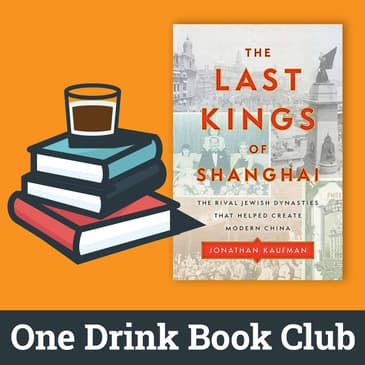
In this episode, Jamey and his guest Tim Rice of the Free Beacon discuss The Last Kings of Shanghai by journalist Jonathan Kaufman. The book tells the fascinating story of two rival Jewish dynasties that helped create modern China.
[00:00:00] Hello and welcome to The One Drink Book Club. Today we're discussing The Last Kings of Shanghai by journalist Jonathan Kaufman. The book tells the story of two rival Jewish dynasties that help create modern China.
[00:00:18] My guest tonight is Tim Rice, a friend and associate editor of The Free Beacon. Welcome, Tim! Thanks for having me, Jamey. Of course, of course. So this was a great suggestion. You made the suggestion on the book and I loved it.
[00:00:31] And it's a fascinating story, one that I didn't know anything about. I had no idea. How did you hear about the book? What made you try this? Yeah, that's actually a funny story too. So it's sort of outside my wheelhouse.
[00:00:44] I know shamefully little about China and every time I tried to correct that I wound up reading a couple of journal articles and kind of, you know, petering off and just sticking to reading the news, the stuff that we cover.
[00:00:56] But my best friend Eric in March, I went to visit him in New York and he gave me a copy of it. He said, here take this home. I think you'll love it.
[00:01:03] And I, it somehow made its way to the bin of papers and laptop chargers under my coffee table that, you know, where things go to die. And months later I was digging through it looking for some quarter or another.
[00:01:15] And I found the book kind of right at the stages of getting bent and thought, oh, you know, this looks cool. I didn't even really process what it was about. And so I sat down to read it that night and I am a painfully slow reader.
[00:01:26] I read it in two nights. Like I spent through it. I couldn't get enough. And I also knew nothing about this. I think, I think no one knows this story, which is sort of what, why Kaufman wrote
[00:01:35] the book and was so fascinating about it is that this was to such influential families both in Shanghai and around the world. But that's, that's how it came to me. I don't gravitate towards nonfiction.
[00:01:46] I do like some of the spy novels where you're talking about real life espionage issues and some of the World War II stuff. But this really read like a novel and clearly Kaufman knew a lot about the
[00:01:57] subject and he brought in some of his own experiences where he had been reporting in China. And so I thought it was a really neat look at basically from the 1820s through today and it gives some insights on why the Chinese political
[00:02:14] system is what it is and how they relate to the West, all fascinating stuff. Yeah, I think that being in Shanghai too sort of it's interesting because so often especially now, right? You either read about China from the Chinese side or you read about China
[00:02:29] from in our case the American side or broadly speaking the West, right? Because that's sort of the great power competition that we're in now. The fascinating thing about telling the story of sort of the rise of modern
[00:02:40] China from the vantage point of Shanghai was it's sort of this third place and it certainly was at the time, right? Where it was deep in China but also very Western. It was very pre-modern but also ultra-modern.
[00:02:55] It had it sort of jumped in a large part thanks to the families discussed in this book. So I think it's sort of it really gives a good kind of birds eye view or outsiders perspective on this clash that we're all whether we want to
[00:03:06] or not very much on the inside of right now. Oh, absolutely. As you know, this is the one drink book club. So I ask people to make a cocktail inspired by the book and I will tell
[00:03:18] you that I have a cocktail that I have researched but this took me more research than any other one that I've done any other podcast. So I'm curious to find out what you made. So OK, I made just a simple brandy cocktail.
[00:03:32] It is so it's two ounces of brandy, one ounce of dry curacao and then pay shows and Angostura bitters with 11 peel twist. I used cognac because I don't have brandy. I only like brandy and cocktails and I have this one bottle of cognac that I use.
[00:03:47] The reason I made this, though, was because the cocktail that I was going to make was the Cobra's Kiss, which is what they mentioned in the book. And it is a cocktail that Victor Sassoon, who we'll talk about later,
[00:03:58] invented at one of his hotels and that is equal parts brandy, cognac and heavy cream. And I thought I really I really thought about it, but I do not have the best history with cream in alcoholic beverages and I didn't want it to impair my performance.
[00:04:14] So I decided to dial it a step back and make functionally the Cobra's Kiss minus the dairy. Well, does anyone react well to dairy in alcoholic drinks? I just don't. I think it's a bad idea overall.
[00:04:29] I did a lot of googling about so Victor Sassoon, who is one of the main characters in this, he was responsible for a huge real estate empire in Shanghai. He was part of the Sassoon family. There's two families in the book, the Sassoon's and the Cadori's.
[00:04:48] And one of the things as you mentioned, Victor Sassoon had this hotel, which is now it was the Cathay Hotel. It's now the Peace Hotel. It still exists. It's owned by Fairmont now or at least run by Fairmont. Beautiful Art Deco hotel.
[00:05:02] And it was kind of the roaring twenties, thirties time of decadence. And I found an old menu online that talked about a couple of drinks and another drink that Victor Sassoon liked was called the Conte Verde.
[00:05:16] I believe it or not, I had to go deep in the liquor cabinet to have these ingredients, but I actually had them. But this one is two parts gin, two parts Cointreau, two parts French Vermouth, two parts creme de minth and one part lemon.
[00:05:32] So I actually compiled all of those ingredients and I looked at them and thought this is going to taste horrible. There is no way that I want to drink this. So there was another one on the menu called a San Remo.
[00:05:46] So we both had the same thing where we're looking at that the creme de minth. I mean, I may as well just pour a glass of scope and drink it. But the San Remo, which was another one is one and a half
[00:05:58] ounces of sweet vermouth, one ounce of elderflower liqueur, which sage germain if you if you are looking for a brand, one ounce of orange juice, one ounce of Campari, half an ounce of bourbon and half a lime. So this is it's kind of this red.
[00:06:14] It almost looks like a tequila sunrise. Cheers. But mine's very good. Very surprisingly refreshing. Yes, mine is too. As for as boozy as it is, it's good. And I'm going to do a plug. This is a unfunded plug. I'm a big fan of shaken drinks.
[00:06:31] And I have this elevated craft shaker, which is like a double walled. It's got a screw top. It doesn't get stuck. It has a strainer in it. And then the cap actually has lines in the metal so you can actually use it as a measuring thing.
[00:06:47] So I'm a big fan of the elevated craft. I'm always on the hunt for more, you know, barge here and my shaker is very pretty. It's a nice, it's very lovely brass shaker that was a wedding gift, but it's not double vented or double walled.
[00:07:03] And so if you shake it the proper amount of times, you get frostbite on at least one of your hands. If you're and so you either have to compromise how many shakes you want to do or you lose function of some of your digits.
[00:07:16] Yes, I've had the same thing. And they also lock where you can't get them undone and you're like banging it. So for those that want to not have any spoilers, not that the true stories are a little bit hard to have
[00:07:28] a spoiler, but I think we both agree. This was a great book. It's not too long. It's not dry at all. That some of the main characters died in the 60s. Lawrence Kedori died in 1993. So these people are still these families are still relevant to today's business.
[00:07:45] So definitely recommend checking this out. But I'm excited to talk about some of the aspects of these families and how they got there. And one of the things I thought was really interesting, both of these families were Jewish families that started out in Baghdad.
[00:07:59] And one of the Sassoon that left Baghdad in the 1700s, so it was, you know, mid 1700s, ended up going to Bombay and becoming a very successful merchant there, trader there, but always had an affection for the British crown and wanted to become a British citizen.
[00:08:18] He never didn't dress like a Baghdad Sultan almost. You know, I looked up old pictures of David Sassoon his sons were he allowed them to dress like a Westerner. But here this guy was, you know, practically a billionaire and he never learned English.
[00:08:38] He did become an English citizen was super influential and kind of still kind of lived and dressed like he was still in Baghdad. Yeah, it's I when I was reading about David, I think I David's as soon I that those early chapters
[00:08:52] I kept thinking about, I don't know if you watched a Bridgerton, my wife and I watched Bridgerton. Right. It's this sort of send up of Edwardian England. But the kind of central conceit is that it's in this alternate history where racial equality was more or less struck
[00:09:07] in in England, right? And it's you have these people, you have nobles that are Indian, African, you know, Asian, kind of walking around in traditional dress. And it's obviously this sort of modern, a historical invention that's supposed to look what it could have been.
[00:09:20] Right. We can't be able to just get along. And I kept reading it as like someone should make this movie because this is like it's not imagined. We don't have to pretend that that Queen Victoria was actually, you know, West African.
[00:09:32] We have this guy was truly walking around dealing with the Dutch East India Company, you know, doing business in London and truly in these in these huge turbines of the feathers and whatnot. Not as fascinated like this is a real person that existed
[00:09:46] way more recently than it seems like he should have. Right. Like around the time past the American Civil War. Absolutely. And he was so interesting in that as a family, they understood both business and trading and were hard workers, but they also saw opportunities
[00:10:02] and they realized, hey, we need to get in with these people. Some of his sons became friends with the upcoming king. They kind of ingratiated themselves in the nobility and the aristocrats in England and really forged a lot of influence.
[00:10:18] And so it was fascinating how they did both from the trading side as well as from the social side really grew in both influence and in wealth and saw where other people were missing opportunities. And so they did a lot of trade in India on textiles.
[00:10:37] They had their own mills in India. They benefited from the Civil War in the United States because textiles went down, you know, the South wasn't able to produce as much cotton, so they took the slack. I thought it was really interesting.
[00:10:50] And I think both of these families, the Kedoris who basically learned from the Sasunas, they actually worked for them as well as the Sasunas were masters at seeing change and then adapting to it and seeing opportunities.
[00:11:06] The thing that I thought was interesting, I wanted to get your take on is clearly the Sasunas more so than the Kedoris made a bulk of their wealth from the opium trade. And so how does that taint their history overall?
[00:11:19] So I have kind of a cop out answer to this question, which is that, I mean, obviously it does right on the one hand, it does. But I think on the other hand, it doesn't or it does, but it shouldn't,
[00:11:30] maybe because reading about the the opium wars and the opium trade and the sort of the opening, the spheres of influence, the opening of China and Japan for that matter, let's not discuss in this book. It really if you read a description of what of what China,
[00:11:45] what Shanghai of what of what Japan were like before the Western countries kind of forced their opening in the 19th century. And you were asked to guess a year if you didn't know the year attached to it, you would say 1492 1500.
[00:11:59] Like the fact that it was, you know, Franklin Pierce and Millard Fillmore were the American presidents that were, you know, pushing the the American, the Navy, the naval forces that went to open Japan and China. It's it's almost I use this word before, but it's almost pre-modern,
[00:12:16] even though it wasn't. And so I this doesn't excuse anything. But I think that I don't it really when we talk today about sort of, you know, Orientalism, right? We talk about that as a, you know, kind of Western people that see Southeast Asia
[00:12:33] or the kind of the East broadly as this mysterious, dark, savage other. We're referring to this period of time where like the Orient really was like we didn't know very few people had been there. It just kind of been always existed that way.
[00:12:49] And I'm sure that some people, I, you know, had a very done up 19th century racial notions of why it was OK to get these people addicted to opium. But I think and, you know, from from what Kauffman reports,
[00:13:02] it really does seem that this is soon just sort of this was a this was a thing that happened, right? The opium trade in China was a thing in the same way that tea merchants were a thing in in Europe and cotton merchants were a thing
[00:13:13] in the United States. And much like in those places with the triangle trade and the slave trade, like the systems propping them up might not have been good, but like it was the economy. So I think like obviously it taints them as much as any of this stuff
[00:13:27] taints anyone that was making money at the time. Well, I think it yes, in some ways, but I feel like there's some real parallels to the Sacklers, for example, with Purdue Pharma and the opioids here, those, you know, the Sacklers did a lot of philanthropy.
[00:13:43] They did a lot of good things. But does that absolve them from, you know, creating a country of addicts or at least contributing to a country of addicts? Yeah, I think the Sackler comparison is interesting.
[00:13:55] I think I don't have a strong or a concise case to make here, but it seems to me and I'll think more about this, but it seems to me that there is something worse about the Sacklers and the other and the opioid crisis too, right?
[00:14:10] It's it is the Sacklers. Yes, but it's also there are a lot of contributing factors, right? There's prescribing doctors and, you know, all sorts. They're you look into it and they every time you think you can point to who a true villain is someone else comes up
[00:14:23] and a lot of it is people that are well intentioned, which you probably can't say about the opioid war. All that being said, to me, it strikes me as worse. And maybe this is my presentism bias, but it strikes me as worse
[00:14:34] that in the 90s and the early 2000s, amidst all we know about pharmacology and addiction and science and medicine and all this stuff. It strikes me as that they have a little bit more culpability, right? They they have a little bit more.
[00:14:50] And again, that's probably just because this is what we're living through. And if you, you know, plucked, you know, a Shanghai resident in 1855, would probably say that this is soon family and the Dutch East India company.
[00:15:03] They could make the same, you know, in our age of enlightenment, how could you know? You know, continue to push the poppy on us. I'm sure that's a thing. But to my modern years at least, it's I don't know, it seems
[00:15:15] it seems so far in the past for me that I'm more willing to kind of take it as a function of the times. Sure. I hadn't thought about the spheres of influence since probably sophomore year in high school.
[00:15:27] You know, there was a part of the history book for world history that talked about it. But I mean, it really was incredible that, you know, you have these sections of China where the Americans were in control or the British were in control
[00:15:41] or the French were in control and they literally did not have to abide to any Chinese laws. Any crime that happened in there was regulated by Britain or America or France. They had no culpability with anything local.
[00:15:57] I mean, it was like diplomats here in DC, but you know, they get out of their parking tickets. But beyond that, they have to like play by the rules. This was out of control. They go on to talk about how the Chinese government and the Chinese economy
[00:16:14] often talks about the 100 years humiliation and they never want to repeat it and they keep drumming it into the heads. But I get it after you see how they were just really in their own country
[00:16:25] treated like second class citizens as these people kind of came in and made these deals that they didn't have any choice with. They said, we're going to do it the way we want to do it. We'll do whatever we want.
[00:16:34] Yeah, no, the extra territoriality, which I think is what they called it, was you can't, it's like you start thinking about it too much. And it's kind of like a divide by zero error in your head. It doesn't and it doesn't make sense.
[00:16:46] And this is part of why I think this is soon this is soon's involvement in the opium trade kind of stings less relative to some of the other good contributions that they've made for me because it's like
[00:16:57] that's the perfect example of how this really was kind of a world beyond our comprehension. I think the thing that I kept thinking of is and I think about this a lot is thinking about the industrial revolution or thinking about, you know,
[00:17:09] sort of even through kind of mid century America, right? To us, it seems crazy. Say what you will, you know, you can everyone can debate the climate change and environment and, you know, the various structures of that.
[00:17:18] But it seems crazy to think that there was a time when people genuinely thought, let's just take all this garbage and toxic stuff and let's either burn it or put it in the ocean. And you know what? It's probably going to have no effect.
[00:17:30] Like I'm not I'm not saying that I'm not a climate alarmist, but it seems just so intuitive. It seems self-evident that of course this is going to do something and probably not something good. Right. The fact that there was a time when people didn't know
[00:17:47] that when people didn't think that way, the fact that there was a time when some people thought, yeah, we can do we can just we'll talk to England. We don't need to include China and we'll just carve out little slivers and we can do whatever we want there.
[00:17:59] There's no crime. That is insane. Like modern government would think that way. It's it's it's so again, it's sort of I totally understand the 100 years humiliation. I also would not want to endure that again. But for us looking back at it from a historical vantage point,
[00:18:15] I do think that those are the sort of things where it's like it's easy to condemn, just say that was bad. But it's more interesting to think through like what was going on that made this happen? Like what what were the what was that world really like?
[00:18:28] And I think Kaufman does a good job of that, if not necessarily praising your condemnation, but just putting us on the ground. This is what it was like. And that's that's I think what makes it such a great book. I agree. It's interesting.
[00:18:40] They justified it obviously in a lot of different ways. They considered themselves more civilized and I'm using air quotes with civilized and they had the the technological prowess and the basically the manpower and the gunpowder that they did whatever they want.
[00:18:55] They had they were so superior in military might that China didn't really have a choice. And so I think you see that in a lot of situations throughout history, that if somebody has an advantage that's a notable advantage from a military standpoint,
[00:19:09] they will culturally dominate everything that they're up against. I mean, Genghis Khan did that. The horsemen of Genghis Khan were so far advanced than the other countries that they were going up against that it just wasn't even a fair fight. Yeah. Yeah.
[00:19:25] So one of the things I think, I mean, the book talks about this early history. They talk about the later history. But for me, the real meat was that like 20s, 30s, 40s where it's Victor Sassoon is kind of the most dominant Sassoon.
[00:19:39] Ellie Kadori, who is the other kind of rival Jewish family. Not that they're rivals so much that they were fighting, but that they both were big in business, big in real estate, big in trading, big in Shanghai.
[00:19:52] But it's got this allure because it's kind of this golden age, the Art Deco buildings, the fancy hotels. There's a glamour to it where Shanghai kind of was the up and coming glamorous town, which was really neat to me. Yeah.
[00:20:09] It's it's there's something about the the the Cosmopolitan city, which I think is what you got a lot of in this book that we don't kind of paradoxically, we get less and less the more globalized we become because
[00:20:24] everything is so interconnected now that to take this the most extreme way, everything is international. But every city is international in the sense of there are, you know, you go to New York, right? Queens has more Puerto Ricans than in Puerto Rico and more Jews than Israel.
[00:20:38] And, you know, it's these like literally an international city. But back back in the 20s and the 30s, right? You had these kind of Cosmopolitan hubs, London, Shanghai, Paris, right? These places where it's there was a class, right? There was the cost.
[00:20:51] It was the precursor of the jet set, right? But it was these, these, you know, the wealthy, the rich, the famous, the intelligentsia, the revolutionaries, and they would travel the world and go to places like this.
[00:21:02] And it was again, it was it was so specific because so much of the world was so provincial or localized that it does. It gives this kind of this impossibly glamorous allure to these places that I think we're especially drawn to now because it was a time when
[00:21:18] interconnectedness was really truly something special instead of just the common, right? Workaday. Yeah. Well, I've talked about that a number of times throughout the years. Every city in the United States, there are few places that are truly unique anymore.
[00:21:33] If you go to Dallas or Columbus or Denver, there aren't a lot in terms of buildings and architecture and stores. I mean, you're going to have the same restaurants and the same chain stores. I feel like Las Vegas, New Orleans, San Francisco have these kind of unique
[00:21:52] personalities, unique feels to them, but so much of America and the world at this point is becoming homogeneous in the way that it looks. And that's a shame. And I think you're right that Shanghai was was really unique at the time
[00:22:06] due to the Sasunas and the Cadoris for all their building. I mean, it was the real estate ventures that they did. And one of the things I thought was really neat, both families had these very high end hotels that were catered to that jet set crowd.
[00:22:21] The Sasunas had the Cafe Hotel and the Cadoris had the Majestic Hotel. And I thought, I mean, did you look up any of the photos of those hotels? I did, I did. And I'm like it seems you are on the sucker for the old Art Deco buildings.
[00:22:36] So I too, like this is it's you know, it's incredible. It's they're really something to be old. Well, and I'll try to put some maybe in the video version of this podcast to show they're all in this area called the Bund, which was the international portion of Shanghai.
[00:22:52] And when it was after the Opium Wars, this area was basically patrolled by the British Army was its own little section of the city. And these massive Art Deco buildings and the the Cafe Hotel that Victor Sasun built is still in existence today.
[00:23:09] The Majestic, I don't know if you notice this in the book. I actually went back and was kind of rereading sections before tonight. And the Majestic Hotel was an equally fancy hotel. It had it had this ballroom that would hold more than a thousand people.
[00:23:23] Shaykai Shek had his marriage in that ballroom. That hotel was opened in 1924 and was torn down in 1932. I mean, can you imagine? I didn't really pick up on that. I remember that Chiang Kai-shek. Yeah, the timing. Yeah, wow.
[00:23:41] And I don't know whether it was a, you know, they overbuilt or that because Victor Sasun's Hotel opened in 1929. Did they just put him out of business? They were the new fanciest thing on the block. But to literally have it torn down in less than 10 years is crazy.
[00:23:58] That's wild. Yeah, it's I think thinking through this and reading this, I think it's there's hotels. It's sort of kind of what part and parcel of what I said earlier about sort of the way that globalization has kind of cannibalized the cosmopolitan.
[00:24:11] But I've as I was thinking through this, I noticed that a lot of like the best books that I've read in the past few years have been about hotels, the type of hotel that doesn't exist. Nonfiction, Last Call, The Hotel Imperial.
[00:24:23] It's a phenomenal book about a hotel in Germany, I think Germany, where the journalists, the American and British journalists between the World Wars kind of coalesced and came together and realized that something, there was something rotten in the state of Deutschland.
[00:24:37] Gentlemen in Moscow, which I believe you've read the novel, which is about a, you know, kind of a grand hotel in an old Imperial Russian hotel through the Soviet era, the Grand Budapest Hotel, the great West Anderson movie.
[00:24:52] And I was I was sort of thinking through these things because like, man, I really like I love stories, true or not true book or movie about these kind of old hotels. And it's not it's not like an interest of mine.
[00:25:03] Look, I don't know anything about the construction or management of these hotels, but I'm sort of drawn to and always appreciate a story taking place in them and about them. And I do think that again, it's sort of like
[00:25:15] it's kind of got one foot in each side, right? Where it's like on the one, it's like, yeah, obviously I get this. It's a hotel. We've all been to hotels. We all know what it's like to travel, to stay somewhere,
[00:25:23] to travel somewhere new, to see interesting people in the lobby at the bar. But of course, like the hotels we go to today are not the hotels that we're talking about. So it's sort of like it's accessible enough where you can picture yourself there.
[00:25:35] And then once you're there, it really transports you back to this different age. And I think I think it's sort of, I don't know, I feel like we're in the age of Airbnb. Maybe we're due for a revival. Well, yeah, a re-appreciation of the old hotels.
[00:25:50] Well, the author Kaufman talks a little bit about how the hotels at the time were kind of an oasis of British aristocracy. And so you'd have these hotels and they were very important, especially in these kind of far flung places like Shanghai,
[00:26:07] where you know you could go and you could have a fine cigar and your cognac. And it was going to be very much like you would experience in London or in Paris. And so these were kind of place where people could feel like they were at home.
[00:26:22] But at home for a very upper crust first class kind of existence. At one point I thought, well, geez, I would add this to my list of the Metropole Hotel in Moscow in Gentlemen in Moscow and it's now called The Peace Hotel in Shanghai.
[00:26:40] It would be a fun tour to go to these places that that really are characters in these books, whether it's fiction or nonfiction. Yeah, yeah. Maybe one that's that's we can we can we'll do that. That would be a great tour and maybe a different age.
[00:26:53] The Moscow mass Moscow for a couple of weeks and then and then Shanghai for another. That'll be that wouldn't arouse any suspicions for anybody. No, no, no, maybe not today. We can take our zeppelin from spot to spot. We'll just hop on the Orient Express.
[00:27:07] Nothing bad has ever happened there. One of the parts of this book that is really interesting is the role that both the Sassoons and Kedoris played in Shanghai at the lead up to World War Two, sheltering Jews of Europe. So talk a little bit about what happened there
[00:27:28] and what role those families had in this really interesting time and really desperate time for European Jews. Yeah, so I mean, this is, you know, this is sort of kind of one of the more shameful areas of history for most countries
[00:27:43] and peoples in the world because you read these horrible stories about, you know, we the West America, your England, Franklin Roosevelt. Like people people knew that the Holocaust or at least that the pogroms were happening earlier than we like to remember that they were happening.
[00:27:58] And you read these terrible stories of ocean liners full of Jews to try and departing Germany, departing Poland and going from port to port and countries turning them away and eventually them getting sent back to Nazi occupied territory and, you know, sort of being being sent
[00:28:12] to the concentration camps. And it's sort of these heartbreaking stories. This fortunately was the one, like maybe one of the only instances on mass where that did not happen. And so it was again, it was sort of the perfect. You mentioned before that they were, you know,
[00:28:25] they were competitors, but not competitors and they were. They were kind of like friendly competitors that really did. It was like the Beatles on the stones, right? Like obviously competitive, but also pushing each other to be better to innovate more.
[00:28:36] And so Ellie Kedori, who was the Potter familiarist of the second family, right? The ones that he was originally a Sassoon employee. He went to Victor Sassoon and said something along the lines of it's a war. You're a Sassoon. Stop being a playboy and do something about this.
[00:28:53] And so Victor Sassoon started raising money. He enlisted celebrities like Charlie Chaplin to raise money for sort of the cause of the Jewish refugees. He also negotiated with the Imperial Japanese officers that were occupying Shanghai, who at first Japan had not yet
[00:29:09] entered the Axis powers, but they were occupying China. So this happened separately. And he kind of, you know, distracted him sort of, you know, they were getting pressure. They wanted to enter the Axis power. So they're like, we don't really want to bring in that many Jews.
[00:29:22] Like that's not going to, that's not going to impress our buddies in Munich. But they, you know, he sort of kind of talked his way out of it and bribed it and did a little misdirection. And they eventually, I think on order of 150,000 Jews
[00:29:34] from all across Europe, eventually made their way to Shanghai. And not only did they, did they shelter them or did they bring them there? But then the Kudori is built a school to educate the children.
[00:29:45] And it was like from, you know, I'm sure that, you know, conditions were hard, but they made it a good faith effort to, they taught them music and art and literature and fed them like, you know, it was a lot of them. They were overcrowded.
[00:29:56] They were constantly struggling to keep up, but it wasn't just like they didn't stop once the refugees got there. And then once the war really after Pearl Harbor, after the Japanese entered the Axis powers, once things really, you know,
[00:30:08] kicked into gear, they, the Kudoris and the Sasunas worked to keep the Jewish refugees that they had sheltered safe. They didn't, the Nazis were putting pressure on the Imperial Japanese. They, true, one of the say, they suggested just put them on a barge
[00:30:22] and sink it in the middle of the ocean. They were like, just get rid of them. That's, that's, you know, that's sort of our aim here. And even as the Kudoris and the Sasunas were having their buildings
[00:30:31] occupied, even as they were some of them getting round up and sent to, to, you know, occupy POW camps, they managed to sort of protect as best they could these populations. And I agree. I thought that was a, again, a staggering story
[00:30:46] that is something that should be like, like make that movie, right? That's something that we should all know more about. Oh yeah. And I thought one of the real heroes was a guy who was, I think in the Austrian Chinese embassy. So he was in the Chinese embassy.
[00:30:59] He was a Chinese bureaucrat or statesman, but relatively low level. And at the time, Shanghai was one of the few places where you didn't need a visa to enter. And so all over Europe, Jews needed to get visas to get out of Germany,
[00:31:14] to get out of some of these countries. And if you couldn't get a visa, nobody would let you onto a ship to leave. And so this guy in the Chinese embassy realized that even though you didn't need a visa to get into Shanghai, he could create a visa,
[00:31:30] which would then allow a family or a person to get out of Europe. And so he himself, I think gave 3,000 visas out to people, which are, you know, it's kind of like giving out monopoly money because you didn't need one of these.
[00:31:44] You didn't need one to get into Shanghai, but you needed one to get out of Europe. And nobody told him to do it. Nobody gave him permission, but he took it upon himself and saved thousands of people. Really an unsung hero.
[00:31:57] You can't even use it's a stunning story to read. It's really it's like, you know, you think about you think about even Casablanca, right? Which obviously is a fictional account, but you think about right in that
[00:32:07] mood there's people waiting and waiting to just get these exits to get out. That was that was the craziest thing, right? It wasn't it was two layers. It was they want you had to get out first and then you had to get in somewhere else.
[00:32:17] And for a lot of people, the best case scenario was you only checked the first box. You only got out. Then you were waiting where I mean, yeah, you were basically in what is now
[00:32:28] Israel and that, you know, that was that was there was a lot of, you know, conflict there because that was the sort of the they were the kind of nascent kibbutzes in in the Middle East. But you know, so a lot of them ended up there.
[00:32:39] That obviously was not from the second they landed there. They were immediately fighting for survival once again. So if you didn't get to America or Australia, it was you were, you know, you were kind of the best thing you could say about the places
[00:32:51] you ended up where was that you weren't in Nazi occupied territory. And oftentimes that was only better by a slight degree, whereas you get to Shanghai and it was like Michael Blumenthal, right? Bill Clinton's secretary was one of the was one of the refugees, right?
[00:33:05] I'm not him and his parents were there. So it's like, and he credits where he's like, I learned math in the Kedori school. Like that's where I started to like think about the world and think about he talks about seeing the kind of international village
[00:33:16] that sprung up in the Bund. And, you know, he says like, that's where I kind of started to think about these things. So they weren't it wasn't just subsistence. Like they really did do they made a good faith effort to give give
[00:33:27] lives to these people after welcoming them in and that that more than even sheltering them would have been a feat in and of itself. But what what they did after that, how above and beyond they went is was an incredible story. Yeah.
[00:33:39] The the fact that they gave these chances to all these people kept them safe and and then we're still able to, you know, thrive in their businesses and everything else was was really an interesting aspect. Kaufman sets it up as a rivalry.
[00:33:55] And as we said, they were rivals, but not I mean, they they ended up getting into different businesses. The Kedoris ended up getting into energy and power. The Sasun's, you know, obviously had their opium for a long time,
[00:34:06] but then they were also doing textiles and then real estate in Shanghai was was there a favorite for you? Were you team Kedori or team Sasun? I was I was team Kedori because because I'm a sucker for like
[00:34:23] a new Varyish startup and as funny as it is, because now that they're both these multi-billion dollar conglomerate families, the Kedoris were in this instance, the startup. So I love a good I love a good rags to riches story, but also,
[00:34:35] you know, joking aside, because of that, right? The Sasun family, as you say, at the beginning of the book, they were bankers to the sultans or whatever the ruling class was in Baghdad. They the whoever I forget his name, but whoever the first Sasun
[00:34:50] of the dynasty, he was a billionaire before the American Revolution. So when David Sasun had to flee Baghdad under, you know, whatever political strife it was, he was an aristocrat looking for a new aristocracy and a businessman looking for a new market.
[00:35:05] And you see that with the way he raised the sons and he dispatched them and he told them to go far away from their wives and families and far away from each other. And they always kind of rivaled and they were always always had
[00:35:16] it, you know, their eye on the ball. Whereas the Kedoris, they, you know, they were a little more they were a little more warm. They were a little more familial, right? Ellie Kedori kept his sons close all while maximizing a
[00:35:27] profit, but he, you know, he kept he didn't want his sons to have to leave their families. He he cherished his wife, the brothers, Lawrence and Horace, who were his two sons, who were the ones that were active in the World War Two period, right?
[00:35:39] They were very close, even though they were very different. And they sort of divided things up. And I mean, obviously, again, as you say, this book almost reads novelistically. So as as as characters, the Kedoris, I think are more legible and more accessible.
[00:35:53] But I also just sort of found that was a I was kind of fascinated by the way that, you know, it really shows how you can kind of plant a seed of the family dynamic early on. And it's kind of fascinating how it's like you
[00:36:04] can tell the different personalities that different generations are going to have just based on how it started off. You definitely could. And I agree with you, I was kind of team Kedori as well. They just they were a little less ruthless and a little more friendly.
[00:36:18] Although I would say if I were living in Shanghai in the 30s, I would have loved to go to both of their parties because the Sasu Victor Sasu knew how to throw a party. Yeah. And the Kedoris knew how to throw a party,
[00:36:30] especially when Ellie Kedori, you know, he had this beloved wife. Everybody loved her. She was really an amazing woman. But when she died, he was kind of a bachelor and he had these two bachelor sons. They lived in this massive mansion and he basically
[00:36:48] was saying like, hey, let's all have fun. I mean, it was it was kind of like Rodney Dangerfield and back to school. Like he was just going to have this, you know, crazy. They were just having these crazy parties all the time.
[00:36:59] So I think it would have been fun to know both of them. But I think I probably I would have wanted to party with Victor and then maybe hang out a little bit more with the Kedoris. Yeah. Maybe look at nice dinner with the Kedoris, right?
[00:37:10] Victor will do the Charles and maybe drink one of these cream based cocktails that he swears are good. But but yeah, no, I certainly would have been an equal opportunity hotel guest. But if I had, if I had to lay down loyalties.
[00:37:22] Well, you know, and I will say that I think the Kedoris won if you were going to have a rivalry. And the reason the Kedoris won is that they saw that communism was coming before Victor Sasu did. And they really made their moves to move a lot
[00:37:38] of their businesses, their wealth and their their roots really to Hong Kong because they saw that Britain still owned Hong Kong. They had the longtime lease on it. And they were smart in the way that they never angered the Communist Party. They worked with them to provide power
[00:37:58] to parts of China and were able to continue to be successful. Whereas basically Victor owned, as they said, in today's dollars, about half a billion dollars worth of real estate in Shanghai. And when Mao went into power, they took it all over and he moved to the Bahamas.
[00:38:19] He lived very well there for the rest of his life. But he still lost a lot of money in the real estate market in Shanghai. Yeah, I think the I mean, you mentioned having an eye on the trends, right? The Kedoris certainly had a better
[00:38:33] eye on the trends in that sense. I think it's also because again, this assumes where they were old school tycoons, right? They really were they were what they really wanted to be, which was an old money British family. And as anyone who's ever watched down
[00:38:47] in Abbey knows, right, the old money British families did not see the changing economy coming. They assumed that because it's always been this way, it always will be this way. And that was what they put all of their faith. And I think that imperiled both their
[00:39:02] their business futures, but also their legacies, right? So the Kedoris were they were they were more adaptable, I think, in their business because, you know, as Kaufman shows, right, they were more not only were they more family oriented, they were also more community oriented.
[00:39:15] And they were also of the two families, the more religious, right? They were the ones that built and endowed the synagogues and the Hebrew schools. And so when you read the the testimonies from people that were sort of the beneficiaries of these two families,
[00:39:29] the people that went through the Sassoon academies that they built to train their workers, those are all older accounts, right? Because those were those were eventually the, you know, industrial eras changed. And that mattered less. It didn't matter that you ever educating
[00:39:43] your own factory foreman, but things like primary school, secondary school, Hebrew school, music school, like these these are things that are perennially important. And this is how you you leave a legacy. And this is something that the Kedoris understood. And it seems to me that maybe the fact
[00:39:59] that they understood that there were important things outside of the business world probably allowed them to be a little bit more open minded with the business landscape. Because if you had made, you know, the modern equivalent of a hundred billion dollars doing the same thing for 200 years,
[00:40:12] if that were me, I probably I would probably think, yeah, I mean, we've made it through all, you know, we made it through. We got kicked out of Baghdad. We made it through all these conflicts, all these World Wars. You know, what could possibly come next?
[00:40:24] True. And between the two families, the Kedoris were the only ones that I think befriended as probably too strong a word, but worked directly with Chinese business people. And the Sasun's very much kept themselves separate, lived in this kind of international expatriate type of world where the Kedoris
[00:40:44] had very close business associates who were Chinese merchants, Chinese business people. And I think that's what really helped them when they made the move to Hong Kong. And they also, along with the charities that you talked about with the synagogues and the schools, they were the company
[00:41:03] that that brought electricity to a lot of the rural areas of Hong Kong. And they were helping small farmers, families and villages that were really far flung. And I think that bought them a lot of good will locally that made it a lot harder
[00:41:18] to kick them out of the country. Yeah. And during, I mean, as Kaufman recounts, right, there are there are times during the Communist Revolution in China, during during Mao's Long March and whatnot where there are, you know, leaders in the nascent, you know,
[00:41:33] in the in the nascent People's Republic who see the name Kedori and remember the name from the trucks that brought gas to their remote farm villages or the, you know, the people, the uniform labels of the people that hugged the power lines
[00:41:48] and and felt, you know, if not gratitude, at least the saw at least the softness, right? It associated them with, you know, for all the reasons they were Western, you know, millionaire, imperious imperialist, bourgeoisie, whatever. They were also the people that kept the lights on.
[00:42:03] They were the people that, you know, set up tenant farming systems that allowed my parents to make it through a famine and things like that. And that stuff always matters, but certainly in times of violent revolution. Absolutely. Well, I think this was a fantastic book.
[00:42:19] Definitely spurred me to do a lot more research. Again, looking at photos of the old hotels, looking at history of menus at the Peace Hotel or the Cafe Hotel. And I really appreciate you taking the time to discuss it with me and I appreciate the suggestion. Yeah, absolutely.
[00:42:37] And thank you so much for having me. I always go to talk about some great books. What's next on you? What's on your nightstand now to read? I am currently reading Jamie Kirchick's Secret City, the Hidden History of Gay Washington.
[00:42:51] It is fascinating and also gripping and reads like a thriller. It's about a thousand times as long as Kings of Shanghai. But absolutely, absolutely worth it. It's you would like it. It kind of reads like a spy thriller. Interesting. But it's a fascinating social history.
[00:43:11] So I am I've been working my way through that for a while and I am I am two nights away from finishing it. But but strong recommend. All right, well, that's a good one. I appreciate it. And again, thanks for being here.
[00:43:24] If you are listening, please make sure to subscribe and throw in a review if you can. And check out the website, OneDrinkBookClub.com to get the recipes for tonight's cocktails and have a good evening and enjoy whatever you're reading.