
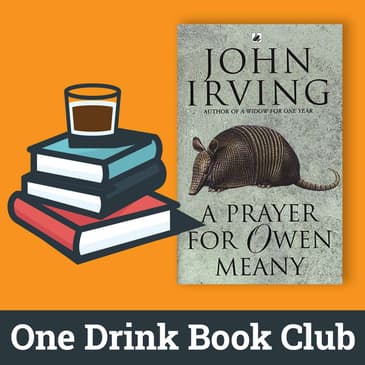
In this episode of the One Drink Book Club Jamey and his guest Shane Sleighter discuss A Prayer for Owen Meany, a novel by John Irving. In the novel, the main character John Wheelwright tells the story of his childhood growing up in New Hampshire in the 1950s and 60s with his best friend Owen Meany. In the episode, Shane makes his own twist on a Pimms Royal and Jamey makes a Toronto cocktail. Recipes can be found at http://www.OneDrinkBookClub.com.
[00:00:00] Hi and welcome to another edition of the One Drink Book Club. Tonight, my guest is Shane Slater and we're going to be discussing a prayer for Owen Meany by John Irving. In the novel, the main character, John Wheelwright, tells the story of his childhood growing
[00:00:25] up in New Hampshire in the 1950s and 60s. He is growing up with his best friend, Owen Meany. The story flips between present day and in this book, present day is 1987 and then his childhood. And so, Owen Meany is a really unique character. He is very smart.
[00:00:45] He's very tiny. He has this very strange, high-pitched voice and he also is a very charismatic leader. So the other thing that makes Owen unique is that he feels that it is his destiny in life to be an instrument of God.
[00:01:01] So Shane, welcome and thanks for joining me. Well thank you for having me, Jamey. I truly appreciate it. What made you suggest this book? Because clearly this is probably something you read a while ago. This is not a new book. What kind of drew you to this? Sure.
[00:01:18] Well thanks for asking. You know, you actually kind of did me a solid, Jamey, by letting me pick the book because I found recently I've had a hard time reading. So when you had recommended that I come and join and you had said, you know, that I could
[00:01:32] pick the book, I thought I'd pick one that I had already read. So I wouldn't have to go through it again. And Prayer for Owen Meany is one of my favorite books of all time.
[00:01:40] And realizing that when it read it, I downloaded it to my Kindle and then I couldn't put it down. So I ended up reading it all over again and I came out of it feeling the same way
[00:01:49] that I did the first time, which is that it's just one of my favorite books. So that's why I picked it. Oh good. I really enjoyed it. I had not read any of John Irving's things.
[00:01:59] And so Ciderhouse Rules and World According to Garp, clearly he's an accomplished author with lots of bestsellers. And for whatever reason, I just never came across him. So I was really happy to get the opportunity to read one. And I too thought it was great.
[00:02:13] I mean, it's really, it's deep. You care about the characters. While it's sad at the end, it's also uplifting. No, I would agree. And in fact, John Irving is probably one of my favorite authors, if not my favorite one.
[00:02:26] And if you enjoyed Owen Meany, all the things that made it good, you'll see in the Ciderhouse Rules, World According to Garp, Widow for One Year. I pretty much everything he's written follows very similar, not necessarily plot, but just
[00:02:40] with the rich characters, the kind of humor, the, you know, the sadness that kind of permeates things and makes it bittersweet. So I definitely recommend reading more of his, uh, Ruppets Bar. Well, I think after this one, I definitely will.
[00:02:54] So really my first and probably most important question was what drink did you decide to make tonight that would be inspired by the book? Well, so I call my drink a Pemroy for Owen Meany, which is a Pems Royal that I kind
[00:03:10] of monkeyed with myself to make it taste good for tonight. And in fact, if you'll humor me, I actually have all the ingredients right here. So I started with a little bit of mint and a glass.
[00:03:21] I'm going to pour in some champagne, which in this case is just the cheap stuff that we have laying around the house. A lot of times like the recipe says that you want to do like three parts
[00:03:31] champagne to one part Pems cup, but I found that I actually prefer a little extra champagne and then Pems number one, which I'm going to pour a little bit in and then a little bit of orange juice that I and a gentle
[00:03:44] stir and you'll probably see me making more of these because tonight's my cheat night that I'm going to be drinking alcohol when I usually don't during the week. And so if I'm going to cheat, I'm in a cheat. So cheers. Now, what did you make, James?
[00:03:58] You know, there wasn't a lot of drinking involved in the book. There was, you know, people would go for a few beers, things like that. But since the main character, John, he lived in the present day. He lived in Toronto. So I made a Toronto cocktail.
[00:04:15] And so the Toronto cocktail you might not be familiar with. I was not. So I had to do a little research. It is two ounces of rye whiskey, a quarter ounce of Fernet Bronca, which I had never had before.
[00:04:30] It's in the Amaro family of Italian drinks, kind of up there with Campari, Apparol is one in this. So it's a very bitter taste. And then it has simple syrup, some bitters and an orange twist. Well, it appears you win this time, Janie, but I'll be back
[00:04:48] and I'll have a better drink next time. I think yours is delightful. It looks very refreshing. So I think I kind of anticipated this in the sense that clearly you like the book. But if you were to make a rating of the book, so out of five cocktails,
[00:05:06] what would you give a prayer for Owen Meany? Oh, one cocktail. I hated it the second time I read it. No, no, five. It was it was great. In fact, I for reasons that we'll talk about when we get into the book,
[00:05:18] I actually found I enjoyed it more than the second time. So definitely five out of five. Five out of five. Well, I think it was very good. I'd probably give it a four point five. So close to a five definitely was was really good.
[00:05:31] And one of those books that you thought about a lot afterwards, which to me is a sign of a really good book. If you if you actually kind of revisit it in your head after you've finished. For those of you who do not want any spoilers,
[00:05:45] if you just wanted a good book suggestion and a good drink suggestion, I think you've got two good drinks and a good book. If you want to kind of listen along to the discussion about the book, we're going to go into this.
[00:05:56] I will remind people we're just starting this podcast. I'm excited about it. And I would encourage you to both subscribe and review the podcast if possible. That would be helpful. And we'll hopefully try to entertain and enlighten along the way.
[00:06:12] So Shane, clearly Owen was was the most compelling character in the book. He was it was really different than any other character I think I could think of, both from a physical, his voice, his stature, even his characteristics and his drive were different than any other character.
[00:06:32] But what what drew you to Owen and what did you like best about him? And what were some of the other characters that you really kind of thought were interesting? You know, I believe the thing that I like the most about Owen was
[00:06:46] when you're first introduced to this character, you assume that he's going to be the butt of all the jokes and he's going to be picked on. And the book goes in a completely different way. He ends up despite his very, you know, minor stature
[00:07:01] is his, you know, high pitched voice, etc. Like he ends up becoming quite the leader and in fact, in many points in the book, entire society looks to him for, you know, answers or direction. And I think that's what kind of makes him a really attractive character
[00:07:21] is he's different than you expect. And you can see it like in his interaction with the other townspeople with John, the lead character, how he looks after him. And, you know, in the end, he gets trying to remember the Reverend Lewis,
[00:07:36] Lewis Merrill, I think he gets him the job. Like, I mean, just there's so many things that Owen does that, you know, defy what you expect when you first meet the character. In fact, sorry, not to get too much into it, but there's even a certain point
[00:07:48] where the grandmother, who's one of my other favorite characters, I think Harriet was her name, John's grandmother. When she first remembers about Owen, you think, oh, my gosh, like, you know, she obviously hated him. And then as the book goes on, you find out they were fast friends
[00:08:04] and they were watching Liberace together like in the living room. And she looked after him like it was just filled with good characters. And I think Owen Meany was probably kind of the glue that stuck it all together.
[00:08:16] I think it's interesting that you mentioned how you were led to believe in the beginning that he was going to be a struggling character that he had overcome these kind of his physical stature and everything else
[00:08:28] that first scene when John is talking about it and remembering meeting Owen Meany. It was in Sunday school and the kids would lift him up over their heads and pass him around the room because he was so small and he would kind of complain
[00:08:42] like, you know, put me down. I don't want to be here. So you've kind of thought, jeez, this kid's going to be bullied his entire life. And you're right, it goes in a completely different direction. And he is not bullied.
[00:08:53] And I think one of the first times that I noticed he was not going to be bullied was when John, the main character would always go to his cousin's house for the summer and he would visit his cousins and his cousins were kind of these
[00:09:05] wild hellion kids who were completely out of control and hugely physical. And Owen talks many times about meeting his cousins. He really wants to meet them. He's heard about them for years. He's heard about their house and he wants to go there.
[00:09:23] And the main character is worried that he's going to be bullied, that Owen is just not up for these cousins, that they'll just destroy them when they finally do meet Owen. And Owen takes total control of the situation.
[00:09:38] And he kind of decides what they're going to do, where they're going to do it. And even though Owen was had kind of an embarrassing situation with them where he did get upset and over-frightened and wet his pants.
[00:09:53] He was able to, these kids were still like respecting him and wanted him to be part of their club. It was cool. Yeah. In fact, I think that that was one of the parts that made me laugh out loud
[00:10:06] was that he wets his pants and then storms off to go home. And then John and his mother go and pick him up and bring him back. And by the time he gets back, he goes back and he meets these wild men and cousins and their little sister.
[00:10:21] And he says, I'm sorry that I wet my pants, basically. But I've come up with a game that we can play where I don't think I'll get over excited. And he wins the game. It's a version of Biden's secret.
[00:10:36] And he ends up winning and they all respect him for it. Well, in fact, that comes up later, which is something that until you mentioned that right now, I didn't even think of. But, you know, after Owen has died and John is back in his grandmother's house
[00:10:54] where his stepfather lives now and he ends up like looking in the couch and he finds under the couch cushions. He finds one of Owen's beloved baseball cards. And he realizes at that point that that is where Hester had hidden Owen all of those years ago.
[00:11:13] And he said that was the first time that Owen's ghost had returned to him as an adult was when he found that card. Yep, it was it was a cool part. Did you you said you read this book and you didn't listen to it?
[00:11:26] Right. You read it on I did listen to it because I tend to be an audible guy. And I will tell you that Joe Barrett, who is the voiceover talent, who did it did an incredible job with the voices.
[00:11:39] So not only did he have to do, you know, it was a wide array of characters from Grandma to John to Owen, who is a really unique voice. And while maybe it would have been better to hear Owen's voice in my imagination,
[00:11:55] I think this guy really nailed it. So if you ever get a chance to just kind of sample the audio book, you'll be impressed with the rendition of of Owen Meany's voice. I definitely will because in my imagination,
[00:12:11] like and it isn't until you get to the end and you realize that the reason why his voice was the way that it was was so the Vietnamese children would respond to it. And so in my mind, the first time I read the book,
[00:12:27] I couldn't really get like a pin on what I thought his voice would have sounded like. But when I read that part, then it sort of kind of came to me. But to your, you know, the point that you're making is that like in my
[00:12:38] imagination, it was almost undefined the way his voice sounded. You knew it was high pitched and you knew it was unique, but it was hard to think of what that might actually sound like. Yeah. You mentioned that you reread it in that, you know,
[00:12:51] you took it out of the second time. What was different or what was kind of revealed to you on that second reading? Well, first off, there's so many things that happened in it that lead up to that final finale where Owen actually like saves the children and dies.
[00:13:09] And many of the things, the little breadcrumbs that John Irving leaves along the way, the first time I read it, I never noticed. So I picked up on a lot of those things, like in fact his voice, you know, it being high pitched like that for the children.
[00:13:22] I had actually forgotten that that was like the reason why his voice was that way. But, you know, there were just many things, the arms, the indium totem that was kind of the symbol for the town was armless. I think Wattakachi or something like that.
[00:13:37] And that's brought up many times at the very beginning. And of course, Owen loses his arms when he's being, you know, when he's saving the children from the grenade. In fact, you mentioned like them holding him up that very first scene, how you kind of meet Ellen.
[00:13:51] And of course, John has to lift him up to, you know, like protect the kids from the grenade and they practice the basketball shot. That's what it is. But then above and beyond that,
[00:14:01] like it kind of also lends to how Owen is a leader because they do lift him up. And when the Sunday School teacher comes in, he's the one that gets in trouble. Owen Meany is the one that gets in trouble.
[00:14:12] But John notes at that very beginning that he never turns anybody in for lifting him up. He always takes all of the blame on himself. And that's part of what makes him like kind of a leader character
[00:14:25] for everyone else is that he doesn't just get blown by the wind. So to speak. Sure. Well, in a lot of it is kind of this Jesus Messiah aspect, you know, the being lifted up, being presented as kind of the Christ child,
[00:14:41] him being the Christ child in the Sunday School play at Christmas. And all of the arm things were definitely interesting throughout. And the fact that when he stole the Virgin Mary statue, the arms got chopped off.
[00:14:56] I think one of the things I found out in the audio book, there was a neat interview with John Irving after you finished the book. And one of the things he talks about is his practice is to write the last chapter first.
[00:15:10] So he knows how the book ends and then fills in backwards. And so I think that would make it a lot easier to add in that symbolism when you know here's what we're starting with and then kind of work backwards.
[00:15:23] It's really interesting that his practices to start at the end. Yeah, and you could you could almost see how that would be the preferable way to do it. Like if you've ever watched those, you know, kind of murder mystery shows like Poro or something like that.
[00:15:37] And in the end, it's kind of how they figure out how it got the intricacies to how it got to solving that crime. I think you'd almost have to start that with knowing what the crime is and how they committed it and then putting those breadcrumbs in.
[00:15:50] So perhaps that's the way John Irving writes, because certainly the book itself is really leading up to that finale. I mean, everything that happens before, you know, whether it be funny or sad or angering or whatever that is, it all like ends up going to that final chapter.
[00:16:09] And I also thought something that was interesting that I didn't realize until I reread the book is it literally ends on that final scene. There's no like chapter afterwards, you know, like everything that happens to the people after that scene you already know about.
[00:16:25] And it ends right then and there where he saves the kids. Yeah, I mean, the big tension in the in the book is Owen Meany has revealed that he has this vision, his dream that he knows how he's going to die.
[00:16:36] He knows when he's going to die and he knows it's saving a bunch of kids. And so he assumes because it's Vietnamese kids in his dream that he is in Vietnam.
[00:16:47] And so when he doesn't get shipped to Vietnam on the day that he thinks he's going to die, you wonder, well, was this and he wonders, he you know, he really has this question of conscious, almost this question of faith.
[00:16:59] Have I been believing the wrong thing my entire life until you find out the kids, the Vietnamese kids are off of a plane and they're in Arizona. It's not in Vietnam. He didn't know where the where the kids were.
[00:17:13] Yeah. And in fact, that that's what makes reading at that second time harder. Have you ever watched a movie that has a sad ending and you've watched the movie again and you find yourself hoping maybe it'll end differently this time? I agree. And I don't know about you.
[00:17:31] I mean, I definitely got choked up at the end. I mean, it's hard not to. I mean, because clearly he wanted to do the right thing. Clearly he was comfortable with this idea that he would lay down his life
[00:17:43] for these children and really thought that that was his life's mission. And so it was it was a tearjerker there at the end. Yeah, no, I agree. And in fact, it was funny because knowing that that is how it ends.
[00:17:57] And, you know, even though you kind of hope maybe it'll end different if I read it this time than the first time, even knowing that it makes it kind of heartbreaking when he's sitting in the airport with John and he starts to think, hey, you know,
[00:18:10] maybe that maybe I was mistaken this whole time. And then when he sees the children and the nuns get off the plane, he realizes no, like this is this is what it's meant. But you just get that brief glimmer of doubt from him and you think,
[00:18:24] oh, maybe it's going to be OK. Yeah, yeah. Even the second I'm reading it. Yeah, I will admit, Shane, and I'm a little ashamed to admit this. But one of the drink ideas that popped into my head
[00:18:40] in thinking about the drink was a hand grenade, which I thought would be. Be inappropriate. It's not very nice. So I did opt with the Toronto. I just want you to know that while I did have the thought, I didn't go through it.
[00:18:55] Well, I've got to say that that actually is delightful. It's I always say that I am almost inoffensive. But perhaps some of the people that have read the book that that would find that upsetting may actually get upset. I think that's pretty funny.
[00:19:15] And I'm starting in on number two. All right, so while you're in on number two, one of the things I thought was an interesting theme was that there were a lot of father figures, both good and bad. Owen's father was almost a non issue. He wasn't necessarily bad.
[00:19:33] He wasn't abusive, but he was not good. He wasn't helpful. He wasn't a kind and loving father. John Wheelwright, the main character, never knew who his father was until the very end of the book. So he that was a constant question mark form.
[00:19:48] But he did have his mother did marry his stepdad, who was I thought a really incredibly kind, wise man who from the very get go was able to bond with a six year old John Wheelwright, who didn't have a father,
[00:20:04] didn't know what a father was supposed to be. And so you're a father and you have, I mean, you have a lot of kids. I think 17. But what did you what did you think about the fathers, the father figures as a
[00:20:18] father? Is there anything that kind of grabbed you as either admirable or things you want to emulate or things that made you just cringe? You know, honestly, like the character of Dan was one of my favorites.
[00:20:32] I guess one of the things as a father and as a friend and husband that I find to be important is kind of like sticking to things. Like, and if you care about something, you don't abandon it.
[00:20:48] You know, like you're there, you're there for the swim meets, right? Which certainly we've been to quite a few. You go to the musicals that they put on at elementary school and all of those kinds of things.
[00:21:00] And I think that's the thing that I really liked about Dan is that he marries his own mother, they end up having to have a four year courtship that you find out later is because the father, John's real father promised John's mother
[00:21:15] that he wouldn't ever reveal himself if she waited before she met before she married Dan. And then after this courtship, the Tabitha, the mother dies, I think, within a year or two. So Dan, as a stepfather, ends up taking care of John for really the rest of his
[00:21:33] life. They are closer than most fathers, fathers and sons are by the end. And I think that that kind of stick to it to this that he had was kind of something that that I personally think is, you know, both admirable,
[00:21:48] makes him like made me like him as a character. And it's something that I hope I am that way as well, which is reliable in there. You know, but what about you? What did you think you're a father of two?
[00:22:00] I am and I think I agree with you. Dan was was inspirational because he met Owen or not Owen, even Owen too, because he was a bit of a father to Owen since Owen's father was so absent, Dan was not trying to push his goals or his ideas
[00:22:19] of success on either John nor Owen when John's mother dies. And she dies in this kind of freak accident where Owen, who never has a hit with baseball, I mean, it really is like the worst thing. The kid never hits the ball ever.
[00:22:33] He usually doesn't even get to swing because the coach wants him to take the walk because his strike zone is so small. So he gets this one chance where the guy says swing away. He swings away. He hits like the shot of his life.
[00:22:45] It hits John's his best friend's mom in the temple and kills her. I mean, it's awful and funny at the same time. And one of the things to add to that, though, is that Owen and Tabitha were really close too.
[00:23:00] She was very much a mother figure to him as well. But I'm sorry, I think interrupted you. No, no, totally. But there is a scene where afterwards clearly Dan as Tabitha's husband is crushed and John is crushed and Owen feels this tremendous amount of guilt.
[00:23:18] And that night, Owen's father, who again is not horrible but not great, drives Owen to John's house where Owen drops off his entire baseball card collection in a box. And John is trying to process what this means. And Dan so intelligently says, this is Owen's way of saying,
[00:23:43] this is this is the most important thing to me. And I'm giving it to you because I feel so bad. And then what I thought was so incredible was John says, well, what do I do? I don't know how to what to do next.
[00:23:55] And I think most I wouldn't know what to do. But Dan was smart enough to say you give it back to him. And that is the way to really say, thank you. John ends up doing the same thing with this
[00:24:08] favored stuffed armadillo that they've been playing with together for a long time and does the same with the hope that he will give it back to him because it's such a beloved creature. But I thought that that interaction was so insightful and so impressive,
[00:24:24] especially when here this guy is dealing with his own grief. His wife just died, but he kind of drops all that in order to help Owen and John resolve their grief, which I thought was really special. Yeah.
[00:24:37] And that brings up something else interesting too, which is that John takes the armadillo to Owen and Owen removes the front two arms, which again, another arm reference. And when he brings it back, John is like crushed because he loved this armadillo. It was like his favorite possession.
[00:24:58] And Dan says, you know, basically, Owen's even smarter than I thought, right? Like he was kind of like, look, it's broken. It can't be the same that it was before, but it can still be great. It's missing the arms just like you guys are missing your mother.
[00:25:15] And it was just kind of and in fact, that armadillo is so important in the book that it was the cover of the original one that I read. And I think it's still the cover of the newer ones, I believe. I think you're right.
[00:25:30] And it was really the armadillo was what was the first gift from Dan to John. And he gave it to him in a way that was really a cute way where he implied that he had to carry this bag and that he didn't know it was in it.
[00:25:45] And it was it was just kind of this creative somebody who clearly knows how to deal with kids, you know, presented it to John. And so that that was kind of the start of their relationship. And so the armadillo was clearly a constant theme throughout. Yeah, absolutely.
[00:26:02] And that was you you have mentioned about how the book could be funny. It could be angry. It could be upsetting. And that was just one of many like, you know, laugh out loud to me at least
[00:26:14] parts when I read when, you know, John opens the bag with the armadillo in it and screams and he turns around and there's Dan and his mother who had just recently met and Dan said, I told you he wasn't going to be able to leave that bag closed.
[00:26:31] Yeah, clearly he knows six year olds. That's right. There's an interesting part in the book where John is trying to research more about his mother, his mother was a little bit of a mystery because it really led to him not knowing who his father was.
[00:26:48] And his mother would always disappear on Wednesdays. I think it was Wednesdays to go to Boston, which was kind of the big city by train. And she would take music lessons and then she would come back the next day.
[00:27:01] And so everybody that was a little bit of a mystery there as to what happened on the train and where did she actually go? And as part of that discovery, they find out that she had been singing in a
[00:27:12] jazz club and this is after she died and she was the woman in red. And so she had this kind of alter ego, this extra life. And it made me wonder, I think as kids, we always think of our parents as our
[00:27:26] parents, we don't think of them as having their own life as their own people. And so I think there was this kind of like epiphany from both Owen and John that, oh, my mom had kind of her own thing
[00:27:38] going on. Did you have was there ever a point where you kind of discovered that your parents were not just your parents, but had this kind of other life, either professional or with friends or anything else? You know, that's a really great question.
[00:27:54] I guess I didn't realize there would be any math questions on this test. You know, I don't know that I can answer that, but I can answer a little bit of the opposite, which is my
[00:28:08] I was in Greece with one of my children a couple of weeks ago. And I was there to kind of chaperone him. He was staying with a friend. And while I was there, my wife and my oldest son were cleaning out the
[00:28:22] kind of the storage room in the basement. And my wife had decided, hey, we're going to take all the photos and we're getting them scanned so that we don't have these boxes. And in doing so, my son came across a scrapbook that a friend of mine made
[00:28:38] when we were down in Texas, I think between my sophomore and junior year in college. And she had just hundreds of pictures in the scrapbooks of me and my friends and doing all this stuff.
[00:28:48] And my son kept my oldest son, Buddy, kept sending me pictures of the pictures like I cannot believe that you were doing these things. And of course, I mean, this is college time. So it wasn't like we were studying and churning butter or anything like that.
[00:29:06] But at any rate, it was kind of like your question is kind of funny. I can't necessarily answer for my parents. I can say that just recently my son had the epiphany that, hey,
[00:29:14] you know, maybe dad didn't come out exactly the way he is right this very second. Now, how's about you? Did you find out any like when did you realize your parents were people? You know, well, I think probably the one thing
[00:29:28] that I have a memory of was in college, I visited my dad at work. I spent the whole day with him and he was at the time head of the radiology department at a hospital.
[00:29:40] And so all of a sudden I got to see my dad as like this very respected knowledgeable guy, you know, dads are traditionally kind of dopey. But here he was like had to line out of his office with people with questions and he was going, here's the answer.
[00:29:57] There's the answer. That's the thing. And then he'd go do procedures and talk to patients. And it was really cool. I mean, all of a sudden I thought, man, you're the you're the man. I mean, this is really impressive.
[00:30:08] And so it was the first time I kind of saw him in that role where he was kind of master of his domain and and authoritative and and really the person people wanted to talk to. So it was a cool experience.
[00:30:21] Well, I wonder like is life different for the kids now? Like from the standpoint, I mean, of course it is. And in fact, I would even argue my kids' lives and kids generally today are appreciably better than when I grew up in the 70s and 80s.
[00:30:35] But they have, you know, my my children are connected to me on Instagram and they're connected to me on Snapchat. And, you know, they while they're not on Facebook, they've seen Facebook posts that I have.
[00:30:49] And I wonder if kids now because of all of these social media and all of the documentation that we have now of our lives, I wonder if they see us differently than we saw our parents when we grew up. I think there's some of that.
[00:31:02] I mean, my parents weren't particularly social either. And so like they weren't friends with my friends' parents, whereas, you know, for a good portion of my life, my friends are all based on my kids' activities.
[00:31:16] I mean, we wouldn't know each other if it wasn't for our kids' activities. And so I think that probably breeds some of the things where they get to see you in social social situations with your peers far more than I ever saw my parents
[00:31:31] in social situations with their peers. Oh, yeah. In fact, I mean, I could probably count on, you know, one hand the number of baseball games or basketball games that my father went to that I was at and he was a wonderful father.
[00:31:45] You know, and the only time I miss one of my kids' sporting events is when I'm at another one of my kids' sporting event. Yeah, those are good years, but boy, they're really good years now. You're rear view mirror too. Well, you're a little further off.
[00:32:01] But it is funny because I'm at the point. I'm at the point now where I'm worried about it. Like, I'm like, they're going to be gone. What am I going to do? They don't beef. Definitely. So I strongly suspect that'll be the case. Yeah.
[00:32:20] So I have a deep question to kind of to kind of, I think, wrap up our discussion here. Owen said that he was an instrument of God and he firmly believed that whether it was for good things or bad things, but he really felt that
[00:32:37] he was kind of being guided by this higher beam. Have you ever felt in your life that you had a situation where you felt like, for whatever reason, I was I was the instrument of God here. I said the right thing or I did the right thing.
[00:32:51] And it may not have even come from your own brain. Have you ever had an experience like that? I thought I already answered the hard math question. Actually, I do have some thoughts on that.
[00:33:05] But because you are such a great host and I feel like I've been doing the majority of the talking, let me ask you, have you ever felt that? Interesting. So I see what you've done here. You must have.
[00:33:19] I will answer, by the way, I will answer for myself, but I want to give you a chance to shine. There are times when I think I hope that I have said the right thing or done the right thing that was needed in that point.
[00:33:30] There is a one situation. I was in eighth grade and I was on a class trip to the East Coast. I grew up in Indiana and so we took this class trip to the East Coast and we saw New York and Philadelphia and Washington.
[00:33:46] And at some point during the trip, we went to a giant mall in New Jersey and we're walking around the mall. They let us loose for the food court and to shop for a couple hours.
[00:33:57] There were a lot of older people, kind of these sad old people sitting in the benches or walking around. They just kind of looked depressed and all of a sudden I had this kind of inspiration to buy flowers for somebody.
[00:34:14] And I was with one other guy, a friend of mine named Channing Van Gogh and I said, I know this sounds weird, but I feel like I need to buy flowers for somebody and he looked at me like I was crazy.
[00:34:25] And I recognized that I was being crazy. Like this was like a really weird situation. And I said, I know it's weird, but I really feel like I should do this. And so I looked around and there was a florist and I bought a rose and I walked
[00:34:38] out of the place and I saw this old woman who just looked kind of depressed. And I went over and I was super embarrassed. I mean, this is like I'm like 13 and I hand her the rose and I said, this is for you.
[00:34:49] And I kind of scurried away in this embarrassed, awkward moment. And Channing is elbowing me like, what are you doing? You are this super weird guy. So we get on an escalator to go to the next level and all of a sudden I get this
[00:35:03] tap on my shoulder and I turn around and it's the woman. And she said, are you the young man who bought me this rose? And I said, yes. And she said, well, my husband died a year ago today.
[00:35:15] And I've been sitting here depressed, thinking about him and you did that. It was like, oh my gosh. Like, you know, no, you couldn't get a clear sign that that was not your idea. That was put on you.
[00:35:29] So that was really a really kind of wild special moment. Now did you get her digits? Well, you know, I mean, I was an eighth grade. She. You are a sick sick person. You were going to have a hand grenade for the drink. So that's true.
[00:35:58] Oh, you know, I first off, that is a really amazing story. Like I sometimes I think we make fun of things instead of feeling them for real. But that was an amazing story.
[00:36:12] Like and I mean, I bet that made that woman's day like on a day that she was like having, I mean, obviously, like a really hard time. Like I think about how hard it would be, you know, being older and if your spouse died.
[00:36:25] I unfortunately do not have any great stories like that. I will say that I have kind of taken it as my mission to try to make people happy. You know, what I try to do, you know, many days is try to engage with people,
[00:36:46] you know, tell people, you know, strangers when I think they're doing a good job. Like as an example the other day, kind of close to where we ran into each other.
[00:36:55] You know, I think it was a week ago when you were walking the dog and I was out exercising, there was a UPS woman that was just going through. And so I kind of stopped and said, hey, you know, like you're doing a great
[00:37:06] job and I can't tell you how much it's appreciated. Like people probably don't tell you all the time, but you should know that like you made us you got us through this pandemic. Like, you know, you're doing a great job.
[00:37:17] And so and I think that while, I mean, you know, I usually only get maybe six likes and three of them are my mom on Facebook. Like I always try to put something on it to try to make somebody laugh or,
[00:37:31] you know, and usually at my own expense, by the way, you know, or something to kind of be uplifting. And so, you know, while I wouldn't say that it was like necessarily a message
[00:37:40] from God on a specific instance, I will say that I've kind of taken, you know, kind of the Mr. Rogers type attitude of we're all in this together and, you know, let's do everything we can to support each other.
[00:37:54] And that's what I kind of see as my calling is to just try to lighten the day for people in times when it's not always light. Well, I think that is a great way to end the podcast on a prayer for Owen Meany. So thank you, Shane.
[00:38:12] I really appreciate you taking the time to do it and reread the rereading the book. You know what? It was absolutely my pleasure, Jamie. Thank you so much for having me.